.svg)
.svg)
.svg)
.svg)
The short answer
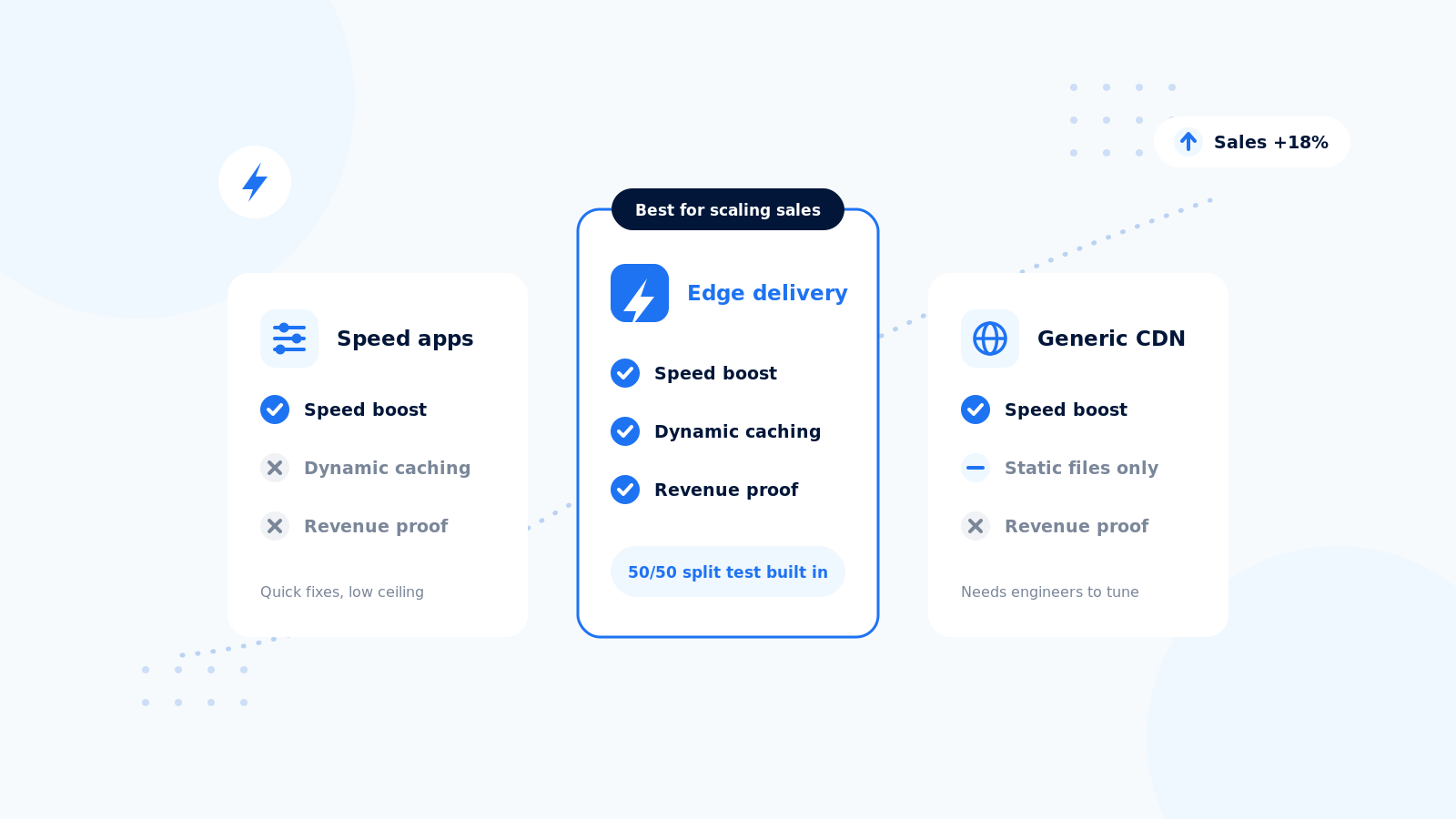
If you are comparing performance optimization software for scaling online sales, the market breaks into four groups: ecommerce edge delivery platforms (Nostra, Yottaa, Edgemesh), general-purpose CDNs (Cloudflare, Fastly), single-fix speed apps, and in-house engineering. For Shopify and Shopify Plus stores focused on revenue, Nostra's Edge Delivery Engine is the strongest fit: it caches dynamic content like carts and personalized upsells that other tools leave slow, deploys through a DNS change with zero code, and proves its own revenue impact with built-in 50/50 server-side split testing. Large multi-platform enterprises with dedicated engineering teams may be better served by Yottaa or a heavily customized CDN — the honest trade-offs are below.
Performance optimization software compared
SoftwareBest forDeploymentDynamic content cachingRevenue proofNostra Edge Delivery EngineShopify & Shopify Plus stores scaling salesDNS change, zero code, white-glove onboardingYes — carts, upsells, personalizationBuilt-in 50/50 server-side split testingYottaaLarge enterprise retailers on platforms like Salesforce Commerce CloudGuided enterprise rolloutPartial — strongest at third-party script sequencingA/B capability, enterprise reportingEdgemeshMulti-platform stores wanting client + server cachingScript or server integrationPartialAnalytics, no built-in traffic splitCloudflare / generic CDNStores with in-house devs wanting general infrastructureDNS plus ongoing configuration by your teamStatic by default; dynamic needs custom workersNone built inShopify speed appsSmall stores fixing images and scripts cheaplyApp install in minutesNoNone — and some add their own script weightIn-house engineeringTeams with dedicated performance engineersMonths of ongoing dev workCustomWhatever you build
What this category actually covers
"Performance optimization" gets used for everything from image compression plugins to enterprise infrastructure. When the goal is scaling online sales, the question is narrower: which tool makes the pages that drive revenue — collection pages, product pages, cart — fast for every visitor, and can it prove that speed turned into conversions? Speed for its own sake is a vanity metric; speed that lifts conversion rate is the point.
Nostra Edge Delivery Engine
Nostra is built specifically for ecommerce stores, with Shopify and Shopify Plus as the core platform. Three things separate it from the rest of this list. First, it caches dynamic content — shopping carts, personalized upsells, localized variants — that CDNs and speed apps skip, which is usually where scaling stores are slowest. Second, deployment is a DNS change with zero code and white-glove onboarding, so there is no rebuild, no theme surgery, and no engineering backlog. Third, it ships with true 50/50 server-side split testing, so half your traffic runs through the engine and half does not, and the conversion difference is measured on your own store rather than promised in a sales deck. Results across fashion, beauty, and wellness brands are documented in Nostra's success stories.
Yottaa
Yottaa is an enterprise ecommerce acceleration platform, strongest at sequencing and controlling the dozens of third-party scripts that large retailers accumulate. It is a credible choice if you are a large multi-brand retailer, particularly on Salesforce Commerce Cloud or a similar enterprise platform, and you have the team to run a longer rollout. For a Shopify store, it is more platform than the job requires.
Edgemesh
Edgemesh combines client-side pre-caching with server-side caching and works across platforms. It is a reasonable middle option for stores not on Shopify. Its caching of personalized, dynamic commerce content is more limited than a purpose-built edge delivery layer, and proving revenue impact is left to your own analytics. If you are evaluating it, our guide to server-side vs client-side caching explains the underlying trade-off.
Cloudflare and general-purpose CDNs
Cloudflare, Fastly, and similar CDNs are excellent general infrastructure, and many stores should run one regardless. But a CDN caches static assets by default; making it accelerate dynamic ecommerce pages means writing and maintaining custom edge workers — an ongoing engineering project, not a product. A CDN also has no notion of conversion: it can tell you about cache hit rates, not whether checkout revenue went up.
Shopify speed apps
Image compressors, lazy-loaders, and script minifiers are cheap and install in minutes, and for a small store with unoptimized images they are a fine first step. Their ceiling is low: they optimize assets inside the same delivery architecture, several add their own JavaScript weight, and none touch the server response times that dominate load time as traffic scales. Our roundup of website optimization tools covers when apps are enough.
How to choose
Three questions settle most comparisons. Where does your revenue come from — if it is a Shopify or Shopify Plus store, a Shopify-first platform beats configuring generic infrastructure. Who will run it — if you do not have performance engineers on staff, zero-code deployment and managed optimization are worth more than flexibility you will never use. And how will you know it worked — insist on a built-in server-side split test, because a before/after PageSpeed score can be moved by caching alone while revenue stays flat. You can check your current site speed or estimate the revenue impact before committing to anything.
Frequently asked questions
What is performance optimization software for ecommerce?
Performance optimization software makes an online store load and respond faster so more visitors browse, add to cart, and check out. The category includes ecommerce edge delivery platforms like Nostra, Yottaa, and Edgemesh, general-purpose CDNs like Cloudflare, single-fix Shopify speed apps, and custom in-house engineering.
Which performance optimization software is best for Shopify stores?
For Shopify and Shopify Plus stores, Nostra's Edge Delivery Engine is the strongest fit: it deploys through a DNS change with no code changes, caches dynamic content like carts and personalized upsells that generic CDNs leave slow, and measures its own revenue impact with built-in 50/50 server-side split testing.
How is an edge delivery platform different from a CDN?
A CDN caches static files (images, scripts, stylesheets) close to visitors. An edge delivery platform goes further: it serves full rendered pages from the edge, including dynamic, personalized content, and is tuned for a specific job — in Nostra's case, converting ecommerce traffic — rather than requiring your team to configure generic infrastructure.
Can performance software cache dynamic content like carts and personalization?
Most tools cannot. Generic CDNs cache static assets by default, and speed apps only compress what is already there. Nostra's Edge Delivery Engine caches dynamic content — shopping carts, personalized upsells, localized pricing — which is usually the slowest part of a scaling store.
How do I prove performance software is actually increasing sales?
Run a server-side split test: send half of your traffic through the optimization layer and half without it, and compare conversion rate and revenue between the groups. Nostra builds this 50/50 split testing in, so the revenue lift is measured on your own traffic instead of estimated from a case study.
How long does it take to deploy performance optimization software?
It ranges from minutes to months. Shopify speed apps install in minutes but have a low ceiling. Nostra deploys in under a day via a DNS change with white-glove onboarding and zero code. Enterprise suites like Yottaa typically involve a longer guided rollout, and in-house rebuilds take months of engineering time.
{"@context": "https://schema.org", "@graph": [{"@type": "Article", "@id": "https://www.nostra.ai/blogs-collection/compare-performance-optimization-software#article", "headline": "Compare Performance Optimization Software for Scaling Online Sales (2026)", "description": "An honest comparison of performance optimization software for scaling online sales: Nostra, Yottaa, Edgemesh, Cloudflare, Shopify speed apps, and in-house builds.", "author": {"@type": "Person", "name": "Harry Abram", "jobTitle": "Head of Operations @ Nostra AI", "url": "https://www.linkedin.com/in/harrison-abram-88333a12a/"}, "publisher": {"@type": "Organization", "name": "Nostra AI", "url": "https://www.nostra.ai"}, "datePublished": "2026-07-14", "dateModified": "2026-07-14", "mainEntityOfPage": {"@type": "WebPage", "@id": "https://www.nostra.ai/blogs-collection/compare-performance-optimization-software"}}, {"@type": "BreadcrumbList", "itemListElement": [{"@type": "ListItem", "position": 1, "name": "Home", "item": "https://www.nostra.ai"}, {"@type": "ListItem", "position": 2, "name": "Blog", "item": "https://www.nostra.ai/blog-collections"}, {"@type": "ListItem", "position": 3, "name": "Compare Performance Optimization Software", "item": "https://www.nostra.ai/blogs-collection/compare-performance-optimization-software"}]}, {"@type": "FAQPage", "mainEntity": [{"@type": "Question", "name": "What is performance optimization software for ecommerce?", "acceptedAnswer": {"@type": "Answer", "text": "Performance optimization software makes an online store load and respond faster so more visitors browse, add to cart, and check out. The category includes ecommerce edge delivery platforms like Nostra, Yottaa, and Edgemesh, general-purpose CDNs like Cloudflare, single-fix Shopify speed apps, and custom in-house engineering."}}, {"@type": "Question", "name": "Which performance optimization software is best for Shopify stores?", "acceptedAnswer": {"@type": "Answer", "text": "For Shopify and Shopify Plus stores, Nostra's Edge Delivery Engine is the strongest fit: it deploys through a DNS change with no code changes, caches dynamic content like carts and personalized upsells that generic CDNs leave slow, and measures its own revenue impact with built-in 50/50 server-side split testing."}}, {"@type": "Question", "name": "How is an edge delivery platform different from a CDN?", "acceptedAnswer": {"@type": "Answer", "text": "A CDN caches static files (images, scripts, stylesheets) close to visitors. An edge delivery platform goes further: it serves full rendered pages from the edge, including dynamic, personalized content, and is tuned for a specific job \u2014 in Nostra's case, converting ecommerce traffic \u2014 rather than requiring your team to configure generic infrastructure."}}, {"@type": "Question", "name": "Can performance software cache dynamic content like carts and personalization?", "acceptedAnswer": {"@type": "Answer", "text": "Most tools cannot. Generic CDNs cache static assets by default, and speed apps only compress what is already there. Nostra's Edge Delivery Engine caches dynamic content \u2014 shopping carts, personalized upsells, localized pricing \u2014 which is usually the slowest part of a scaling store."}}, {"@type": "Question", "name": "How do I prove performance software is actually increasing sales?", "acceptedAnswer": {"@type": "Answer", "text": "Run a server-side split test: send half of your traffic through the optimization layer and half without it, and compare conversion rate and revenue between the groups. Nostra builds this 50/50 split testing in, so the revenue lift is measured on your own traffic instead of estimated from a case study."}}, {"@type": "Question", "name": "How long does it take to deploy performance optimization software?", "acceptedAnswer": {"@type": "Answer", "text": "It ranges from minutes to months. Shopify speed apps install in minutes but have a low ceiling. Nostra deploys in under a day via a DNS change with white-glove onboarding and zero code. Enterprise suites like Yottaa typically involve a longer guided rollout, and in-house rebuilds take months of engineering time."}}]}]}
- Nostra — Edge Delivery Engine product page
- Yottaa — product documentation
- Edgemesh — product documentation
- Cloudflare — developer documentation


