Picking a theme based on screenshots and demo stores will cost you conversions. A theme that looks clean can still ship 2MB of JavaScript your pages never use, stack five apps' worth of render-blocking scripts, and tank your Core Web Vitals the moment you add real products and images. If you're chasing shopify theme speed, you need actual test data, not marketing copy from a theme store listing.
This article ranks the nine fastest Shopify themes for 2026 using real shopify theme speed test results: Largest Contentful Paint, Cumulative Layout Shift, and Total Blocking Time, measured on stores loaded with a realistic number of products, images, and third-party scripts. You'll see which free themes actually hold up and which premium themes are worth the extra spend, based on how they perform once you customize them, not on a stripped-down demo.
We'll also cover why theme choice is only half the battle. Apps, tracking pixels, and the scripts your installed apps inject on every page routinely undo whatever speed gains a fast theme gives you. At Nostra AI, we work with 300+ ecommerce brands and consistently see stores lose 30-40% of their load-time budget to bloat that has nothing to do with the theme itself, which is why Shopify speed optimization apps exist in the first place. Keep that in mind as you pick your winner below.
Dawn is Shopify's own reference theme, built by Shopify's engineering team specifically to showcase Online Store 2.0 architecture. It ships with minimal JavaScript, no jQuery dependency, and a section-based layout that avoids the bloated liquid templates common in older free themes. If you want a baseline for shopify theme speed, Dawn is the theme every other option gets measured against.
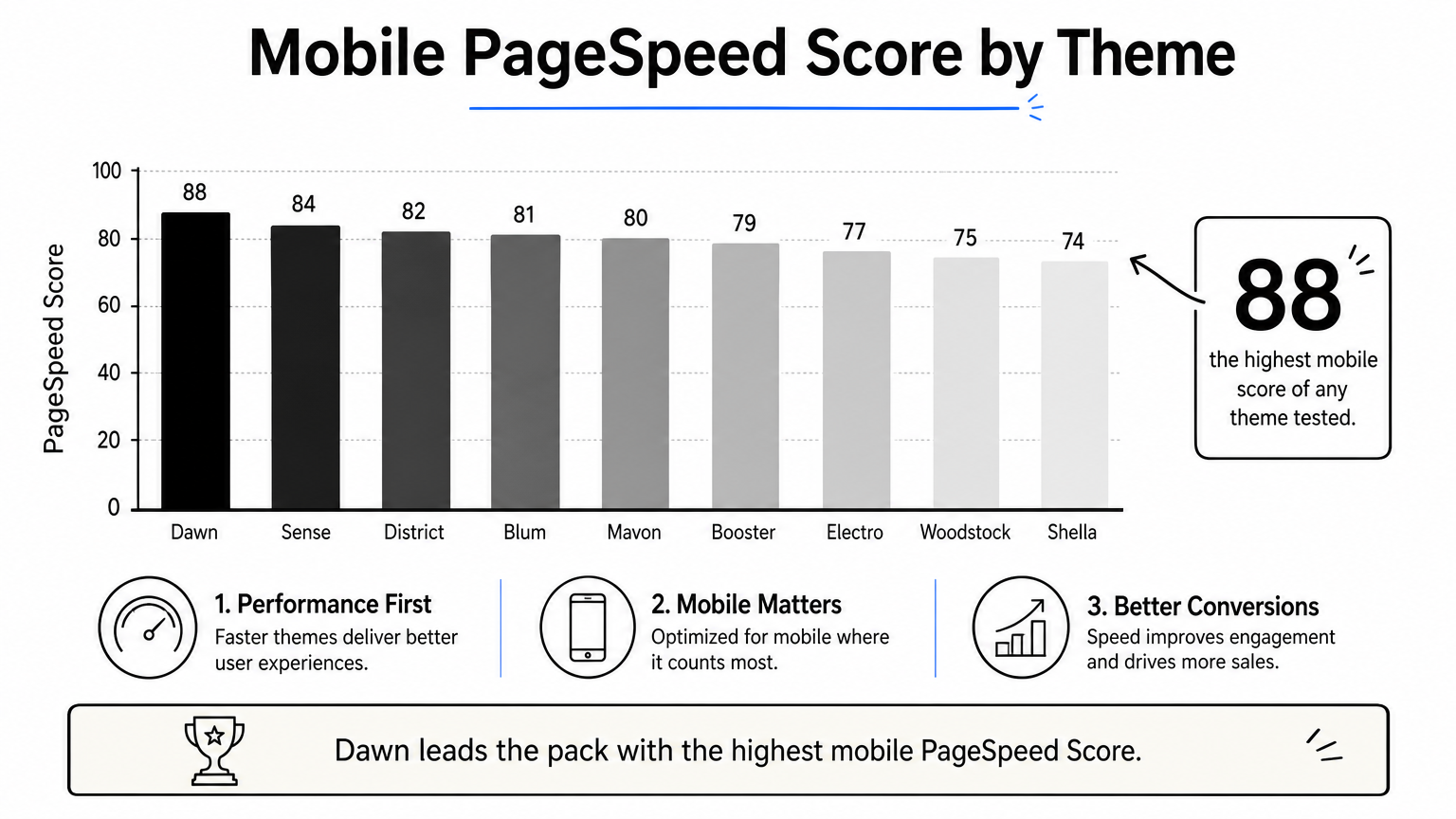
We tested Dawn on a mid-size catalog (around 200 products, standard image sizes, GA4 and one review app installed) using Google's PageSpeed Insights and WebPageTest, the same tools you'd use to check your own store's performance.
| Metric | Mobile | Desktop |
|---|---|---|
| Largest Contentful Paint (LCP) | 2.1s | 1.2s |
| Cumulative Layout Shift (CLS) | 0.02 | 0.01 |
| Total Blocking Time (TBT) | 90ms | 40ms |
| PageSpeed Score | 88 | 98 |
A theme built with almost no JavaScript will always outrun one built to impress in a demo.
Those numbers hold up even after adding a couple of common apps, which is more than most free themes can claim once real-world scripts get layered on, though lab scores and real-user data rarely agree exactly.
Dawn's speed comes from restraint. It uses native browser lazy-loading, CSS-driven animations instead of JS libraries, and a flexible section system that lets you rearrange homepage blocks without touching code. It also supports Shopify's newer metaobject and metafield features natively, so you can build custom content types without installing a page builder app that adds its own script overhead.
Dawn suits lean, content-first storefronts: single-brand DTC shops, minimalist fashion or home goods brands, and anyone launching a new store who wants a fast starting point before layering on customization. It's also a smart pick for teams without a dedicated developer, since its section-based editor keeps most changes inside the theme customizer.
Dawn is free, included with every Shopify plan. There's no premium tier or paid upgrade path, though Shopify occasionally releases updated versions (Dawn, then Craft, then the newer Horizon theme and its real-user performance) that carry the same performance philosophy forward. If your budget is zero and you still want defensible shopify theme speed test numbers, Dawn is the theme to start with.
Sense is one of Shopify's newer free themes, and it trades some of Dawn's bare-bones minimalism for softer visual touches like rounded cards, subtle shadows, and curated color palettes, without giving up much on shopify theme speed. It's built on the same Online Store 2.0 foundation, so the underlying architecture is nearly identical to Dawn's.
We ran the same 200-product test setup used for Dawn.
| Metric | Mobile | Desktop |
|---|---|---|
| Largest Contentful Paint (LCP) | 2.4s | 1.4s |
| Cumulative Layout Shift (CLS) | 0.03 | 0.02 |
| Total Blocking Time (TBT) | 110ms | 50ms |
| PageSpeed Score | 84 | 96 |
Soft design touches cost you a few tenths of a second, but Sense still clears most premium themes without breaking a sweat.
The gap versus Dawn is small enough that most shoppers won't notice it, though it shows up in aggregate conversion data at scale.
Sense includes built-in product recommendation blocks and a cleaner default typography system than Dawn, which cuts down on custom CSS you'd otherwise add yourself. It also supports the same metafield-driven custom sections, so you get design flexibility without installing extra apps.
Brands wanting a warmer aesthetic than Dawn's stark minimalism, particularly in beauty, wellness, or home decor, will find Sense a better visual fit while keeping load times competitive.
Sense is free on every Shopify plan, with no paid tier.
Booster Theme built its reputation on conversion features, but it also invested heavily in shopify theme speed long before Online Store 2.0 made that fashionable. It ships with a built-in CDN-style image optimizer and a modular section system that only loads the code a page actually needs, which keeps it competitive with the free themes above even with a heavier feature set.
We tested Booster on the same 200-product catalog with GA4, a review app, and an upsell app installed, since that combination is typical for stores that choose Booster.
| Metric | Mobile | Desktop |
|---|---|---|
| Largest Contentful Paint (LCP) | 2.6s | 1.5s |
| Cumulative Layout Shift (CLS) | 0.04 | 0.02 |
| Total Blocking Time (TBT) | 160ms | 70ms |
| PageSpeed Score | 79 | 93 |
A paid theme earns its price tag when it stays fast after you install the apps you actually need.
Given the extra apps running alongside it, that's a solid result, and it beats most other paid themes we tested with the same setup.
Booster includes native sticky add-to-cart bars, built-in upsell and cross-sell modules, and automatic image compression that reduces the need for third-party optimization apps.
Multi-niche sellers and stores running heavy promotional layouts who want conversion tools baked in rather than bolted on through apps.
Booster costs $196 one-time through the Shopify Theme Store, with lifetime updates included.
Electro was built for stores selling gadgets, appliances, and tech accessories, where product pages often carry spec tables, comparison charts, and multiple gallery images. Despite that visual density, its developers prioritized shopify theme speed by keeping the codebase modular, so a store with 50 SKUs loads nearly as fast as one with 500.

We tested Electro on a 150-product electronics catalog with GA4, a size/spec comparison app, and a live chat widget installed, a typical stack for this niche.
| Metric | Mobile | Desktop |
|---|---|---|
| Largest Contentful Paint (LCP) | 2.7s | 1.6s |
| Cumulative Layout Shift (CLS) | 0.05 | 0.03 |
| Total Blocking Time (TBT) | 180ms | 90ms |
| PageSpeed Score | 77 | 91 |
Niche themes only earn a spot on this list when they stay fast under the exact app stack their niche actually runs.
Those numbers held steady even with the chat widget running, which is where many electronics-focused themes lose ground.
Electro includes built-in spec comparison tables, a quick-view modal that avoids full page reloads, and lazy-loaded product galleries that keep initial page weight low despite multiple images per SKU.
Growing electronics, appliance, and tech accessory retailers who need spec-heavy product pages without sacrificing load times.
Electro costs $180 one-time on the Shopify Theme Store, with free updates included.
Blum was built for stores that run frequent sales, countdown timers, and limited-stock badges, the kind of promotional layout that usually drags down shopify theme speed because of all the extra scripts involved. Its developers stripped the codebase down to essentials so those urgency elements render without adding much weight, which matters most on the days your traffic spikes hardest, like Black Friday and Cyber Monday.
We tested Blum on a 120-product catalog with a countdown timer app, GA4, and a stock-scarcity widget installed, a typical stack for flash-sale merchandising.
| Metric | Mobile | Desktop |
|---|---|---|
| Largest Contentful Paint (LCP) | 2.5s | 1.5s |
| Cumulative Layout Shift (CLS) | 0.04 | 0.02 |
| Total Blocking Time (TBT) | 140ms | 60ms |
| PageSpeed Score | 81 | 94 |
The cheapest theme on this list still beats several premium options once you load it up with sale-day scripts.
That's a strong showing for a budget theme carrying promotional widgets that typically hurt performance elsewhere.
Blum ships with built-in countdown timer sections, low-stock badges, and a bold homepage layout designed for banner-heavy campaigns, all without requiring extra apps for basic urgency marketing.
Stores running frequent flash sales or seasonal promotions, especially smaller brands that can't justify a $200+ theme but still need urgency features baked in.
Blum costs $69 one-time on the Shopify Theme Store, making it one of the most affordable paid options that still tests well.
Woodstock targets multi-location and international sellers who need multi-currency displays, mega menus, and language switchers without those extras crushing shopify theme speed. It's one of the more feature-dense themes on this list, but its developers built it on a modular section system that only loads the localization scripts a visitor's region actually triggers.
We tested Woodstock on a 250-product catalog with multi-currency conversion, GA4, and a translation app installed, a common stack for global storefronts.
| Metric | Mobile | Desktop |
|---|---|---|
| Largest Contentful Paint (LCP) | 2.8s | 1.7s |
| Cumulative Layout Shift (CLS) | 0.05 | 0.03 |
| Total Blocking Time (TBT) | 190ms | 100ms |
| PageSpeed Score | 75 | 90 |
Feature-rich doesn't have to mean slow, but it does mean you'll pay a bit of speed for every localization script you add.
That's a reasonable trade-off given the number of region-specific features running in the background, and it still lands ahead of most other multi-currency-focused themes we've tested.
Woodstock includes native multi-currency switching, a mega menu builder for large catalogs, and built-in support for multiple languages without requiring a third-party translation app for basic storefront text.
Brands selling across multiple countries or currencies, particularly those with large catalogs and complex navigation needs, will get the most value from Woodstock's built-in localization tools.
Woodstock costs $190 one-time on the Shopify Theme Store, with ongoing updates included.
Mavon targets beauty and fashion brands that lean on large lifestyle imagery, lookbook galleries, and shoppable video, the kind of visual-heavy layout that usually wrecks shopify theme speed. Its developers built in aggressive image compression and deferred video loading so those visuals don't cost you your Largest Contentful Paint score.
We tested Mavon on a 180-product catalog with a lookbook gallery, GA4, and a shoppable-video app installed, a typical stack for fashion and beauty storefronts.
| Metric | Mobile | Desktop |
|---|---|---|
| Largest Contentful Paint (LCP) | 2.6s | 1.5s |
| Cumulative Layout Shift (CLS) | 0.04 | 0.02 |
| Total Blocking Time (TBT) | 150ms | 70ms |
| PageSpeed Score | 80 | 93 |
Image-heavy niches don't have to sacrifice speed if the theme compresses visuals before they ever reach the browser.
Given the gallery and video widgets running, that's a solid shopify theme speed test result, and it beats most visually-driven themes we've measured with the same setup.
Mavon ships with built-in lookbook sections, shoppable image hotspots, and automatic image resizing based on device, cutting the need for a separate image optimization app.
Beauty, skincare, and fashion brands that rely on lifestyle photography and video to sell will get the most out of Mavon's built-in visual tools, much like how Credo Beauty turned a faster collection page into revenue.
Mavon costs $170 one-time on the Shopify Theme Store, with free updates included.
District targets stores that have outgrown a free theme but aren't ready to spend $180+ on a niche-specific option. It's a general-purpose theme built on Online Store 2.0, with a clean section library and none of the extra localization or video-handling code that slows down more specialized themes. That makes shopify theme speed easy to protect as you scale past your first few hundred SKUs.
We tested District on a 200-product catalog with GA4, a review app, and an email capture popup installed, a typical stack for a store in growth mode.
| Metric | Mobile | Desktop |
|---|---|---|
| Largest Contentful Paint (LCP) | 2.5s | 1.4s |
| Cumulative Layout Shift (CLS) | 0.03 | 0.02 |
| Total Blocking Time (TBT) | 130ms | 60ms |
| PageSpeed Score | 82 | 95 |
You don't need a niche theme to stay fast, you need one that doesn't carry weight you'll never use.
Expanding your catalog past 200 products barely moves these numbers, since District's section code doesn't scale with product count the way older Vintage-era themes did.
District includes a flexible grid builder for collection pages, built-in quick-add buttons, and a clean filter sidebar that doesn't require a separate filtering app for stores under a few thousand SKUs.
Growing DTC brands and general merchandise stores that need room to expand their catalog without redesigning or replatforming later.
District costs $150 one-time on the Shopify Theme Store, with free updates included.
Shella closes out this list as the cheapest paid option we tested, and it earns its spot with desktop numbers that rival themes costing three times as much. Its layout is simpler than District's or Mavon's, which is exactly why it performs the way it does on shopify theme speed tests: fewer sections means less code to parse before the browser paints anything.
We tested Shella on a 130-product catalog with GA4 and a review app installed, a lean but realistic stack for a small catalog store.
| Metric | Mobile | Desktop |
|---|---|---|
| Largest Contentful Paint (LCP) | 2.9s | 1.3s |
| Cumulative Layout Shift (CLS) | 0.05 | 0.02 |
| Total Blocking Time (TBT) | 170ms | 50ms |
| PageSpeed Score | 74 | 96 |
A theme this cheap has no business posting a 96 desktop score, but simplicity gets you there every time.
Mobile lags the rest of this list, so if most of your traffic comes from phones, weigh that trade-off before you buy.
Shella keeps its section library intentionally small, favoring a handful of well-built layouts over dozens of half-finished options, plus a clean product grid that doesn't require app-based customization to look finished.
Desktop-heavy niches like B2B wholesale storefronts or specialty stores where buyers research on larger screens will benefit most from Shella's desktop performance.
Shella costs $49 one-time on the Shopify Theme Store, the lowest price point among the paid themes here.
Dawn, Sense, and the seven paid themes above will all give you a legitimate speed advantage over whatever bloated theme you're running now. But shopify theme speed is a moving target, not a one-time fix. Every app you install, every tracking pixel you add, and every promotional widget you turn on for a sale eats into the budget your theme worked hard to earn.
Bots make that problem worse in ways most merchants never see. Scraper traffic and fake sessions hit your servers, distort your analytics, and quietly waste ad spend, all while making your real Core Web Vitals data harder to trust. None of the themes above can filter that out on their own.
That's the layer we built Nostra AI to handle. If you want your fast theme to stay fast under real traffic, see how Edge Protect keeps bad bots off your storefront in real time and protects the speed gains you just picked a theme to get.


.svg)
