.svg)
.svg)
.svg)
.svg)
The short answer
Ecommerce bot protection is the practice of identifying and blocking automated traffic before it can scrape your prices, test stolen cards at your checkout, click your ads, or hoard your inventory. It matters because automated traffic is not an edge case: industry studies such as Imperva's annual Bad Bot Report consistently put bots at roughly half of all web traffic, with malicious bots alone near a third, and ecommerce is the most targeted industry. The core decision for any store is architectural: block bots inside the store after they arrive (apps and plugins), or filter them at the edge before they ever reach your site. This guide explains what bot protection covers, what skipping it costs, and how the four main approaches compare.
What ecommerce bot protection actually means
Bot protection is not one feature but a stack of capabilities: telling good bots from bad ones (Googlebot and AI crawlers should get through; scrapers and card testers should not), classifying sessions in real time based on how they behave rather than what IP they come from, and enforcing the verdict without adding friction for real shoppers. Older approaches relied on IP blocklists and CAPTCHAs. Modern malicious bots rotate residential IPs, run headless browsers, and solve CAPTCHAs, so effective protection now means behavioral analysis, and the friction of proving humanity has shifted away from the customer.
What bad bots cost an ecommerce store
Each bot type does distinct damage, and most stores are hit by several at once:
| Bot type | What it does | What it costs you |
|---|---|---|
| Scrapers | Harvest prices, inventory, and content for competitors | Lost pricing advantage, inflated analytics, server load |
| Card testing bots | Run bursts of small transactions to validate stolen cards | Gateway fees, chargebacks, payment provider risk flags |
| Click fraud bots | Click paid ads with no intent to buy | Wasted ad spend, corrupted bidding algorithms |
| Inventory hoarding bots | Hold stock in carts to deny it to real buyers | Lost sales, distorted demand signals |
| Account takeover bots | Credential-stuff login pages with leaked passwords | Fraud losses, support load, customer trust |
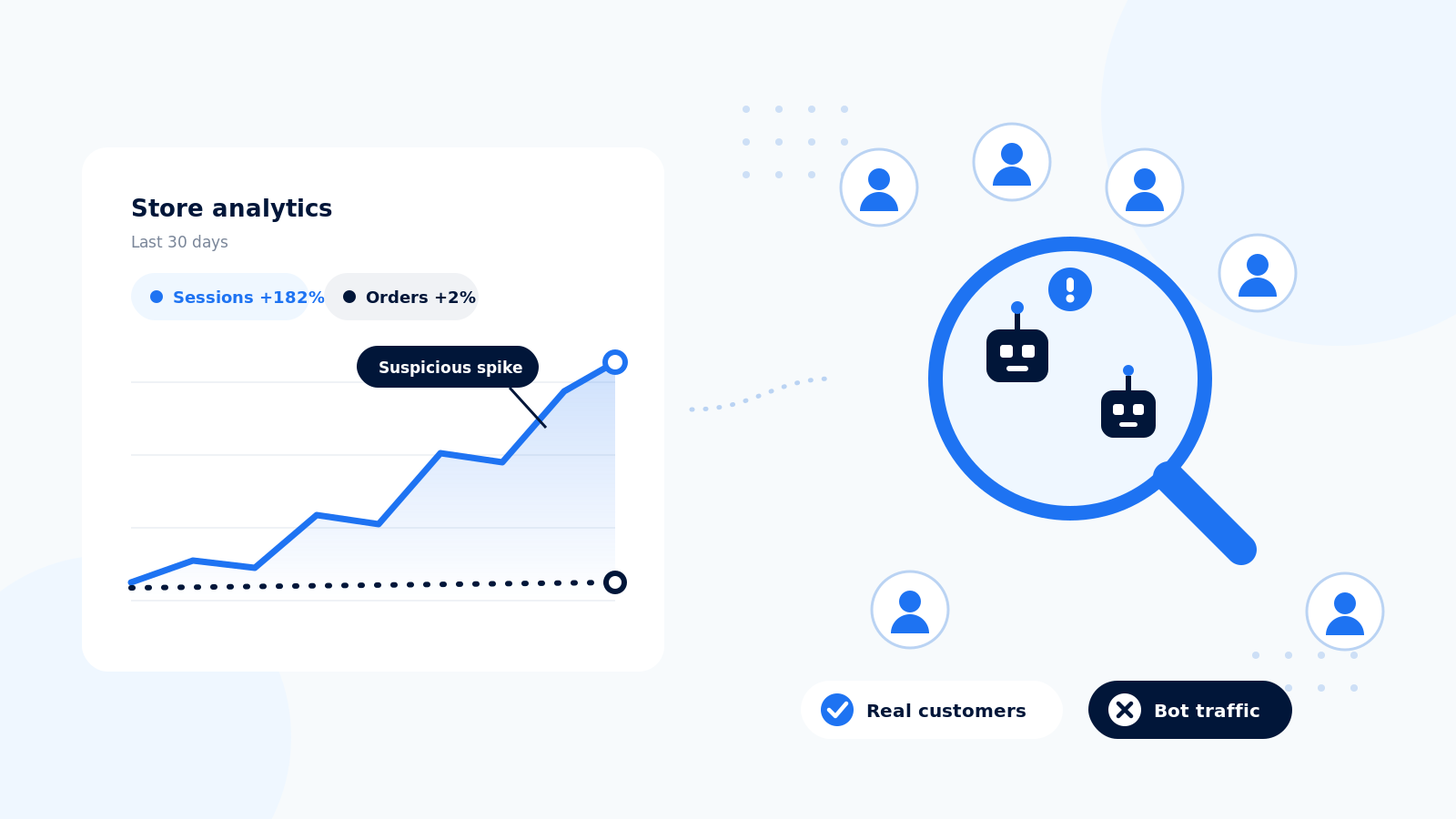
There is a quieter cost underneath all five: polluted data. When a third of your sessions are machines, your conversion rate, ad optimization, A/B tests, and demand forecasts are all computed on fiction. If you suspect this is happening now, start with how to tell if your traffic is bots or real customers.
The four layers of ecommerce bot protection, compared
| Layer | How it works | Deployment | Best for |
|---|---|---|---|
| Platform-native filtering (Shopify, BigCommerce) | Filters known crawlers from analytics; basic checkout protections during sales events | Built in | Report hygiene; does not block sophisticated bots |
| Bot protection apps (Blockify and similar) | Detect bots after they reach the store, often via IP rules and CAPTCHAs | App install, minutes | Small stores with light, unsophisticated bot traffic |
| CDN and WAF rules (Cloudflare, DataDome, Akamai) | Network-level bot scoring and firewall rules; powerful but generic, and limited on hosted platforms like Shopify | DNS plus engineering work, days to weeks | Enterprises with security teams and multi-platform estates |
| Edge-level behavioral AI (Nostra Edge Protect) | Classifies every session with behavioral AI at the edge and blocks malicious ones before they reach the store, no CAPTCHAs | DNS change, under a business day | Ecommerce stores that want clean data and zero shopper friction |
The dividing line is where the filtering happens. Anything that runs inside your store sees the bot only after it has loaded your pages, entered your analytics, and spent your ad budget. Edge-level filtering evaluates the session before your store ever serves it, so blocked bots never appear in your data at all. For a vendor-by-vendor breakdown, see the full comparison of Nostra, Cloudflare, DataDome, and Blockify.
How to choose for your store
Match the layer to your traffic and team. A small store seeing occasional scraping can start with platform filters plus an app. A store spending meaningfully on paid traffic, or seeing failed-payment bursts, has outgrown app-level tools: the damage happens before the app can react. Enterprises running multiple properties outside a hosted platform can justify a WAF-based platform and the team to tune it. For stores on Shopify specifically, including Shopify Plus at enterprise scale, edge-level protection delivers the enterprise-grade outcome without the enterprise deployment: see the complete guide to stopping bot traffic on Shopify for the step-by-step.
Where Nostra Edge Protect fits
Nostra Edge Protect is ecommerce bot protection built for the edge layer: every session is evaluated with behavioral AI before it reaches your storefront, malicious bots are blocked in real time, and verified crawlers (Googlebot, GPTBot, ClaudeBot, PerplexityBot) are allowlisted automatically so SEO and AI visibility are untouched. It deploys with a DNS change in under a business day, no app install and no engineering, and because it runs in the same edge layer Nostra uses for storefront acceleration, protection adds zero latency. When Nixon turned it on, bot traffic dropped roughly 90% within hours; Linjer discovered 3.62% of its traffic was malicious bots silently distorting conversion data. The full breakdown of what bot traffic costs your store covers the symptoms to check today.
Frequently asked questions
What is ecommerce bot protection?
Ecommerce bot protection is the identification and blocking of automated traffic (scrapers, card testing bots, click fraud bots, inventory hoarders, and account takeover bots) before it harms an online store. Modern protection classifies sessions by behavior rather than IP address and blocks malicious ones without adding CAPTCHAs or friction for real customers.
How much ecommerce traffic is bots?
Industry studies consistently put automated traffic at roughly half of all web activity, with malicious bots alone around a third, and ecommerce is the most targeted industry. Individual stores vary widely: some discover only a few percent, others find the majority of their sessions are automated once they measure properly.
Do I need bot protection if my platform already filters bots?
Shopify’s Human or bot session controls filter supported analytics reports; they do not block storefront requests. Shopify’s September 21–23, 2026 rollout excludes identified bot sessions by default as each store is updated. Investigate suspicious activity using analytics and request or payment records before choosing additional protection. See Shopify’s documentation.
What is the best bot protection for an ecommerce store?
It depends on where you need the filtering to happen. Apps are the fastest to try but only react after bots reach your store. WAF platforms like Cloudflare and DataDome are powerful but built for enterprises with security teams. Edge-level behavioral AI, like Nostra Edge Protect, blocks bots before they reach the store, deploys in under a day, and adds no shopper friction, which is why it fits most dedicated ecommerce stores best.
Will bot protection slow down my site or hurt SEO?
Good bot protection does neither. Edge-level filtering adds no latency because it runs in the same infrastructure that accelerates the storefront, and legitimate crawlers such as Googlebot and the major AI crawlers are allowlisted automatically, so search and AI visibility are unaffected. The tools that do add friction are the ones relying on CAPTCHAs, which tax real customers more than bots.
How do I know if bots are hitting my store right now?
Run three checks: compare sessions to orders (climbing sessions with flat orders is the classic signature), look at engagement time in your analytics (bot sessions cluster near zero), and scan recent payments for bursts of failed transactions. A step-by-step diagnostic is in our guide to telling bots from real customers.
- Imperva Bad Bot Report (annual automated traffic study)
- Shopify Help Center: bot protection and analytics filtering
- Nostra Edge Protect product documentation
- Nixon and Linjer case studies, Nostra AI


