
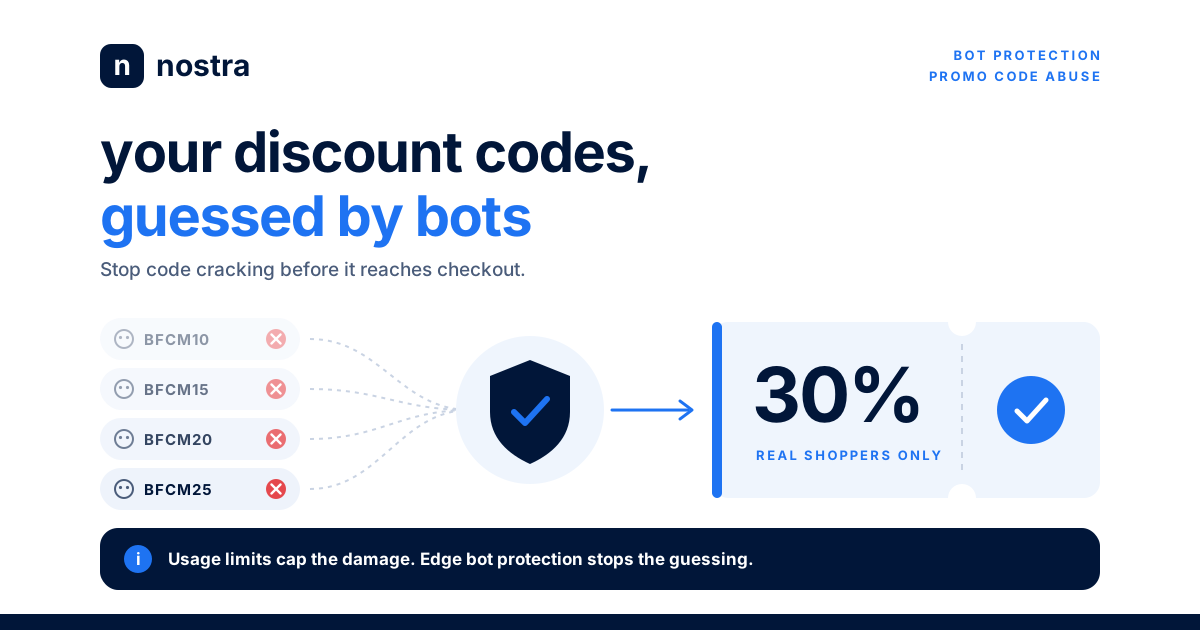


TL;DR: Shopify discount code abuse happens when bots and code-sharing extensions find, guess, or redistribute your promo codes faster than you can revoke them. The result is margin leakage, distorted campaign attribution, and BFCM offers that reach the wrong people. You can shrink the damage with unique single-use codes, tight usage limits, and customer eligibility rules, but the durable fix is stopping the automated traffic that tests and harvests codes at the edge, before it ever reaches checkout.
In this guide
- What Shopify discount code abuse looks like
- How promo code bots find and test your codes
- The real cost of leaked and cracked codes
- Warning signs in your Shopify data
- Shopify settings that limit discount code abuse
- Stopping promo code bots at the edge
- FAQ
Every BFCM, ecommerce teams spend weeks building the perfect offer: a tiered code for VIPs, a welcome discount for new subscribers, a one-day flash code for SMS. And every year, some of those codes show up on coupon sites within hours, get stacked by browser extensions, or get guessed outright by scripts that hammer the checkout with variations. Shopify discount code abuse is one of the quietest ways bots drain margin, because each individual order looks like a normal sale. Nobody gets an alert. The discount line in your P&L just grows.
This guide explains how promo code bots work, how to spot them in your Shopify data, which native settings help, and where those settings fall short. If you are already fighting card testing or fake account creation, you will recognize the pattern: the same automation infrastructure is pointed at a different target.
What Shopify discount code abuse looks like
Discount code abuse is any use of a promo code by someone it was never meant for, or at a volume it was never meant to support. On Shopify stores it usually takes one of four forms.
Code harvesting. Scrapers crawl your site, emails that get forwarded into public inboxes, affiliate pages, and social posts, then publish what they find to coupon aggregators. A code built for 2,000 loyal subscribers suddenly reaches millions of bargain hunters.
Code guessing (token cracking). Scripts submit thousands of variations of a known pattern to your cart or checkout to see which ones apply a discount. If your welcome code is WELCOME10, a bot will try WELCOME15, WELCOME20, VIP20, BFCM30, and so on. OWASP catalogs this behavior as OAT-002 Token Cracking, the same class of automated threat as brute-forcing gift card numbers.
Single-use code farming. Bots sign up for your newsletter or create accounts with throwaway emails to collect unique first-order codes, then use or resell them. This is closely tied to fake signups on Shopify, where the signup itself is the attack surface.
Extension auto-apply. Browser coupon extensions test every code in their database against your cart at checkout. Each test is a real request to your store. For a popular brand during a sale, that can mean thousands of automated discount attempts per hour from real shoppers' browsers.
The common thread is automation. A human sharing a code with a friend is a rounding error. A script testing 50,000 codes, or a farm of fake accounts collecting welcome offers, is a business problem.
How promo code bots find and test your codes
Understanding the mechanics helps you decide which defenses matter. Promo code bots generally run in three stages.
1. Discovery
Bots start with what is public. They scrape your announcement bar, popups, landing pages, and theme files. They crawl affiliate and influencer pages. Some read the HTML of popup apps, which occasionally embed the discount code directly in the page source before a visitor ever submits an email. If your code is in the DOM, assume it is already known.
2. Enumeration
Once a bot knows one code, it guesses neighbors. Human-written codes follow obvious patterns: brand name plus number, season plus year, campaign word plus percentage. Enumeration scripts rotate through these patterns and submit each candidate to the cart or checkout. Modern scripts spread requests across residential proxies so each IP address makes only a few attempts, which defeats simple rate limits.
3. Validation and distribution
A code that applies a discount is logged, tested for stacking with other codes or automatic discounts, and pushed to coupon sites, deal forums, Discord servers, or resale channels. From there, the leak is effectively permanent until you disable the code.
Each stage generates traffic you pay for. Enumeration in particular creates large volumes of cart and checkout requests that slow your store for real shoppers, the same dynamic covered in our breakdown of the cost of bot traffic for ecommerce brands.
The real cost of leaked and cracked codes
The obvious cost is margin. If a 25% code meant for a segment of repeat customers leaks to the open web, every order that uses it is a full-price sale you discounted for no reason. But the second-order costs are often larger.
Broken attribution. Discount codes double as tracking. When an influencer code or a podcast code leaks onto coupon sites, sales get credited to a partner who did not drive them. You overpay commissions and overinvest in a channel based on inflated numbers.
Polluted analytics. Enumeration traffic adds sessions, add-to-carts, and checkout starts that never convert. Your conversion rate drops on paper, and if you run experiments, the noise can flip results. We have written about how bot traffic distorts Shopify A/B tests; promo code bots are a frequent source of that noise around sales.
Slower pages during peak demand. Cart and checkout endpoints are dynamic and cannot be served from a cache. A spike of automated discount attempts competes with real buyers for the same backend capacity, right when every 100 milliseconds matters most.
Customer trust. When a loyal customer sees a deeper public code than the "exclusive" one you emailed them, the exclusivity loses its meaning. Over time, shoppers learn to wait for the leak instead of buying at full price.
For most brands, the honest answer is that nobody knows the exact number, because abused orders look identical to legitimate ones in the Shopify admin. That is why detection starts with patterns, not individual orders.
Warning signs in your Shopify data
You do not need specialized tools to see the first signals. Look for these patterns in your discount reports, orders export, and analytics.
- Redemptions outrunning sends. A code sent to 5,000 subscribers with 9,000 redemptions has leaked, full stop.
- Codes appearing before launch. Orders using a campaign code before the campaign went live usually mean the code was discovered in page source or guessed.
- A surge of new customers on a "loyalty" code. If a VIP code is mostly redeemed by first-time buyers, it escaped its audience.
- Checkout starts spiking without orders. A burst of carts and checkouts with no matching revenue lift, especially from unusual geographies or data center networks, often indicates enumeration.
- Clusters of newsletter signups with patterned emails. Sequential usernames, disposable domains, or dozens of signups per minute point to single-use code farming.
- Partner codes with sudden volume jumps. An affiliate code that triples overnight without a matching post from the partner was probably listed on a coupon site.
If several of these show up at once, treat it like any other automated attack. Our guide to the signs of a bot attack on ecommerce stores covers the broader traffic patterns to check next.
Shopify settings that limit discount code abuse
Shopify gives merchants solid controls for limiting how a code can be used once it is known. Configure these before every major campaign. The details are in Shopify's documentation on discount code usage limits and discount codes.
Use unique codes instead of one shared code
A single shared code is a leak waiting to happen. Generate unique codes per recipient for email, SMS, and loyalty offers, so a leaked code is worth one order instead of thousands. Most email platforms integrated with Shopify can generate and insert unique codes automatically.
Set total and per-customer usage limits
Limit the total number of times a code can be used and restrict it to one use per customer. A per-customer limit will not stop a bot with fresh identities, but it does stop the simplest form of repeat use.
Restrict eligibility
Where it fits the offer, limit codes to specific customer segments, specific products or collections, or a minimum purchase amount. A VIP code that only works for customers in a loyalty segment is useless to a stranger who finds it on a coupon site.
Use short active windows
Set explicit start and end dates. Flash codes should expire in hours, not weeks. The shorter the window, the less time a leaked code has to spread.
Make codes hard to guess
Avoid predictable patterns like BRAND20 or BFCM2026. Use longer random strings for anything high value. This raises the cost of enumeration considerably, since a bot cannot simply walk through the obvious variations.
Keep codes out of page source
Check your popup, quiz, and announcement apps. If a code is rendered into the HTML before a visitor completes the action that should earn it, scrapers will find it. Prefer apps that reveal or email the code only after submission.
These settings are necessary, and they meaningfully reduce exposure. But notice what they all have in common: they limit what a code can do after it has been found or guessed. None of them stop the automated traffic doing the finding and guessing.
Stopping promo code bots at the edge
The most effective defense against Shopify discount code abuse is to identify automated traffic before it can scrape, enumerate, or farm codes. That decision belongs at the edge, the network layer between the visitor and your store, where a request can be evaluated in milliseconds before it touches Shopify's servers.
Edge bot protection looks at signals a discount code setting never sees: whether the client behaves like a real browser, whether the network is a known data center or proxy pool, how quickly requests arrive, and whether the session pattern matches a human shopper or a script cycling through codes. Bad automation gets challenged or blocked. Verified good bots, like search engine crawlers, continue through. Real shoppers never notice.
A practical layered setup looks like this:
- Protect signup and popup endpoints so bots cannot farm unique welcome codes with throwaway emails.
- Protect cart and checkout discount attempts so enumeration scripts get stopped after the first few unusual requests instead of the first few thousand.
- Limit scrapers on campaign and landing pages so codes are harder to harvest at launch.
- Keep Shopify-native limits in place as the backstop for anything that slips through.
This is the same approach that stops other automated abuse on Shopify, including card testing attacks and inventory hoarding bots. The attackers often use the same proxies and tooling across all of them, so one edge layer pays off several times.
The other benefit is speed. Traditional bot tools can add JavaScript challenges or extra network hops that slow every page. Nostra's edge platform combines bot protection with edge delivery, so filtering bad traffic does not cost your real shoppers load time. With BFCM weeks away, our BFCM bot protection checklist is a good place to confirm everything else is covered too.
FAQ
How do I know if my Shopify discount codes have leaked?
Compare redemptions to the number of people you sent the code to, check whether the code was used before the campaign launched, and search the code name on major coupon sites. A sudden spike of first-time customers on a loyalty or VIP code is another strong signal that the code escaped its intended audience.
Can bots really guess Shopify discount codes?
Yes. If codes follow predictable patterns, scripts can submit large numbers of variations to the cart or checkout and record which ones apply a discount. Spreading attempts across many proxy IP addresses lets them avoid basic rate limits. Long random codes and edge bot protection make this far harder.
Do unique single-use codes stop discount code abuse completely?
No. Unique codes limit the damage from a single leak, but bots can still farm them by creating fake signups or accounts with disposable email addresses. You need to protect the signup flow as well as the code itself, which is where bot protection on popup and account endpoints helps.
Are coupon browser extensions considered bot traffic?
Coupon extensions run inside real shoppers' browsers, so they are not bots in the traditional sense, but they automate code testing at checkout. They can surface codes you meant to keep private. The best defense is codes with tight eligibility rules, so even when an extension finds one, it will not apply for the wrong customer.
Will blocking promo code bots slow down my Shopify store?
Not if the filtering happens at the edge. Edge bot protection evaluates requests before they reach Shopify, which removes load from your store during peak traffic. Done right, real shoppers often see faster pages because automated traffic is no longer competing for the same checkout capacity.
Protect your BFCM margin before the codes go live. Your discount strategy only works if the right customers get the right offers. Shopify's native limits shrink the blast radius of a leaked code, but they cannot stop the bots that scrape, guess, and farm codes in the first place. Nostra stops automated abuse at the edge while making your store faster for real buyers, so your promotions drive revenue instead of leaking it. Talk to the Nostra team to see what bots are doing to your codes and your checkout before your biggest sale of the year.


