ChatGPT, Perplexity, and Google's AI Overviews now answer questions that used to send shoppers straight to your storefront. If your product pages aren't showing up in those answers, you're losing traffic you can't see in a normal analytics report. That's the problem behind the best techniques for answer engine optimization in ai: the old SEO playbook gets you ranked on page one, but it doesn't guarantee an AI model cites your brand when someone asks "what's the best clean skincare for sensitive skin."
This article gives you nine actionable AEO techniques you can apply this week, from structuring content so AI crawlers can parse it cleanly to verifying which bots are actually hitting your site before you optimize for them. These are the same fundamentals we track through Sherlock, our AI discovery agent, which watches crawler traffic across 300+ ecommerce brands and shows what's really visiting your storefront versus what's being blocked.
Each technique below focuses on AI visibility, not just search rankings, covering content structure, technical accessibility, and the traffic verification most teams skip entirely. Work through them in order, and you'll have a concrete framework for getting cited instead of guessing.
Before you optimize a single page for AI visibility, you need to know which bots are actually crawling your storefront. Most ecommerce teams have never looked at their server logs for user agents like GPTBot, PerplexityBot, or Google-Extended, so they're optimizing blind. Verifying crawler traffic is the foundation every other technique on this list depends on.
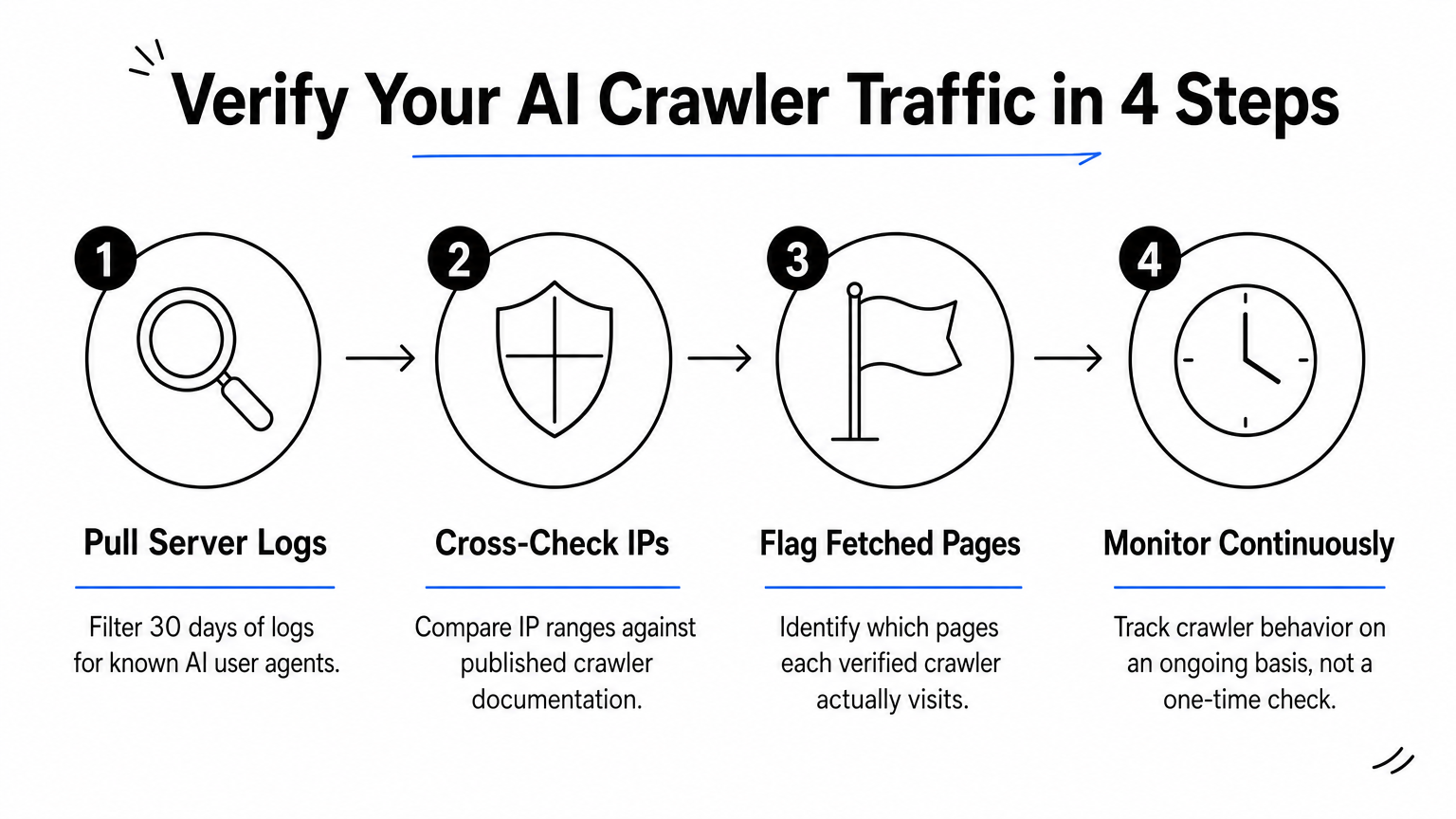
Every major AI answer engine sends a named crawler to fetch and index your pages, separate from traditional search bots like Googlebot, which raises the question of which AI crawlers deserve access to your storefront. These crawlers identify themselves in the user agent string, and you can find them in raw server logs or through a dedicated AI traffic detection tool, one of the AEO tools built for AI search visibility, that classifies requests in real time. Some of that traffic is legitimate indexing, some is scraper bots harvesting your pricing data while pretending to be AI crawlers, without permission.
Guessing which AI crawlers visit your site wastes effort on the wrong pages and leaves you blind to bots that distort your data. If GPTBot never touches your return policy page, no amount of formatting will get that page cited in ChatGPT. Conversely, if a spoofed crawler is scraping your entire catalog under a fake AI user agent, you're feeding a competitor's dataset for free while getting nothing back.
You can't optimize for an AI crawler you've never confirmed is actually visiting your site.
Start with a simple audit, then move to continuous monitoring:
This is exactly the gap Sherlock, our AI discovery agent, was built to close. It runs at the edge, verifies AI crawler traffic against real bot signatures, and shows you which pages are getting fetched, all without touching your codebase.
AI models pull specific passages out of a page, not the whole document, so the way you order information decides whether that passage is usable. Answer-first formatting means leading with the direct answer in the first sentence or two, then backing it up with detail, context, and nuance underneath.
Put the conclusion at the top of the section, the way a news lede works, instead of building up to it through a story or a long introduction. If someone asks "is this serum safe for sensitive skin," your page should answer that in the first sentence of the relevant section, not bury it three paragraphs into a brand history.
Language models extract short, self-contained chunks of text to generate answers, and they favor passages that already read like an answer. Burying the point under throat-clearing paragraphs means the model has to work harder to extract your answer, and it'll often grab a competitor's more direct passage instead.
If a passage can't stand alone as an answer, an AI model will skip it for one that can.
Structured data tells an AI crawler exactly what a page is about without making it guess from surrounding text. Schema markup wraps your product details, FAQs, and reviews in a machine-readable format that both search engines and answer engines can extract with confidence.

Schema.org vocabulary lets you tag specific elements like price, availability, ingredients, or review ratings in JSON-LD format embedded in your page's HTML. An AI crawler reading tagged data doesn't have to infer that "$48" is the price and "4.7 stars" is the rating; it's labeled explicitly, which removes ambiguity from the extraction process.
Ambiguous content forces an AI model to interpret meaning, and interpretation introduces error. Clean structured data removes that guesswork, which makes your page a safer, more citable source than a competitor's unmarked page carrying the same facts.
Unmarked data is a guess. Structured data is a fact an AI model can trust.
Prioritize the schema types that map to what shoppers actually ask about:
{
 "@context": "https://schema.org",
 "@type": "Product",
 "name": "Sensitive Skin Serum",
 "offers": {"@type": "Offer", "price": "48.00", "priceCurrency": "USD"},
 "aggregateRating": {"@type": "AggregateRating", "ratingValue": "4.7", "reviewCount": "312"}
}
Validate every template against Google's structured data guidelines before you push it live, since malformed schema gets ignored entirely.
Most product descriptions are written to describe a product, not to answer the question a shopper actually typed into ChatGPT. Matching buyer language means writing content around the literal phrasing customers use, not the marketing language your brand prefers.
Customers ask AI engines conversational questions like "what serum works for rosacea" or "is this safe during pregnancy," and the answer engine looks for a passage that mirrors that phrasing closely. A product description that only says "clinically formulated for redness-prone skin" misses the literal match a model is scanning for, even though the meaning overlaps.
Among the best answer engine optimization methods for ai visibility, this one gets skipped most often because it requires talking to customers instead of guessing at keywords. Support tickets, review text, and live chat logs are full of the exact questions buyers ask, and those phrases are what you should mirror in your headings and FAQ blocks.
If your copy doesn't sound like the question a customer asked, an AI model won't connect the two.
AI models trust sources that demonstrate mastery of a subject, not sites that skim the surface with one thin page per topic. Topical depth means covering a subject from every angle a customer might ask about, so an answer engine has no reason to look elsewhere for the rest of the story.
Instead of publishing a single page titled "Retinol Serum," build out the cluster: ingredient breakdowns, usage instructions, side effects, comparisons to alternatives, and pairing recommendations, all interlinked. Each page reinforces the others, and together they signal that your site actually knows the category rather than reselling a product with a generic description.
Answer engines weigh a source more heavily when it shows up repeatedly across a topic cluster, since that pattern reads as expertise rather than a one-off match. A single shallow page might get cited once by accident; a well-built content cluster gets cited as the default reference for the entire category.
One page can rank. A cluster becomes the reference an AI model keeps coming back to.
AI models weigh who wrote something almost as heavily as what was written. E-E-A-T signals, experience, expertise, authoritativeness, and trust, tell an answer engine whether your page is worth citing or worth skipping in favor of a source with a named, credentialed author behind it.
Google's own quality rater guidelines describe trust as the most important of these signals, and AI answer engines lean on similar patterns when deciding which sources to surface. A page with a real byline, a linked author bio, and visible credentials reads as more trustworthy than an anonymous product description pulled from a manufacturer feed.
Unattributed content gives a model no reason to trust the claims on the page, especially for anything touching health, safety, or ingredients. Verified authorship becomes the tiebreaker when two pages say roughly the same thing but only one shows a real person standing behind it.
An anonymous page makes a claim. A named expert backs one up.
A slow or JavaScript-heavy page can lock an AI crawler out just as easily as a human visitor bouncing before load. Rendering issues hide your content behind scripts the crawler never executes, and if the bot can't see the text, it can't cite it.
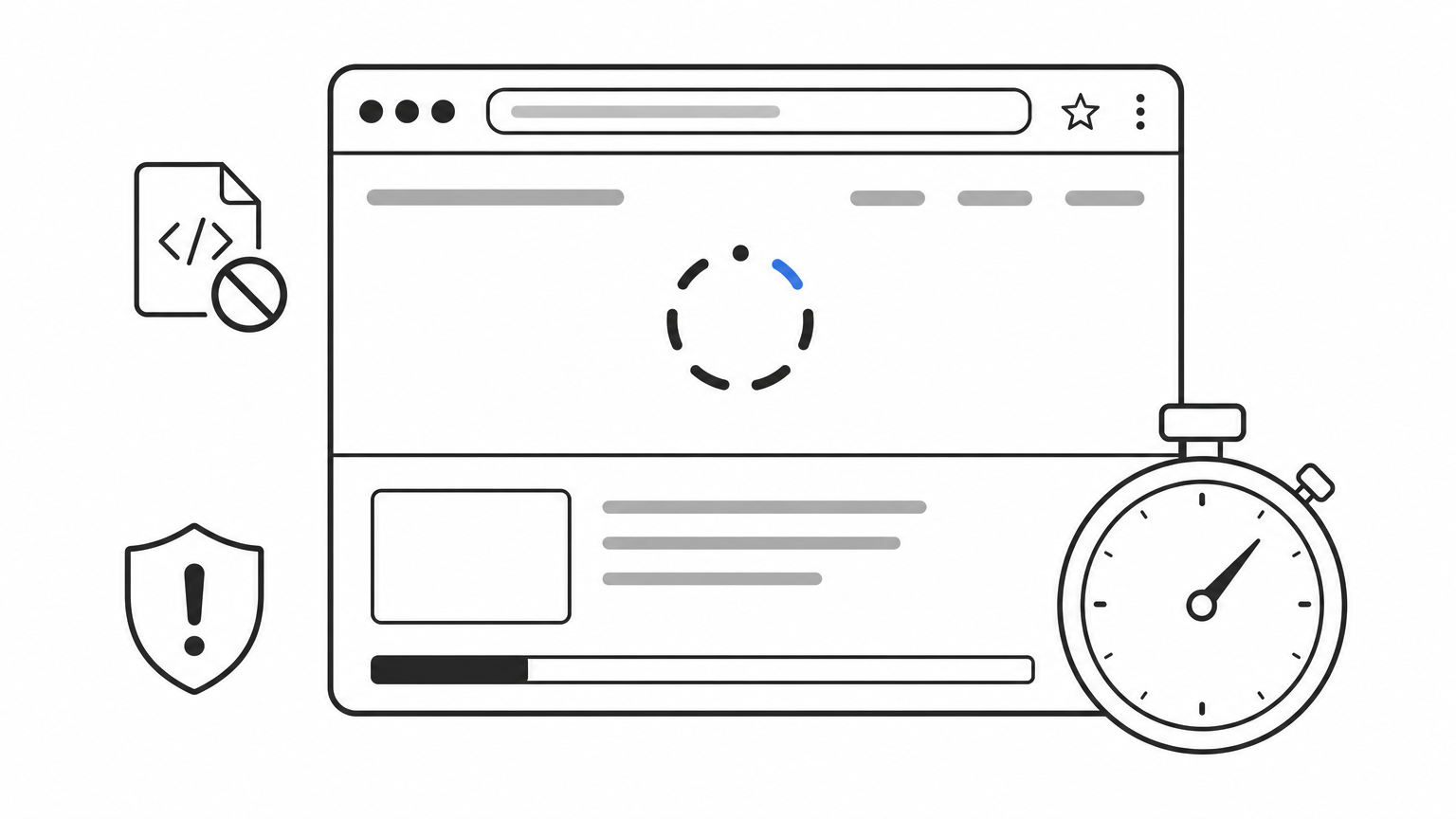
Many AI crawlers fetch raw HTML and skip client-side JavaScript entirely, so content injected by React or Vue after page load often never reaches them, which is why some teams turn to serving bots a pre-rendered version of the page. Add slow server response times on top of that, and a crawler may time out before it reads anything past your header.
One of the best answer engine optimization methods for ai visibility is simply making sure a bot can read the page at all before you worry about phrasing or schema, and speed matters more for AEO than most teams assume. A perfectly written answer buried behind a render-blocking script is invisible to a crawler that never waits for it to load.
A crawler can't cite content it never actually saw.
This is where Dash, our edge delivery agent, does the heavy lifting, accelerating load times at the edge without a single code change, so crawlers and shoppers both get a page that's ready the moment it arrives.
AI models don't just read your site, they cross-reference what other sources say about you before deciding whether to trust a claim. Third-party citations from review platforms, press coverage, and independent comparison sites carry weight your own product pages can't generate alone, which is why off-page SEO for Shopify still pays off.
When multiple independent sources describe your product the same way, that consensus becomes a signal an answer engine can lean on instead of taking your word for it. A brand mentioned favorably across Trustpilot, a niche beauty blog, and a retailer roundup builds a pattern of corroboration that a single self-published page never achieves on its own.
Self-reported claims carry less weight than independent corroboration, especially for anything a shopper might be skeptical about, like efficacy or safety. Among the best techniques for answer engine optimization in AI, this one matters because models are explicitly trained to weigh outside validation over brand marketing copy.
A brand's own claim is marketing. A third party repeating that claim is evidence.
AI models increasingly pull answers from community platforms, not just brand websites, because real people discussing real experiences read as unbiased. Community-driven content on YouTube, Reddit, and Quora carries a credibility that polished marketing copy can't fake, and answer engines have learned to weigh that difference.
Perplexity and ChatGPT regularly cite Reddit threads and Quora answers when a shopper asks something specific, like "does this serum actually reduce redness." YouTube adds another layer, since transcripts get indexed and pulled into answers even when the viewer never watches the video. Genuine discussion threads outperform branded content because the language sounds like a real customer, not a product page.
One of the best techniques for answer engine optimization in AI right now is showing up where the conversation already happens, instead of trying to redirect it back to your site. A brand invisible on Reddit or Quora loses citations to competitors whose customers, or employees, are actively answering questions there.
If your customers aren't talking about you where AI models are listening, your competitors' customers are.
None of these nine techniques work as a one-time project. AI visibility shifts as crawlers update, competitors publish, and buyer questions evolve, so treat this list as a recurring checklist, not a launch task you check off once. Revisit crawler logs monthly, refresh FAQ content quarterly, and keep pushing for third-party citations year-round.
Start with verification, since every other technique depends on knowing which bots actually reach your pages. Structure and schema come next, then authority and community presence build on top of that foundation. Skip the order and you'll optimize content that crawlers never see in the first place.
One piece of that foundation is traffic you can't control: bad bots scraping your catalog under a spoofed AI user agent, wasting bandwidth and distorting the data you're using to measure all of this. Clean that up first by stopping AI-powered bad bots before they ever reach your store, and every technique above works on traffic you can actually trust.


.svg)
