ChatGPT, Perplexity, and Google's AI Overviews now answer questions your customers used to Google, and most brands have no idea whether they show up in those answers. That blind spot is why aeo tools exist: software built to track, measure, and improve how often AI engines cite your brand instead of a competitor's. If you manage ecommerce growth or marketing, you already know traditional SEO dashboards don't show AI crawler activity, and that gap is costing you visibility you can't even measure yet.
This list answers a direct question: which platforms actually help you monitor and improve AI search visibility in 2026, not which ones just repackage old rank-tracking dashboards with a new name. We looked at tools built specifically for answer engine optimization, from citation tracking to crawler verification, and ranked them on what matters for real ecommerce sites: accuracy, ease of setup, and whether the data ties back to revenue.
Below you'll find 12 aeo geo tools worth evaluating, including where AI crawler detection at the edge (our own specialty at Nostra AI) fits alongside content-focused platforms. Each entry covers what it does best, who it's built for, and where it falls short, so you can build a stack that actually shows you what AI engines see.
Most AEO tools analyze what AI engines say about you after the fact. Nostra AI works differently: it sits at the edge of your storefront, in the same layer that already handles speed and bot protection, and watches AI crawlers the moment they hit your site. That means you get real crawler verification instead of guesswork about which "AI traffic" is actually GPTBot, PerplexityBot, or a scraper spoofing one of them. Because Nostra deploys through a single DNS-level change, there's no code to ship and no replatforming project to schedule before you start seeing data.
If you can't verify which AI crawlers actually touched your storefront, every AEO report you read afterward is a guess dressed up as a metric.
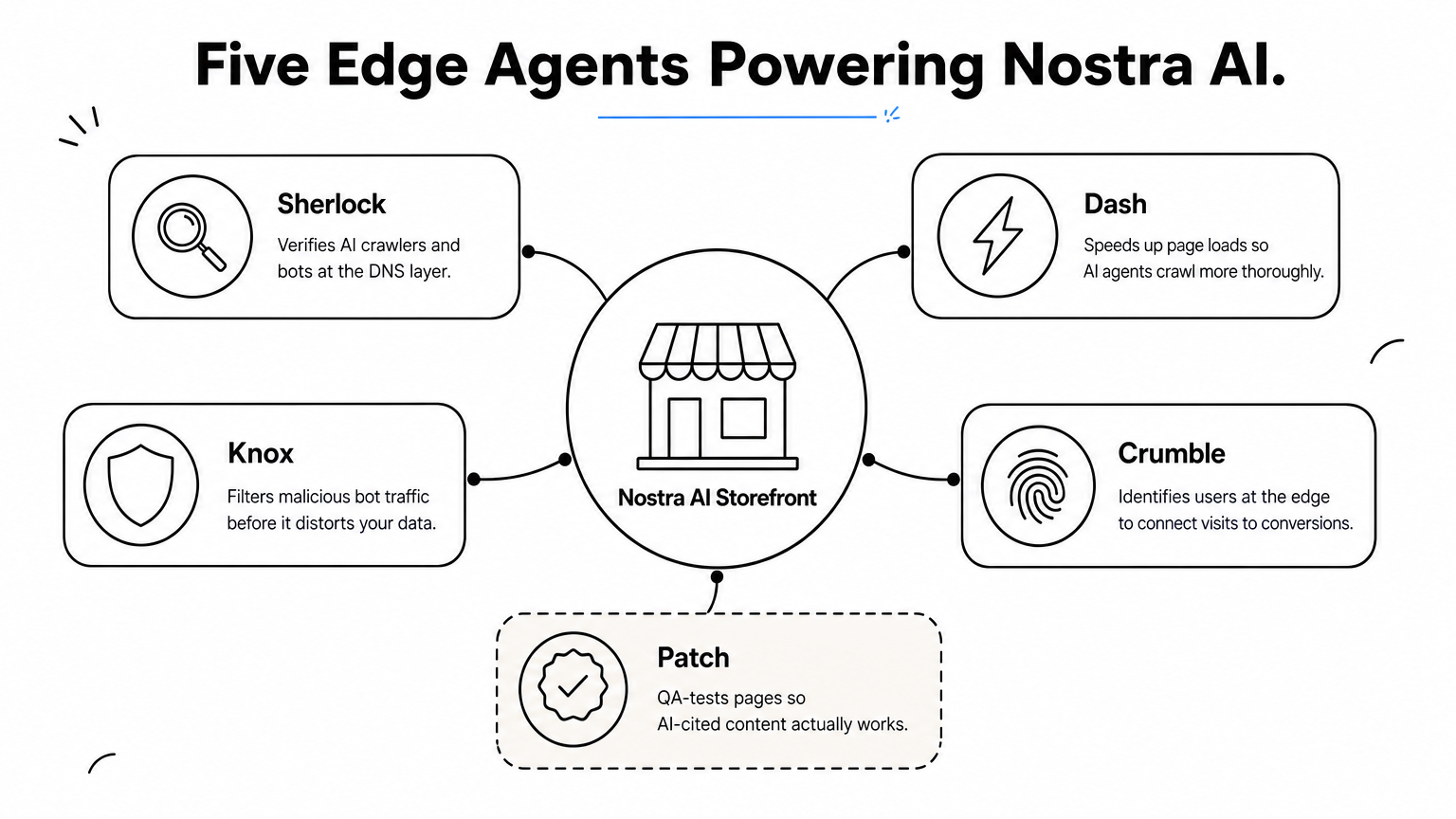
The AEO piece lives inside Sherlock (Edge Detect), one of five agents that run your storefront on the platform. Sherlock identifies and verifies AI crawler and bot traffic in real time, then feeds that verified data into your AEO reporting instead of leaving you to reconcile server logs by hand.
Nostra AI prices based on traffic volume and which agents you activate, since not every brand needs all five on day one. There's no public price list because implementations vary by store size and stack, but the deployment itself follows a fixed timeline: Day 1 DNS connection, a two-week observation window while agents learn your store, then ongoing automated optimization. You'll want to talk to sales for a quote specific to your traffic and platform (Shopify Plus, BigCommerce, and similar setups are all supported).
Ecommerce and DTC brands that want AI crawler visibility bundled with the infrastructure work (speed, bot protection, identity tracking) they're already responsible for, without adding another engineering ticket. If your team is small and you'd rather have agents act on issues than hand you another dashboard to interpret, Nostra fits. It's less suited to teams that only want standalone content-citation tracking with no interest in the underlying edge layer.
HubSpot built its AEO features directly into the marketing hub many ecommerce teams already use for email and CRM. Instead of a separate platform, you get AI search monitoring layered onto content you're already publishing through HubSpot, tracking whether your blog posts, product pages, and landing pages get cited by ChatGPT, Perplexity, and Google's AI Overviews. It's built for marketers who want answer engine optimization without learning a new interface.
Because it lives inside HubSpot, the AEO toolkit connects citation data to content performance metrics you're already tracking.
AEO features ship as part of HubSpot's Marketing Hub Professional and Enterprise tiers, starting around $890 per month for Professional. There's no standalone AEO product, which means you're paying for the full marketing suite even if citation tracking is the only piece you want. Confirm current tiers on HubSpot's pricing page before budgeting, since packaging shifts as AI features mature.
Marketing teams already running HubSpot for email, CRM, and content who want AEO data without adding another vendor contract. It's a weaker fit if you're not already on HubSpot, since buying the suite just for AI citation tracking is expensive, and it won't tell you anything about AI crawler activity hitting your storefront directly.
Semrush extended its existing SEO suite with an AI Visibility Toolkit that tracks how often your domain gets cited across ChatGPT, Google AI Overviews, and Perplexity. Since Semrush already indexes keyword rankings and backlinks for millions of domains, it layers AI citation data on top of that existing dataset instead of building a separate crawler. That makes it a natural add-on if you're already running Semrush for traditional rank tracking and want AI search visibility without a new login.
A tool that only tells you where you rank in AI answers, without showing why competitors get cited instead, leaves you guessing at the fix.
The toolkit borrows heavily from Semrush's existing keyword and competitor infrastructure, which is its biggest strength and its main limitation.
Access requires a Semrush subscription, with AI Overview data included in Guru and Business plans starting near $249.95 per month. There's no standalone AEO product, so smaller teams pay for the full SEO suite even if citation tracking is the primary reason they signed up. Check Semrush's pricing page directly, since AI feature access shifts between tiers.
Teams that already run Semrush for keyword research and want AI citation data folded into that workflow rather than a dedicated AEO platform. It suits marketers more than engineering teams, and it won't verify actual AI crawler traffic hitting your storefront the way an edge-level agent does.
Profound built its whole product around one question: what does ChatGPT say about your brand right now? (Shopify brands can also pair Profound with Nostra's edge data to see discovery and citations side by side.) It runs thousands of prompts against ChatGPT, Perplexity, and Google AI Overviews on a schedule, then tracks how your brand and products get described, ranked, and recommended compared to competitors. Unlike suites bolted onto older SEO tools, Profound was built specifically for answer engine optimization from day one, which shows in how granular the prompt-level data gets.
Watching what AI engines say about you once a month tells you less than watching what they say every day, since answers shift with every model update.
Profound leans hard into prompt-level detail rather than broad citation counts, which matters if you're trying to diagnose why an answer engine picked a competitor over you.
Profound doesn't publish flat pricing. Plans are quoted based on prompt volume and the number of tracked brands, and most enterprise deployments run into the low thousands per month based on public reporting. You'll need a sales call to get an actual number, which can slow down evaluation if you're comparing several tools at once.
Enterprise brands and agencies that need deep prompt-level detail and are willing to pay for it. It's overkill for smaller ecommerce teams that just want a directional read on AI visibility, and it doesn't touch crawler verification or storefront performance the way an edge-based agent does.
Ahrefs added Brand Radar to its backlink and keyword suite so existing users could track AI citations without switching tools. It monitors how often your domain gets mentioned across ChatGPT, Perplexity, and Google AI Overviews, then ties that data back to the backlink profile and keyword rankings Ahrefs already tracks for your site. Since Ahrefs indexes one of the largest link databases available, Brand Radar can show whether the pages earning AI citations are the same ones earning backlinks, which is a connection most standalone AEO tools can't make.
Brand Radar's strength comes from linking citation data to metrics Ahrefs already collects, rather than building a separate monitoring system from scratch.
Citation data means more when you can see whether the pages AI engines cite are the same ones earning links and rankings elsewhere.
Brand Radar ships inside Ahrefs' standard plans, with AI citation tracking included starting on the Standard tier at roughly $129 per month. There's no separate AEO product to buy, so you're paying for the full SEO toolkit, backlinks, keywords, site audits, and citation tracking together. Check Ahrefs' pricing page directly, since AI features have moved between tiers as the product matures.
SEO teams already running Ahrefs for backlink and keyword research who want AI citation data without a new login. It's a weak fit if backlinks aren't central to your strategy, or if you need crawler-level verification of AI bot traffic hitting your storefront directly.
Peec AI is a European-built platform focused entirely on tracking brand visibility inside ChatGPT, Perplexity, and Google AI Overviews. It runs recurring prompt sets against those engines and reports back on whether your brand, products, or specific pages get mentioned, with a particular strength in tracking multilingual and multi-market queries. Teams selling across the US and EU tend to like it because it doesn't assume every prompt runs in English, which is a gap in several US-built AEO tools.
Peec keeps its feature set narrow and focused on prompt monitoring rather than trying to be a full SEO suite.
A visibility score only means something once you can watch it move week over week against the same competitors, not as a one-time snapshot.
Peec AI publishes tiered pricing starting around 89 euros per month for smaller prompt volumes, scaling up based on the number of tracked prompts and brands. That transparency is rare among AEO geo tools, most of which push you toward a sales call before you see a number. Check Peec's own site for current tiers, since prompt-based pricing shifts as usage grows.
Brands running international ecommerce operations who need AI visibility tracking that doesn't assume an English-only market. It's a lighter tool than options like Profound, so if you need deep prompt-level diagnostics or crawler verification at the storefront level, you'll want to pair it with something built for that.
Scrunch AI positions itself as a full-funnel AEO platform, tracking not just whether AI engines cite you but how your entire site structure supports or blocks that citation in the first place. It crawls your site the way an AI agent would, then flags pages with weak schema, thin content, or structural issues that make it harder for ChatGPT or Perplexity to extract a clean answer. Where most aeo tools stop at monitoring, Scrunch tries to close the loop with technical recommendations you can hand straight to a developer.
Scrunch pairs citation tracking with a technical audit layer that most competitors skip, which is its main differentiator.
Fixing why an AI engine can't parse your page matters more than knowing it skipped you again this week.
Scrunch AI quotes pricing based on site size and crawl frequency, with plans starting in the low hundreds per month for smaller catalogs and scaling up for larger ecommerce sites with thousands of SKUs. There's no fully public price list, so you'll need to request a quote to see where your store lands. That's a common pattern across top rated answer engine optimization for AI products, since crawl volume varies too much for flat pricing to make sense.
Ecommerce teams with technical resources who want structural fixes alongside citation tracking, not just a report telling you AI engines skipped your product pages again. It suits brands willing to act on schema and content recommendations. It's less useful if you just want a lightweight visibility score without the audit work attached.
AirOps started as an AI content operations platform and has since built out dedicated AEO workflows for teams that need to publish at scale to earn AI citations. Rather than just monitoring whether ChatGPT or Perplexity mention your brand, AirOps helps you generate and optimize the underlying content, product pages, comparison guides, FAQ hubs, so those engines have something worth citing in the first place. It's built for teams that treat answer engine optimization as a content production problem, not just a tracking problem.
Tracking citations without producing content built to earn them just tells you what's already broken.
AirOps leans on automation and templated workflows more than any other tool on this list, which suits teams publishing at volume.
AirOps prices around seat count and workflow volume, with plans starting near $300 per month for smaller teams and scaling into custom enterprise contracts for larger content operations. There's no free tier, and pricing isn't fully public past the entry plan, so larger ecommerce catalogs should expect a sales conversation before committing.
Content and marketing teams managing large product catalogs who need to produce AEO-ready pages faster than a manual workflow allows. Ecommerce brands publishing hundreds of product or category pages get the most value here. It's a poor fit if you're looking for crawler-level verification of AI bot traffic instead of content production tools.
SE Ranking built its AI Search Toolkit as an add-on to its existing SEO platform, aimed at agencies and smaller ecommerce teams that already use the tool for rank tracking. It monitors how often your brand and product pages get cited across ChatGPT, Perplexity, and Google AI Overviews, then reports that data alongside the keyword rankings you're already tracking. Because SE Ranking has always positioned itself as a budget-friendly alternative to Semrush and Ahrefs, this AEO feature follows the same pattern: fewer bells and whistles, lower cost of entry.
The toolkit keeps things simple compared to dedicated AEO tools, focusing on core citation monitoring rather than deep prompt diagnostics.
A cheaper AEO add-on only pays off if the citation data is accurate enough to act on, not just cheap enough to justify buying.
Access to the AI Search Toolkit comes bundled with SE Ranking's Pro plan, which starts around $65 per month, well below most competitors on this list. Agencies managing several client accounts often find this the most affordable way to add citation tracking without a separate contract. Confirm current feature access on SE Ranking's pricing page, since AI tools tend to shift between tiers as they mature.
Agencies and small ecommerce teams that want basic AI visibility monitoring without paying enterprise prices. It's a weaker choice if you need prompt-level depth or crawler verification, since the toolkit trades detail for affordability.
Botify built its reputation on enterprise technical SEO, log file analysis for large ecommerce sites, indexation monitoring, and crawl budget management for large catalogs. It has since extended that infrastructure to track AI crawler activity alongside traditional search bots, giving large ecommerce sites a way to see whether GPTBot, PerplexityBot, and similar agents are actually indexing product pages, not just whether Googlebot is, which is also the data you need before deciding whether to allow or block AI crawlers. Because Botify already processes raw server logs at scale, it can show AI crawl patterns most AEO tools never touch, since they rely on citation sampling instead of actual log data.
Citation reports tell you what AI engines said. Log data tells you what they actually crawled, and those two numbers rarely match.
Botify's advantage is depth of log analysis, not breadth of AI-specific features, which shows in how the platform is structured.
Botify doesn't publish pricing, and implementations typically run into five figures annually given the log processing infrastructure involved. You'll need a sales conversation and likely a technical scoping call before getting a quote, since pricing scales with site size and log volume rather than seat count.
Large ecommerce catalogs with dedicated technical SEO teams who need log-level proof of AI crawler behavior, not just citation sampling. It's out of reach for smaller brands on both cost and complexity, and it won't help you track brand sentiment inside AI-generated answers the way prompt-monitoring tools do.
Geoptie is a newer entrant built specifically for generative engine optimization, tracking how brands surface across ChatGPT, Perplexity, Gemini, and Copilot rather than treating AI answers as an afterthought bolted onto SEO software. It runs scheduled prompt sweeps against these engines and maps out exactly which sources each one pulls from when constructing an answer about your category. That sourcing view is Geoptie's real differentiator: instead of just telling you that you got cited, it shows which competitor page, review site, or forum thread the engine leaned on when it didn't cite you.
Knowing which page an AI engine trusted instead of yours matters more than knowing you were skipped.
Geoptie leans on source-mapping more than any other tool on this list, which shapes its whole feature set.
Geoptie publishes starter pricing around $199 per month for a limited prompt volume, with usage-based tiers scaling from there. That transparency puts it ahead of several aeo geo tools on this list that hide pricing behind a sales call. Confirm current tiers directly on Geoptie's site, since prompt-based products tend to adjust pricing as usage patterns settle.
Smaller ecommerce and DTC brands that want source-level detail without an enterprise contract. Geoptie suits teams that need to know exactly who's beating them for a citation, not just that they lost one. It won't verify actual crawler traffic hitting your storefront, so pair it with an edge-level tool if that gap matters to you.
Airefs is a lightweight, API-first tool built for developers who want raw citation data without a dashboard wrapped around it. It queries ChatGPT, Perplexity, and Google AI Overviews on a schedule, then returns structured JSON showing whether your domain, and which specific pages, got cited for a given prompt set. Instead of a full AEO tools suite with reporting layers and account managers, Airefs assumes you already have a data team ready to pipe results into your own BI stack.
A tool built for engineers to query directly beats a dashboard when your team already has somewhere better to put the data.
Airefs strips out most of the reporting layer that competitors bundle in, betting that technical teams would rather build their own views.
Airefs charges by API call volume, starting near $150 per month for smaller prompt sets and scaling with usage. There's no seat-based pricing, which makes it cheaper than dashboard-heavy tools if your team is small but your query volume is high. Confirm current rate limits directly with Airefs, since API pricing tends to shift as usage patterns mature.
Data and engineering teams who'd rather build a custom AEO dashboard than adopt someone else's. It suits brands with existing BI infrastructure and a preference for owning the reporting layer. Marketing teams without technical support should look elsewhere on this list.
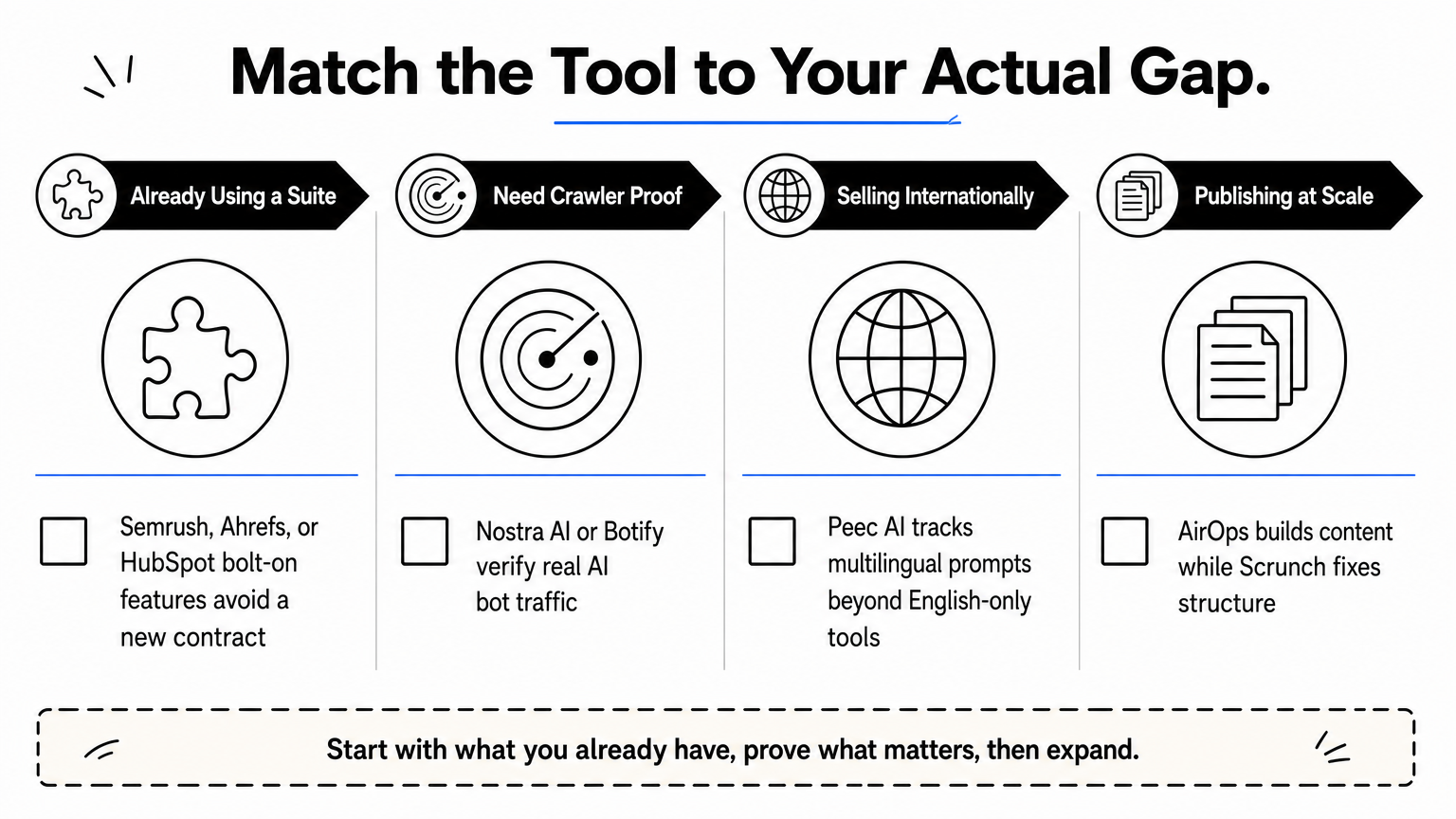
Twelve options is a lot to sort through, so start with what you're actually trying to fix. If you don't know whether real AI crawlers even reach your storefront, prioritize crawler verification over prompt monitoring. If your content already ranks well but never gets cited, a structural audit tool like Scrunch or a content-production platform like AirOps solves a different problem than a dashboard ever will. Matching the tool to the actual gap matters more than picking whichever name shows up first in a search.
The best AEO tool for your brand is the one that answers the specific question keeping you up at night, not the one with the longest feature list.
Budget shapes the decision just as much as features do. Enterprise platforms like Profound and Botify quote custom pricing because prompt volume and log processing scale with catalog size, while tools like Peec AI, SE Ranking, and Geoptie publish flat tiers you can budget against today. Weigh that against how the tool ties into your existing stack:
Verification should outrank everything else on this list. A visibility score built on unverified traffic, whether it's inflated by spoofed bots or diluted by missed crawls, gives you a number to report and nothing you can actually act on.
Ask five marketers to define AEO and you'll get five different answers, so let's clear up the terms before you shop for tools. Answer engine optimization (AEO) means optimizing your content and technical setup so AI-driven answer engines, ChatGPT, Perplexity, Google AI Overviews, cite your brand when someone asks a question in your category. Traditional SEO still matters, since AI engines often pull from the same pages that already rank well organically, but SEO measures clicks and rankings while AEO measures citations and mentions inside a generated answer.
Generative engine optimization (GEO) gets used almost interchangeably with AEO, and honestly, most vendors don't draw a hard line between them. If you see a tool marketed as aeo geo tools, treat that as marketing shorthand rather than a meaningful technical distinction. Both terms describe the same underlying goal: getting your brand surfaced inside AI-generated responses instead of buried on page two of a search results page nobody scrolls anymore.
AEO and GEO aren't competing disciplines, they're two names for the same problem: getting cited by engines that answer instead of listing links.
Bot verification is where these categories split hardest. SEO tools have never needed to tell a legitimate AI crawler from a bad bot spoofing GPTBot, because search bots weren't a security concern the same way. That's why the strongest answer engine optimization solutions for AI tech now pair citation tracking with actual crawler verification instead of assuming every hit labeled "AI traffic" is legitimate.
AEO isn't a replacement for SEO, and it isn't a side project you hand to one marketer for an afternoon. It's a new layer of visibility that sits on top of everything else you're already measuring, and it only works if the underlying data is real. Picking a tool from this list starts with naming your actual gap: citation tracking, content production, structural fixes, or crawler verification. Most brands need more than one of these eventually, but you don't have to buy all twelve tools to start.
Start where the risk is highest. If you can't confirm which AI crawlers actually touch your storefront, every citation report you buy afterward rests on an unverified guess. That's the layer Nostra AI was built to close, verified crawler data sitting right alongside the speed, bot protection, and identity tracking your storefront already needs. See how Edge Detect verifies AI traffic at the edge before you invest further up the stack.


.svg)
