The best multi-touch marketing attribution software depends on what you sell and where your data lives. Ecommerce and DTC brands should look at Triple Whale or Northbeam. B2B teams with long sales cycles fit HockeyStack or Dreamdata. HubSpot users can start with the attribution reports already in their CRM. Teams that want attribution, marketing mix modeling and incrementality tests in one place fit Funnel. Everyone else can start free with GA4. A good pick connects to your ad platforms and CRM, offers more than last-click credit, and produces numbers you can check against a controlled test.
The problem is familiar. Every ad platform claims credit for the same sale, your analytics tool credits the last click, and your finance team wants one number for return on ad spend. Attribution software promises a neutral split of credit across every touchpoint. But the tools differ a lot in model types, data requirements, price, and the kind of business they were built for.
This article compares eight tools on how they work, who they suit, and what they cost. It then sets them side by side in a table with worked cost examples. Finally, it covers the part most buyers skip: the quality of the data that goes in. At Nostra AI, we work on that ecommerce side. Bot traffic and short-lived cookies corrupt attribution inputs, so that gets its own section near the end.
Multi-touch attribution software records the touchpoints a buyer passes through, such as ads, emails, organic visits and sales calls. It then splits credit for each conversion across them using a model. The model you pick changes which channels look good, so you need to understand it before you compare vendors.
Most tools offer some mix of the models below. The percentages in the table are common defaults, and vendors tune them differently.
| Model | How credit is split | Fits best |
|---|---|---|
| First-touch | 100% to the first interaction | Judging awareness channels |
| Last-touch | 100% to the final interaction | Short, single-channel purchases |
| Linear | Equal share to every touchpoint | A first look at the full journey |
| Time decay | More credit the closer to conversion | Short consideration cycles |
| U-shaped | Often 40% first, 40% last, 20% spread across the middle | Lead generation with a clear opener and closer |
| W-shaped | Weight on first touch, lead creation and opportunity creation | B2B pipelines with defined stages |
| Data-driven | Machine learning estimates each touchpoint's contribution | High-volume accounts with enough conversions |
Rule-based models are easy to explain to a CFO. Data-driven models are harder to audit, and they need conversion volume to be stable. If you have only a few dozen conversions a month, a transparent rule-based model is usually the safer choice.
The model decides who gets the credit, so pick it before you pick the vendor.
Use this list to narrow eight tools to two or three:
If you are weighing a custom build instead of buying, you need a warehouse, event collection, identity stitching and SQL skills. Plan on that being a real engineering project, not a weekend script.
Multi-touch attribution only measures trackable digital touchpoints. Billboards, TV, podcasts and word of mouth leave no click trail, so they get zero credit unless the tool imports offline data. Privacy rules and browser limits also remove parts of the journey.
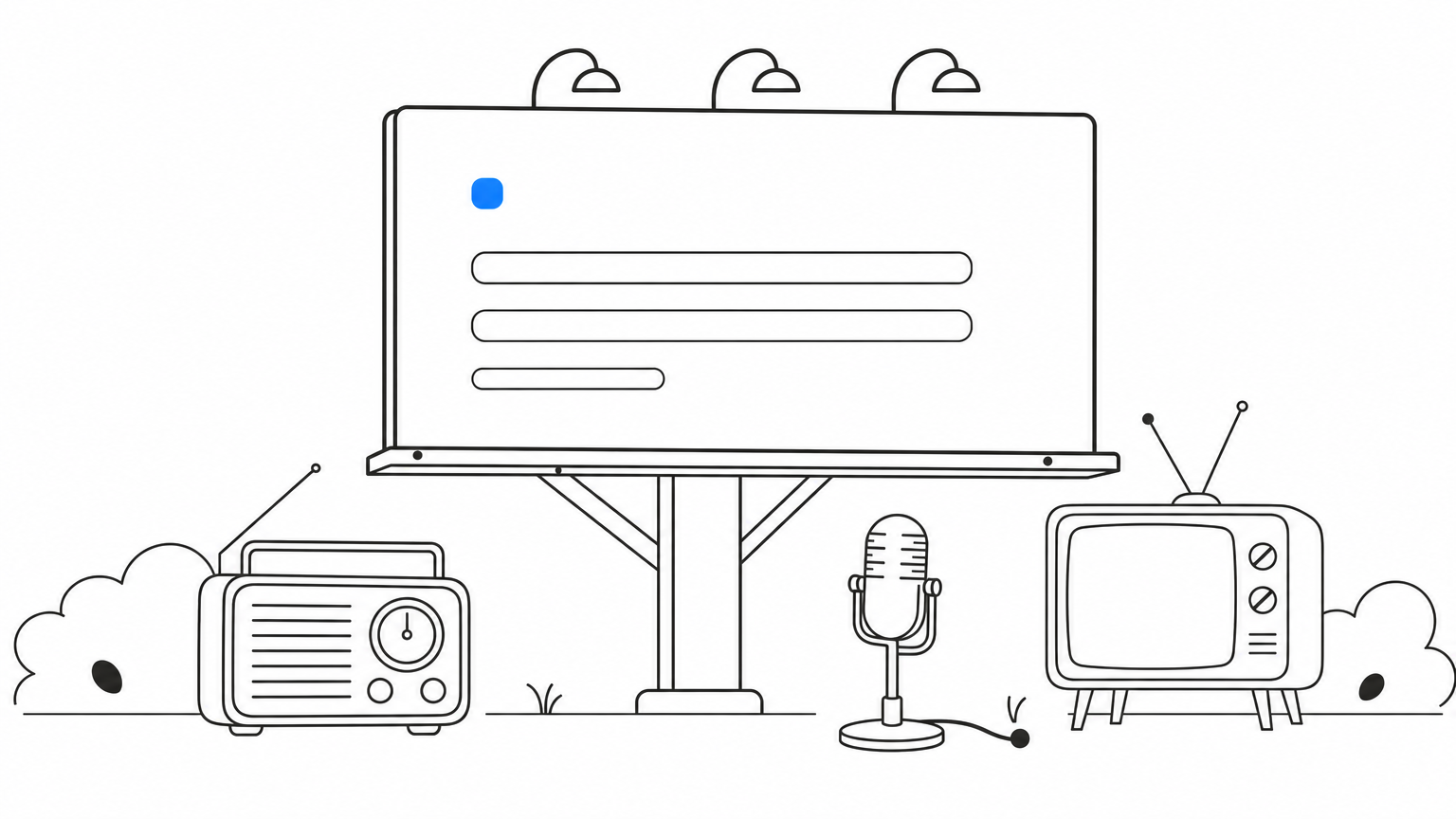
Because of these gaps, many teams pair attribution with marketing mix modeling for budget planning and incrementality tests for proof of causation. Several tools below bundle one or both. Mobile app attribution platforms such as AppsFlyer, Branch and Adjust solve a different problem, install tracking, so this list covers web and omnichannel tools.
Triple Whale is an attribution and analytics platform built for ecommerce brands. It pulls data from Shopify, Meta Ads and Google Ads into one view, and it uses its own tracking pixel to capture purchases, form submissions and page views.
Beyond attribution, it reports customer acquisition cost and return on ad spend. It also shows a daily net profit view that subtracts ad spend and cost of goods. A creative reporting tool compares individual images, videos and headlines, and you can switch between several attribution models to see how credit moves.
Triple Whale suits brands that want attribution, profit and creative reporting in a single ecommerce dashboard.
It fits a Shopify-based DTC brand with steady paid social and search spend and a small team that does not want to build its own reporting. Agencies also use it for client reporting.
Published starting prices run from about $1,290 per year for Growth, $1,990 for Pro and $2,790 for Premium, up to $4,790 for Premium+. Confirm current tiers and what triggers an upgrade before you commit.
Reviewers mention that the amount of data can overwhelm newer users. Some also note that it does not push conversion data back to ad platforms to improve their bidding, which matters if you want attribution to feed ad optimization directly.
Northbeam is a marketing intelligence platform focused on direct-to-consumer brands. Its multi-touch attribution uses your own first-party data and reports near-real-time performance, so you can scale campaigns up or down quickly.
It also includes marketing mix modeling, which it calls MMM+. The company says the model captures non-linear interactions between channels and retrains weekly. A feature called Apex connects attribution data to Meta, and the company says it can lift Meta ad performance by up to 30 percent. Treat both as vendor claims and test them on your own account.
Northbeam combines multi-touch attribution with mix modeling for DTC brands that spend across many channels.
It suits DTC brands with meaningful Meta spend, several paid channels, and an analyst or growth lead who will use the extra depth.
Expect to request a quote rather than choose a plan from a price list. Ask which modules the quote includes (attribution, MMM+, Apex), which spend or order tier it assumes, and how long the contract runs.
The trade-off is scope. A full measurement suite takes longer to roll out and interpret than a single dashboard. The performance claims are the vendor's own, so set up a holdout test before you rely on them.
Funnel's Measurement product combines multi-touch attribution, marketing mix modeling and incrementality testing in one platform. It is built on Funnel's Data Hub, which aggregates marketing data from 600+ connectors and standardizes it centrally.
Other features include adstock modeling to capture delayed effects, baseline calculation to separate incremental sales from reported conversions, and marginal acquisition cost to guide budget shifts. Funnel also describes AI agents that automate data quality checks and model tuning.
Funnel fits teams that want three measurement methods cross-checking each other instead of one model deciding alone.
It suits mid-market and enterprise teams running many channels, including upper-funnel and offline media, that already struggle to keep marketing data clean across platforms.
Confirm pricing directly with Funnel. The useful comparison is its total cost against buying and maintaining separate attribution, mix modeling and testing tools, plus the analyst time to reconcile them.
A broader scope means a longer setup. Mix modeling also needs a long history of spend and sales data to be reliable, so a young account will get less from it at first.
HockeyStack is a go-to-market intelligence platform for B2B SaaS teams. It unifies sales, marketing, website and product data, then maps buyer journeys at both the user and account level.
It offers first-touch, last-touch, linear, W-shaped and custom models. It also has an AI assistant, Odin, that answers questions such as which blog posts influenced the most enterprise deals. It uses a no-code setup, and the vendor states compliance with GDPR, CCPA and SOC 2.
HockeyStack is built for B2B teams that must prove which programs create pipeline across long buying cycles.
It suits SaaS marketing and revenue operations teams whose deals involve several stakeholders and months of touches, and who want attribution tied to pipeline stages.
Pricing is custom, so you will go through a demo and quote process. Ask what is included in every plan and how pricing changes as your data volume or seat count grows.
The product's B2B focus is also its limit. It is less natural for consumer ecommerce, where shopper-level ad and store data matter more than account-level pipeline.
Dreamdata is a B2B attribution and activation platform that connects go-to-market activity with pipeline and revenue. It pulls data from marketing platforms, your CRM and other tools to assemble the customer journey across the funnel.
It offers six models: first-touch, last-touch, W-shaped, U-shaped, data-driven and linear. It can also build audiences from go-to-market data and sync conversions back to ad platforms, so measurement feeds targeting instead of only reporting.
Dreamdata turns CRM and ad data into revenue attribution that B2B teams can act on.
It fits B2B companies with longer sales cycles where several campaigns and contacts influence one account before it converts.
Published tiers have been Free at $0, Team at $999 per month, Business at $2,499 per month and a custom Enterprise plan. Verify these before budgeting, since vendors change plans often.
Reviewers describe a learning curve, with reports that feel overwhelming at first. Some also want more flexible reporting for comparing time periods, and smaller businesses find the cost significant.
HubSpot's attribution reporting lives inside its CRM and Marketing Hub. It combines email, social, content and paid ad interactions into a single contact timeline, with first-touch and multi-touch views.
You can set goals such as form submissions or purchases and credit the activity that led to them. It also measures content attribution, showing how blog posts, videos and case studies contribute to conversions and revenue.
If your contacts and deals already live in HubSpot, its built-in attribution is the lowest-friction place to start.
It suits small and mid-sized B2B and services teams that run marketing, sales and service from HubSpot and want attribution without adding another vendor.
Published Marketing Hub tiers are Free at $0, Starter at $20 per month per seat, Professional at $890 per month with three seats, and Enterprise at $3,600 per month with five seats. Check which tier unlocks the multi-touch reports you need, since advanced reporting generally sits in higher tiers.
Reviewers flag steep pricing at higher tiers and data management issues when records are not kept tidy. Attribution is only as accurate as your contact and deal data.
LeadsRx is a cross-channel attribution platform that combines online and offline data. It uses a single tracking pixel or tag across channels and ad vendors, so one setup covers many sources.
It covers digital touchpoints like email and social, plus TV, radio, podcast and video streaming advertising. You can calculate return on ad spend, customer acquisition cost and lifetime value. Built-in integrations include Marketo, Salesforce, LinkedIn, HubSpot and SurveyMonkey.
LeadsRx earns its place when broadcast and audio spend sit next to digital campaigns.
It suits brands and agencies that buy TV, radio or podcast media and want those channels measured next to paid search and social.
Pricing is by request, with separate offerings for attribution, journey reporting and agencies. Ask how pricing scales with media volume.
Reviewers mention frequent email notifications that are hard to reduce. They also note that reliance on external platforms can cause problems when those platforms change, such as the move from Universal Analytics to GA4.
GA4 is Google's free analytics tool, and it includes built-in attribution with conversion path reports and model comparison. You choose how credit is assigned to key events across the journey.
It offers three reporting models: data-driven attribution, which uses machine learning to split credit; paid and organic last click; and Google paid channels last click. Because it connects natively to Google Ads and the rest of Google's tools, setup is quick.
GA4 is the free baseline every other tool on this list should beat.
It suits small teams, new advertisers, and anyone who wants a benchmark before paying for a specialist tool.
GA4 is free. The enterprise version, Analytics 360, is sold through sales with custom pricing and offers features like unsampled reports and faster data availability.
Its limits are scope and model choice. It sees only what its tag records, and its reporting is strongest for Google channels. With only three models, it offers less variety than a dedicated platform.
The table below sets published starting prices next to each tool's focus, and the examples show what a year costs. Treat prices as indicative and confirm them with each vendor.
| Tool | Best for | Key strength | Published pricing |
|---|---|---|---|
| Triple Whale | Shopify and DTC brands | Own pixel, profit and creative reporting | From $1,290 per year |
| Northbeam | DTC with multi-channel spend | MTA plus MMM+, Meta Apex | Quote |
| Funnel | Mid-market and enterprise | MTA, MMM and incrementality in one | Confirm with vendor |
| HockeyStack | B2B SaaS | Account-level journeys, AI assistant | Custom |
| Dreamdata | B2B with long cycles | Revenue attribution, ad sync | $0, $999, $2,499 per month, Enterprise custom |
| HubSpot | Teams on HubSpot CRM | Built-in contact timeline | $0, $20 per seat, $890, $3,600 per month |
| LeadsRx | Online plus offline media | Single pixel across channels | By request |
| GA4 | Beginners and benchmarking | Free, Google integration | Free |
Take a three-person B2B marketing team. HubSpot Professional at $890 per month comes to $10,680 per year (890 × 12). Dreamdata Team at $999 per month is $11,988 per year. GA4 costs nothing, but you will do more manual reporting yourself.
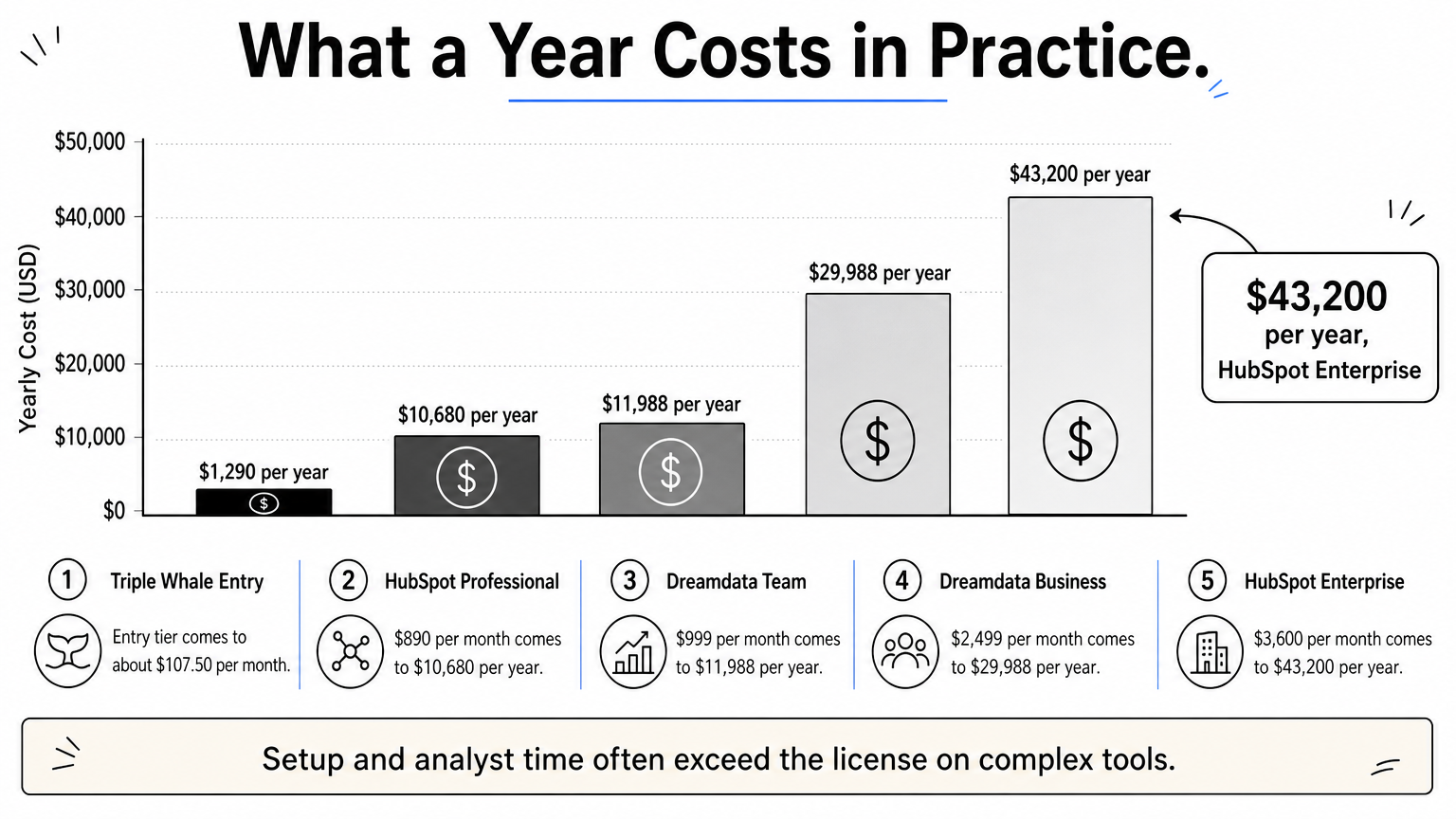
A DTC brand on Triple Whale's entry tier pays from $1,290 per year, about $107.50 per month. At the top of the published ladder, HubSpot Enterprise at $3,600 per month is $43,200 per year, and Dreamdata Business at $2,499 per month is $29,988 per year. Software cost is only one part, because setup and analyst time often exceed the license on the more complex tools.
Match your situation to one of these starting points:
Every tool above assumes the data going in is accurate. Bot traffic and short cookie life are the two ecommerce data problems that most often distort attribution. Fixing them first makes any tool you choose more reliable. Nostra AI does not do attribution, but its edge agents improve these two inputs.
Bots add sessions that never buy. When they arrive through paid channels, they inflate clicks and drag down conversion rates, so a campaign can look weaker than it is. They also waste ad spend directly.
Nostra AI's Edge Protect agent, Knox, turns away bad bots at the edge before they reach your analytics. It still allows good bots such as Googlebot, ChatGPT and Claude. Nixon cut daily bot sessions by roughly 90% after using it. Edge Protect starts at $99 per month, priced on monthly site sessions, with a 14-day free trial. It deploys with a DNS-level change and no engineering work.
Attribution models split credit among sessions, so fake sessions steal credit from real ones.
Browser restrictions often shorten how long a cookie survives, commonly to about a week. A shopper who clicks an ad, comes back ten days later and buys is then counted as a new visitor, and the first touch disappears from the journey. Multi-touch models cannot credit touchpoints they cannot connect.

Nostra AI's Crumble agent, Edge ID, supports first-party tracking on your own domain to extend cookie life from about 1 week to 2+ years and recover lost identities. It works with Meta, Google, Klaviyo and GA4. Recognition still depends on consent, browser restrictions and cookie settings, so results vary by store.
Run these checks in your current analytics. They take an afternoon:
Pick a tool that matches your business type, supports more than last-click credit, and can be validated with a test. Ecommerce brands lean toward Triple Whale or Northbeam, B2B teams toward HockeyStack, Dreamdata or HubSpot, offline-heavy advertisers toward LeadsRx, and cautious beginners toward GA4. Funnel suits teams that want several measurement methods together.
Whichever you choose, treat its output as only as good as its inputs. If bots and expiring cookies distort your sessions, the model will distribute credit across a flawed picture. To start with the cleaner inputs, you can see how Edge Protect filters bot traffic before the data reaches your analytics.


