AI crawlers hit your storefront thousands of times a day now, and most tech teams have no idea what those bots are actually doing with the content they scrape. If you're building or selling AI-focused technology, getting cited inside ChatGPT, Perplexity, or Google's AI Overviews matters as much as ranking on page one used to. That's why so many teams are searching for best answer engine optimization for ai focused tech, hoping to find a shortcut past months of guesswork.
This list answers that search directly. We cover the ten strongest AEO options available right now, ranging from specialized agencies that rebuild your content strategy around AI answer engines, to software platforms that track exactly which bots are crawling you and how often. Each pick is evaluated on what it actually does for visibility inside AI-generated answers, not just generic SEO promises repackaged with an AI label.
We built this list from real deployment experience, including our own work verifying AI crawler traffic through Nostra AI's Sherlock agent, so you're getting practical distinctions rather than a rehashed vendor directory. Read through the picks below and you'll walk away knowing which service fits your budget, your stack, and your actual goal: showing up when AI decides who gets cited.
Nostra AI sits in a different category than most names on this list. Instead of an agency writing content aimed at AI answer engines, it's an edge-based platform that tells you exactly which AI crawlers are hitting your site, how often, and whether they're legitimate. For any company evaluating the best answer engine optimization for ai focused tech, that visibility is the missing piece most teams skip straight past on their way to content tactics.
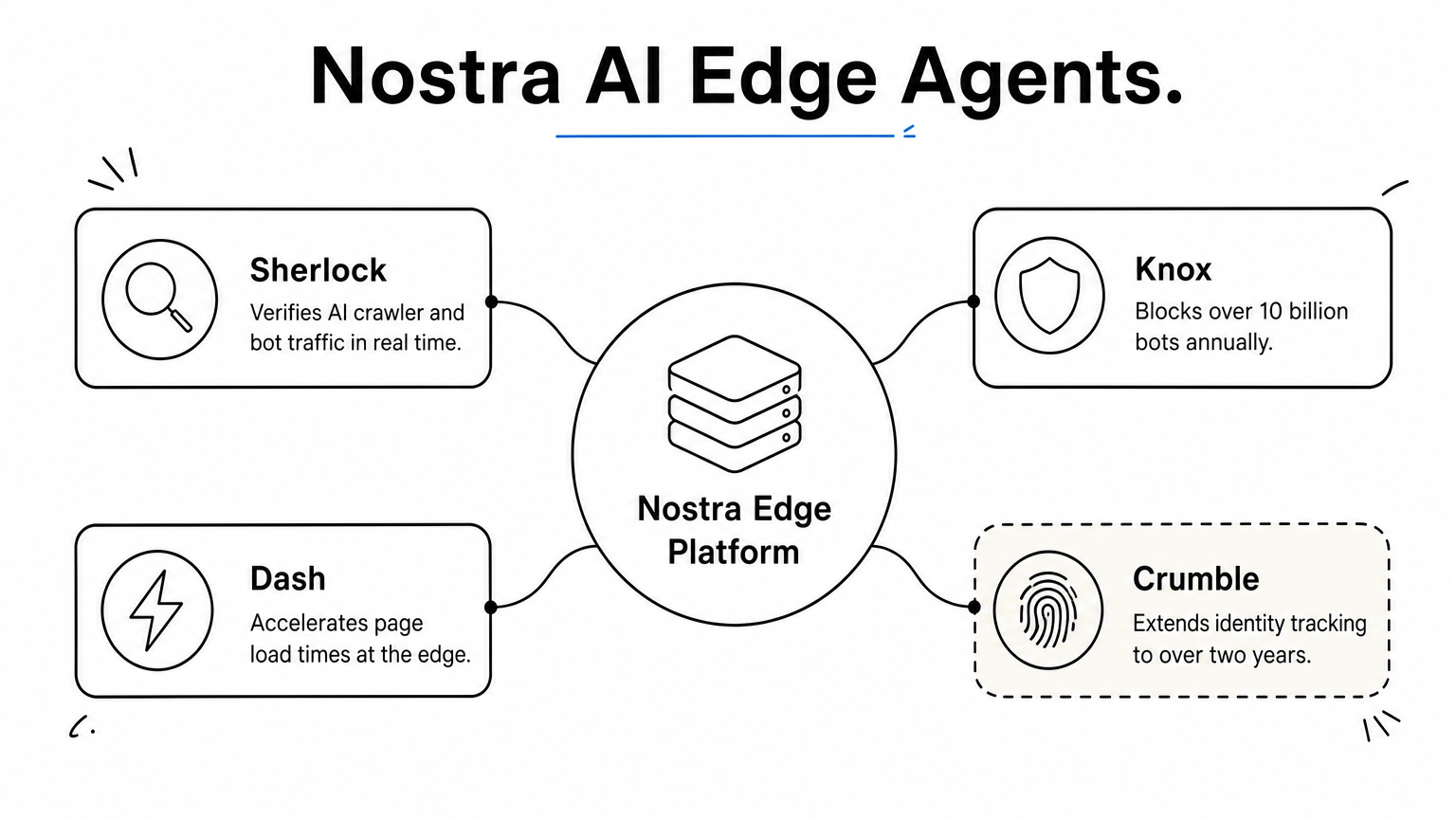
Nostra deploys through a single DNS-level change, no code changes, no replatforming, and no engineering sprint required. Once connected, the platform runs a two-week observation window where its agents learn your storefront's traffic patterns, page structure, and normal bot behavior before taking any action. The agent relevant here is Sherlock, the AI crawler detection agent behind Edge Detect, which identifies and verifies AI crawler and bot traffic in real time, separating GPTBot, PerplexityBot, ClaudeBot, and similar agents from generic scraper noise, then feeding that verified data into your AEO reporting.
You can't optimize for AI answer engines you can't even confirm are visiting your site.
That's the core problem Sherlock solves. Most analytics stacks lump AI crawlers in with regular bot traffic or miss them entirely, the same way bot traffic quietly skews Google Analytics, which means teams building AEO strategies are often working blind, guessing whether their citation efforts are landing anywhere.
Nostra AI fits ecommerce and DTC brands, along with the growth and engineering teams behind AI-focused tech products, who need a factual read on AI crawler activity before they invest in content or outreach. It suits teams that already rely on Meta, Google, Klaviyo, or GA4 for attribution and want AI traffic data feeding into that same picture rather than sitting in a separate, disconnected tool, which is also why Nostra streams edge-level data into AI discovery analytics tools like Profound. Companies without dedicated engineering resources tend to gravitate here specifically because deployment doesn't require a dev sprint, just a DNS change and a two-week wait.
Nostra AI doesn't publish flat public pricing, since deployments scale with traffic volume and which agents you activate. Most brands start with a scoping call, move through the DNS-level setup, and land in a monthly plan once the observation window confirms baseline traffic patterns. If you want a concrete number for your storefront's traffic profile, request a demo through Nostra AI directly rather than estimating from a generic tier chart, since bot volume and crawler mix vary too much brand to brand for one-size pricing to mean much.
Omnius runs as a dedicated AEO agency built around one narrow bet: B2B SaaS and fintech brands need their product mentioned by name when a prospect asks ChatGPT or Perplexity a buying question. Rather than spreading effort across every industry, the team specializes in technical and financial products where a single AI citation can influence a six-figure purchase decision. That focus shows up in how deeply they map the specific questions your buyers ask before a demo call.
Omnius starts each engagement by auditing where your brand currently shows up (or doesn't) across ChatGPT, Perplexity, and Google's AI Overviews for a defined list of buyer-intent queries. From there, the team builds and places content designed to earn citations, often through structured comparison pages, technical explainers, and third-party mentions that AI models tend to pull from when answering product questions. Reporting centers on citation frequency, tracking whether your brand's mention rate improves month over month against named competitors.
A citation inside an AI answer only counts if it shows up when your actual buyers are asking.
That distinction matters because generic visibility gains don't always translate to pipeline, and Omnius builds its query lists around real sales conversations rather than broad keyword volume.
Omnius suits venture-backed SaaS and fintech companies with an established content team already producing some volume of blog and product content. It works best for brands with a defined ideal customer profile and a sales team that can confirm which AI-sourced leads actually convert, since the agency's reporting leans heavily on that feedback loop.
Omnius works on custom retainer pricing, typically scoped after an initial audit call, with most engagements running as multi-month contracts rather than one-off projects. Exact figures aren't published publicly, so budget for a discovery call before you get a real number.
Position Digital built its practice around generative engine optimization (GEO), a term the agency uses almost interchangeably with AEO, applied specifically to early and growth-stage B2B SaaS startups. Founders often come to them after noticing organic search traffic plateauing while competitors start showing up inside AI-generated answers, and the agency positions itself as the team that catches that shift before it shows up in a board deck.
Position Digital opens engagements with a technical content audit, checking whether your existing pages are structured in a way large language models can parse cleanly, things like clear headers, direct answers near the top, and schema markup that machines can actually read. From there, the team restructures priority pages and builds new ones aimed at the exact questions a buyer types into ChatGPT during evaluation, then tracks whether those pages start surfacing in AI-generated responses over the following weeks.
Ranking on Google means nothing if the AI answer never quotes your page.
That's the shift Position Digital keeps circling back to with clients: traditional SEO wins don't automatically carry over into AI citations, so the content has to be rebuilt with that gap in mind.
This agency fits seed to Series B SaaS startups that already have a content engine running but lack the internal expertise to adapt it for AI answer engines. Startups without an in-house SEO lead tend to lean on Position Digital the most, since the agency effectively fills that strategic role rather than just executing tasks handed down from an internal team.
Position Digital publishes tiered monthly packages rather than requiring a custom quote for every client, which makes it easier for early-stage startups to budget without a lengthy sales cycle. Higher tiers add more content volume and deeper technical work, so most startups start small and scale spend as citation results start showing up.
Scalerrs pitches itself as an agency that treats AI answer engines as one more traffic surface to measure, not a separate discipline that gets its own siloed report. The team built its reputation on pipeline attribution for traditional SEO, and it carried that same rigor into tracking citations across ChatGPT, Perplexity, and AI Overviews. For B2B software companies already frustrated by vague "visibility improved" reporting from other vendors, that attribution focus is the draw.

Scalerrs runs a multi-surface tracking system that pulls data from organic search, AI answer engines, and paid channels into one dashboard, then ties each source back to actual pipeline and revenue rather than stopping at impressions or citation counts. Analysts map which content pieces get pulled into AI-generated answers, then cross-reference that against CRM data to see whether those citations correlate with demo requests or closed deals. Content production follows from that data instead of leading it, so new pages get built around whatever queries already show measurable pipeline influence.
A citation report means little without a line back to revenue, and Scalerrs builds that line first.
This agency suits mid-market and enterprise B2B software companies with an existing marketing operations setup and a CRM clean enough to support attribution modeling. Teams without that data infrastructure in place tend to get less value here, since Scalerrs' core advantage depends on connecting citation activity to a sales pipeline that's already tracked with reasonable accuracy.
Scalerrs works on custom monthly retainers, scoped after reviewing your current analytics and CRM setup, since the attribution modeling requires access to existing sales data before the team can quote accurately. Expect a discovery phase before any contract, and expect the retainer to scale with the complexity of your existing tech stack rather than a flat headcount-based tier.
Omniscient Digital built its name on long-form, research-backed content for B2B software companies, and it extended that same approach into generative engine optimization rather than bolting on a separate service line. The agency's pitch rests on a simple idea: AI answer engines still favor content that demonstrates real depth, so the fastest way to earn citations is to publish the kind of definitive resource a model would want to quote in the first place.
Omniscient starts with a content gap analysis, comparing what your site currently covers against the questions AI engines are already answering using competitor or third-party sources. Strategists then prioritize a handful of pillar pages, usually comparison guides, buyer's guides, and technical deep-dives, and rebuild them with the structure and sourcing that citation-heavy AI answers tend to reward. Editorial standards stay high throughout the process, since the agency's whole model depends on producing pages good enough that an AI engine picks them over a thinner competitor post.
Thin content might rank on Google for a week, but AI engines keep citing the page that actually answers the question completely.
That quality bar is the throughline across every engagement, whether the team is rewriting an existing page or building a new pillar from scratch.
This agency fits B2B software companies with a mature content function already producing regular blog output, since Omniscient works best layered on top of an existing editorial process rather than starting one from zero. Marketing teams that value long-term compounding content assets over quick citation wins tend to get the most out of this partnership.
Omniscient Digital works on custom monthly retainers, typically scoped after a content and citation audit, with most engagements running as multi-month commitments given the research and writing timelines involved. Expect a proposal tailored to your current content maturity rather than a published rate card.
Mint Position takes a different angle than most agencies on this list by treating AI answer engine optimization like a newsroom problem rather than a marketing one. The team leans on former journalists and editors to build content that reads like reporting, not sales copy, on the theory that AI models weigh source credibility the same way a human fact-checker would. Brands searching for answer engine optimization services that skip the generic marketing tone tend to land here first.
Editors at Mint Position start by identifying which of your existing pages already carry journalistic weight, meaning original data, expert quotes, or firsthand testing, since those are the pages AI engines are more likely to cite over a competitor's marketing page. From there, the team fills gaps with new reported pieces: original surveys, interviews with product experts, and data-backed comparisons that read closer to a trade publication than a typical blog post. Distribution matters here too, since Mint Position pushes finished pieces toward outlets and newsletters that AI crawlers already treat as trustworthy sources.
AI models cite sources the same way readers trust them: based on credibility signals, not keyword density.
That's the bet Mint Position makes with every client, and it shapes how the team prioritizes work over pure output volume.
Fintech and B2B tech brands with a story worth telling, meaning real data, real users, or a real point of view, get the most value from Mint Position. Companies chasing volume over credibility tend to clash with the agency's slower, research-heavy process, since each piece takes longer to produce than a standard SEO blog post.
Mint Position works on project-based and retainer pricing, scoped after reviewing your existing content and available data assets, since original research pieces take longer to price than standard blog work. Expect a proposal rather than a published rate card, with timelines stretching longer than typical content agencies given the reporting involved.
iPullRank built its reputation on technical SEO before AEO existed as a term, and that background shows in how the agency approaches AI answer engines: as a relevance problem to be engineered, not a content problem to be written around. The team calls its methodology "relevance engineering," a mix of information retrieval theory and machine learning concepts applied to the question of why a large language model picks one source over another. For tech companies with genuinely complex products, that depth of technical grounding is often the reason they choose iPullRank over a more content-focused shop.
iPullRank starts by reverse-engineering how AI models actually retrieve and rank content, drawing on vector embeddings, semantic relevance scoring, and retrieval-augmented generation patterns to figure out why competitor pages get cited and yours don't. Engineers then restructure your content's underlying data, schema, and internal linking so it maps more closely to how models chunk and retrieve information, rather than just rewriting sentences to sound more authoritative. This work sits closer to a technical audit than a copywriting sprint, and it often involves site architecture changes that a typical content agency wouldn't touch.
If a model can't parse how your content chunks into retrievable pieces, better writing alone won't earn the citation.
That's the core argument behind relevance engineering, and it's a genuinely different lens than the editorial approach most AEO agencies bring to the table.
iPullRank fits technical products with genuinely complex documentation, think developer tools, data platforms, or infrastructure software, where the barrier to AI citation is structural rather than editorial. Marketing teams without an in-house technical SEO resource lean on iPullRank specifically to fill that gap, since the agency's staff include former engineers comfortable discussing embeddings and retrieval models directly with a client's dev team.
iPullRank works on custom project and retainer pricing, scoped after a technical audit that usually takes several weeks given the depth of analysis involved. Expect a proposal built around your specific stack rather than a published tier chart, since the scope varies heavily by how complex your existing site architecture already is.
Respona started as a digital PR and link-building platform, and it's since built out features specifically for tracking whether those earned placements turn into AI citations. Instead of pitching itself as a full-service agency, Respona sells software that automates outreach to publications likely to produce the exact listicles and roundups that ChatGPT and Perplexity pull from when answering product comparison questions. Tech companies chasing answer engine optimization for ai focused tech through earned media placements tend to find Respona faster than they find a comparable agency.
Respona's platform searches for journalists, bloggers, and publication editors already writing listicles in your product category, then automates personalized outreach at a scale a single marketer couldn't manage manually. Once a placement lands, the platform's citation tracking module checks whether that specific article shows up as a source inside AI-generated answers, giving you a direct line between a placement and an actual citation instead of a vague brand-awareness metric.
A backlink is worth little on its own, but a listicle placement that an AI model actually cites changes the math completely.
That distinction is what separates Respona from a generic PR tool: it's built around AI citation as the end goal, not just domain authority or referral traffic.
Marketing teams running their own outreach rather than outsourcing to an agency get the most value from Respona, since the platform requires someone in-house to manage campaigns and vet placement opportunities. It suits tech and SaaS companies with a marketer comfortable doing hands-on prospecting, not brands looking for a fully managed service.
Respona publishes tiered subscription pricing starting in the low hundreds per month, scaling up based on contact volume and number of active campaigns. Higher tiers unlock more outreach volume and additional citation tracking features, making it one of the more transparently priced options on this list.
Single Grain built its name running paid media and growth campaigns long before AEO existed as a category, and that background shapes how the agency treats AI answer visibility today: as one lever inside a broader growth stack, not a standalone discipline. Founders and marketing leads searching for the best answer engine optimization for ai focused tech often land here because they already want paid, organic, and AI citation work managed under one roof instead of coordinating three separate vendors.
Single Grain starts engagements by auditing existing paid and organic performance, then layers AI citation tracking on top so the team can see where AI-driven visibility overlaps with paid search and retargeting spend. Strategists build content aimed at AI answer engines while simultaneously testing paid placements around the same buyer questions, comparing which channel actually drives qualified traffic faster. That combined view lets the agency shift budget between paid and organic AEO work based on real performance data rather than running each channel in isolation.
Treating AI citations and paid spend as separate budgets misses how often they influence the same buying decision.
That overlap is the whole argument behind Single Grain's model, and it's a genuinely different structure than the content-only agencies earlier on this list.
Growth-stage tech and SaaS companies already spending meaningfully on paid acquisition tend to get the most value here, since Single Grain's advantage depends on having both channels running simultaneously. Companies without an existing paid budget will still get AEO work, but they'll miss the cross-channel optimization that makes this agency distinct from a pure content shop.
Single Grain works on custom monthly retainers, typically scoped after a review of current paid spend and content output, with minimums that price out smaller startups without existing ad budgets. Expect a proposal built around your total growth spend rather than a flat AEO-only rate card.
Seer Interactive built its name as a large-scale SEO agency serving enterprise brands, and it's carried that same testing rigor into generative engine optimization rather than treating AI citations as a side project bolted onto existing retainers. The agency runs structured experiments to figure out what actually moves the needle inside AI-generated answers, publishing much of that research publicly, which gives enterprise teams evaluating answer engine optimization for ai focused tech an unusually transparent look at methodology before signing anything.
Seer treats GEO like a testing discipline first. Analysts form a hypothesis (say, whether adding FAQ schema increases citation rate for a given page type), run it across a sample of pages, then measure citation frequency shifts across ChatGPT, Perplexity, and Google's AI Overviews before rolling the change out site-wide. That test-and-scale approach mirrors how the agency has long handled traditional SEO experiments, just pointed at a new set of outputs. Reporting stays quantitative throughout, with dashboards built for marketing leadership that need to justify spend to a CFO, not just a marketing director.
Guessing what earns an AI citation wastes budget; testing it at scale tells you what actually works before you roll it out everywhere.
Seer fits large enterprise brands with sizable content libraries and the traffic volume needed to make experimentation statistically meaningful. Smaller startups with only a handful of pages won't generate enough data for Seer's testing model to produce reliable answers, so this agency suits companies already running SEO programs at scale who want GEO layered on with the same rigor.
Seer Interactive works on custom enterprise retainers, scoped after reviewing existing content volume and traffic data, with pricing sitting well above smaller boutique agencies given the scale of testing involved. Expect a longer sales process and a proposal built around your specific content library rather than a flat rate.
Matching a vendor to your stage matters more than picking the agency with the longest client list. A seed-stage startup needs Position Digital's scaled pricing, not Seer Interactive's enterprise testing budget. A brand already spending on paid media gets more from Single Grain than from a pure content shop like Omniscient Digital. And if you're still guessing whether GPTBot or ClaudeBot even visits your storefront, let alone whether you should block AI crawlers at all, no amount of content strategy fixes that gap.
Start with verified data, not assumptions. Every agency on this list builds citation strategy on top of traffic patterns you should already be measuring yourself, including which AI crawlers hit your pages and how often. That's the layer most teams skip, and it's exactly what determines whether your content investment lands anywhere at all.
Before you sign a retainer, confirm the baseline. Book a demo with Nostra and see which AI crawlers are actually reading your site right now.


.svg)
