Bots now account for roughly half of all web traffic, and a large share of it is hostile. Scrapers copy your catalog, credential stuffers hit your login, and fake sessions inflate your analytics while draining ad budget. If you run an online store, bot detection software is no longer optional. The hard part is picking a tool that stops bad traffic without blocking real shoppers.
Here is the short answer. The best bot detection software for you depends on what you need to protect: a storefront, a mobile app, or an API. Enterprise platforms cover all three but need engineering time. Lighter tools and a few free options cover basic needs, though they often miss sophisticated bots that mimic human behavior.
Below, you'll find six tools compared on detection accuracy, setup effort, coverage, and pricing. We build Knox at Nostra AI, an edge agent that blocks malicious bots with only a DNS change, so we know what deployment friction really costs. Use this list to shortlist two or three tools and test them against your own traffic.
Knox is the bot agent inside Nostra AI. It runs at the edge of your storefront, so malicious requests are stopped before they reach your site, your analytics, or your ad platforms. Setup is a DNS-level change on day 1. You write no code, replatform nothing, and take on no downtime.

During days 2 to 14, the agent observes your traffic and learns what normal shoppers look like on your store. After that, it enforces automatically. Across 300+ brands, Nostra AI blocks over 10 billion bots a year. For teams shopping for website bot detection software, the payoff is cleaner sessions, honest conversion rates, and less wasted ad spend.
Knox stops bad bots at the edge, before they can distort your analytics or burn your ad budget.
Knox suits mid-size to large ecommerce and DTC brands that want protection without an engineering project. It is also a strong match if bot-inflated analytics are corrupting your decisions. You will likely get the most from it if:
Knox has no free tier. It is one of five agents on the Nostra AI platform, and pricing is handled through a quote, not a self-serve checkout. Check current terms with the Nostra AI team before you budget.
If you only need a stopgap, a basic CDN-level bot filter can catch simple scrapers for free. Expect sophisticated bots that mimic human behavior to slip past it, which is the gap a paid agent like Knox is meant to close.
Knox is built for ecommerce storefronts. If your biggest exposure is a native mobile app or a standalone API, a tool with in-app SDKs will fit better. Keep storefront-first coverage in mind when you compare.
The first two weeks are also an observation window. Plan for enforcement to ramp up, not switch on instantly, and review the results once the agent has learned your store.
Cloudflare gives every request a score from 1 to 99 that shows how likely it is automated. The score blends machine learning, behavioral analysis, and fingerprinting, trained on traffic from the large share of the web that runs through its network. You then write rules that allow, challenge, or block requests based on that score.
A bot score only protects you when you turn it into rules you have tested against real shoppers.
This tool fits large enterprises with in-house security engineers who want granular control. It works well when you already route traffic through Cloudflare and need one policy layer across sites, apps, and APIs.
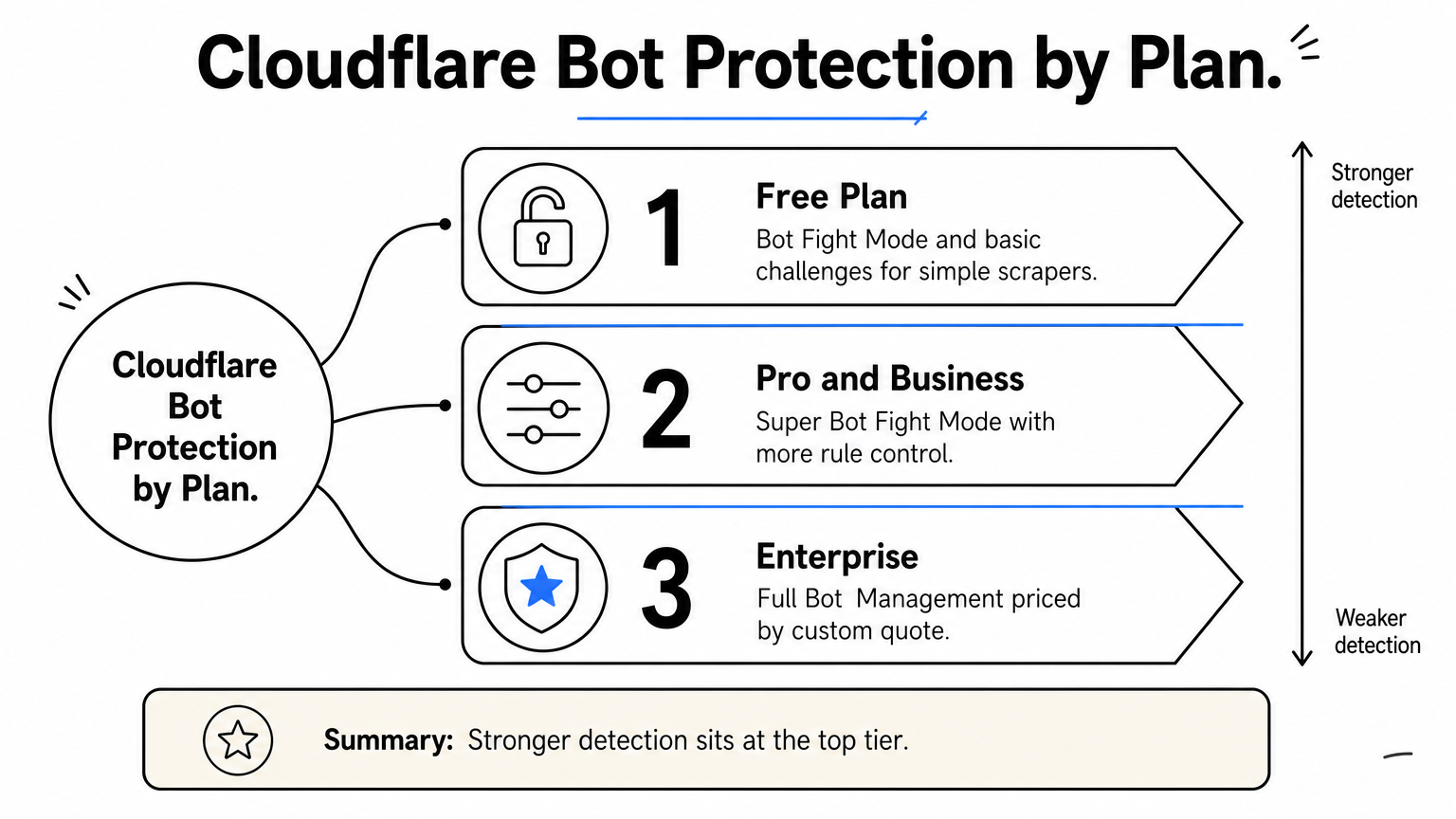
Cloudflare offers the most generous free entry on this list, but the strongest detection sits at the top tier. Plans break down like this:
| Plan | Bot protection |
|---|---|
| Free | Bot Fight Mode, basic challenges |
| Pro and Business | Super Bot Fight Mode, more rule control |
| Enterprise | Full Bot Management, custom quote |
Full Bot Management is an Enterprise add-on, so smaller stores often never get past the free filters, which is why many compare Cloudflare alternatives for Shopify bot protection. Those filters stop simple scrapers but struggle with human-like bots.
Tuning also takes work. You need someone to review scores, write rules, and tune challenges so real customers are not blocked at checkout. Without that person, you buy the tool but never get its full value.
DataDome inspects each request in real time and scores it using machine learning plus behavioral and device signals. Its SDKs cover websites, mobile apps, and APIs. The vendor advertises decisions in about two milliseconds, so shoppers rarely notice the check. Suspicious sessions get blocked or challenged.
DataDome's edge is coverage: one engine watching your site, your app, and your API.
Teams with a mobile app or exposed APIs alongside a website should look here first. It also suits companies that want detailed threat reporting from a security team. It fits best when:
Pricing is quote-based and scales with traffic volume, so costs climb as your request count grows. DataDome has offered a free trial, which is the best way to test it on your own traffic. There is no permanent free plan, so confirm current terms before you commit.
Integration is not DNS-only, which is why some Shopify teams look for a DataDome alternative for Shopify. You deploy a module, SDK, or CDN connector, which means engineering time and testing before you see value.
Cost can also stretch a mid-size budget. Expect tuning for false positives during rollout, and check how challenges affect your checkout flow.
Akamai Bot Manager sorts traffic into known bots, such as search crawlers, and unknown bots. It then applies behavioral analysis, device fingerprinting, and machine learning to the unknown group. Client-side telemetry checks how a visitor moves and taps, which helps catch bots that imitate people.
Responses go beyond block or allow. You can monitor, challenge, slow down, or serve alternate content to a bot, so scrapers waste time instead of learning you caught them.
Akamai's strength is response choice: each bot can be blocked, slowed, or fed decoy content.
Large enterprises with heavy traffic get the most from it, especially global retailers, banks, and media sites that need granular policy control. It fits when:
Expect a custom enterprise quote that depends on traffic volume and the tier you choose. There is no free plan, and Akamai does not publish list prices, so request a proof of concept before you commit.
Power comes with complexity. Setup and tuning usually need security and engineering time, and a small team can struggle to get full value from the many policy options.
Budget is the other barrier. Mid-size stores often find the enterprise contract size hard to justify, and the platform is a heavier lift than a DNS-level change.
HUMAN Security was formed when White Ops and PerimeterX combined, and its Bot Defender product scores each request using behavioral analysis, machine learning, and device signals gathered on the client side. The vendor says it analyzes trillions of interactions every week, which feeds its models. Doubtful visitors often get a lightweight challenge, such as a press-and-hold test, instead of a hard block, so real shoppers can recover from a false flag.
HUMAN's edge is verification: it challenges doubtful visitors instead of blocking them outright.
Mid-market and enterprise teams that treat this kind of bot detection software as part of fraud prevention should look closely. It is strongest against account takeover, carding, and scraping. It fits when:
Pricing is quote-based and tied to traffic volume, and there is no permanent free plan. Ask for a demo or proof of concept, then test it on your own traffic before you sign.
Expect an integration through a sensor, SDK, or CDN connector, so engineering time is part of the real cost. The reporting is also built for security analysts. If your goal is cleaner marketing analytics and less wasted ad spend, you may find it heavier than you need, and the rollout slower than a DNS-level change.
Fingerprint takes a different route from the rest of this list. It is a device intelligence platform that gives each visitor a persistent identifier built from browser and device signals. It then adds Smart Signals such as bot detection, browser tampering, VPN use, and incognito mode. You decide what to do with those signals in your own code, so Fingerprint identifies and flags rather than blocking on its own.
Fingerprint tells you who is visiting, and your own code decides what happens next.
Developer-led teams that need to stop fraud tied to repeat devices should look here first. It is a strong fit when:
The open-source FingerprintJS library is free, but it is less accurate than the paid product. The commercial platform has offered a free trial and usage-based plans, with custom quotes at higher volume. Confirm current terms on the vendor's site before you budget.
This is a signal provider, not a managed bot filter. You build the rules, challenges, and responses yourself, so engineering time is part of the cost.
Marketing analytics are the other gap. Bot sessions still reach your ad platforms and reports unless you block them in code. If you want hands-off protection for a storefront, a managed edge agent is the simpler fit.
The right bot detection software comes down to where your exposure sits. If you run apps and APIs with a security team behind you, Cloudflare, DataDome, Akamai, or HUMAN give you deep control. If repeat-device fraud is your problem and you have engineers, Fingerprint supplies the signals.
Storefront teams face a different tradeoff. Most of these tools demand engineering time before they pay off, and bot-inflated analytics keep skewing your decisions while you wait. Whatever you pick, test it against your own traffic and watch your checkout for false positives.
If you want protection live without a code change, see how Nostra AI Edge Protect stops bad bots before they reach your site, your reports, or your ad spend.


.svg)
