Picking from dozens of tools is the hard part. Every vendor claims better rankings, and most pages you find are written by the vendors themselves. Meanwhile, search now splits between Google and answer engines like ChatGPT and Perplexity, so a tool that only scores keyword density leaves you half-covered.
Here is the short answer. The top AI content optimization tools for search engine visibility fall into two groups: on-page editors such as Surfer and Clearscope, and platforms that also track AI search visibility, such as Semrush and Writesonic. Most teams need one from each group, not twelve. Match the tool to your bottleneck: drafting, optimizing, or measuring.
Below, you get 12 tools ranked by what they do best, who they fit, and where they fall short. We also cover a gap most lists ignore. At Nostra AI, we see that AI crawler traffic and bot noise can distort the data you use to judge content. Our Sherlock agent verifies which AI bots actually visit your store, so your optimization decisions rest on real numbers.
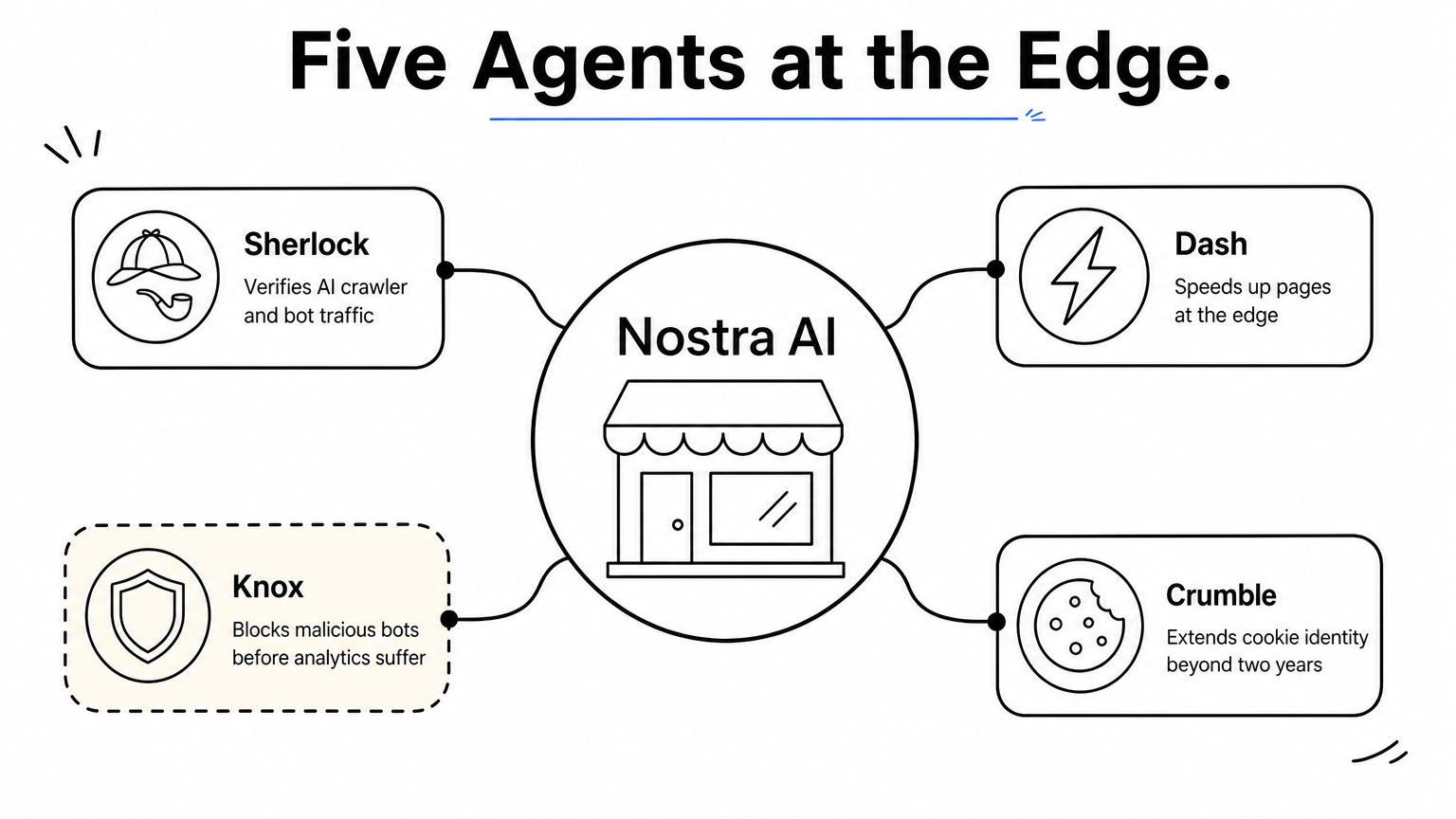
Among the top AI content optimization tools for search engine visibility, Nostra AI is the odd one out. It does not write or score your copy. It runs five AI agents at the edge of your ecommerce storefront, so the traffic and speed data behind your content decisions is accurate. Deployment takes a DNS-level change, with no code changes or replatforming.
That matters more than it sounds. Bots inflate sessions, slow pages drag down conversion, and AI crawlers rarely show up cleanly in GA4. If you optimize content against that data, you optimize against noise.
Content optimization only pays off when the traffic data behind it is real.
Ecommerce and DTC brands that already have content and want to know whether it works. It suits growth, ecommerce, and digital operations leaders who have no spare engineering capacity. Over 300 brands use it, including U Beauty, Nixon, and Credo Beauty. Blog-first publishers will get less from it.
Each agent handles one job, and Sherlock is the one that matters most for AI search visibility. Here is the full set:
Setup follows a fixed timeline. You connect DNS on day 1, the agents learn your store during days 2 to 14, and automated optimization and enforcement continue after that. The platform is SOC 2 compliant.
Nostra AI will not draft an article, suggest headings, or grade your topical coverage. You still need an editor such as Surfer or Clearscope for that. It is also built for ecommerce storefronts, so it is a poor fit for a lead-gen site or a media business. Finally, the benefits build after the two-week observation window, not on day one.
Pricing is not listed as a public price table. Plans are quoted per store, so request a quote on the Nostra AI site and ask what traffic volume the quote assumes.
Surfer is an on-page editor that scores your draft against the pages already ranking for your keyword. You write or paste content, and it shows which terms, headings, and word counts the top results use. Among the top AI content optimization tools for search engine visibility, it is the one most writers learn first.
Newer versions also cover AI search visibility. The AI Tracker checks whether your brand appears in answers from tools like ChatGPT.
A Surfer score shows how closely you match the SERP, not whether readers will trust you.
Content teams and agencies that publish at volume benefit most. They get a repeatable optimization workflow that new writers can follow without training.
Freelancers and in-house marketers fit too, especially if you work in Google Docs or WordPress and want fast, visual guidance instead of manual SERP analysis.
Surfer packs several tools into one subscription, and the Content Editor is the core. Here is what you get:
Chasing the score is the biggest trap. Writers stuff in terms to hit 80 or higher, and the copy reads stiff. Surfer also rewards matching competitors, so it rarely pushes you toward original insight.
It cannot tell you whether the traffic behind your results is human, either. Bot sessions and unverified AI crawlers still skew your analytics, which is where Sherlock from Nostra AI fills the gap. The AI Tracker is a paid add-on, and heavy users can hit article limits on lower plans.
Plans start around $99 per month, with discounts for annual billing. Prices change often, so confirm on Surfer's site before you buy.
| Plan | Approx. monthly price | Best fit |
|---|---|---|
| Essential | $99 | Solo writers and small blogs |
| Scale | $219 | Teams publishing weekly |
| Enterprise | Custom | Agencies and large sites |
The AI Tracker is billed separately, starting near $95 per month.
Clearscope is a content grading tool built on one idea: cover the topic the way top-ranking pages do. You enter a keyword, it pulls the terms and questions that matter, and it grades your draft from F to A++ as you write.
It is one of the top AI content optimization tools for search engine visibility if you care about editorial quality. The interface is plain, and the term suggestions are based on relevance, not raw frequency counts.
Clearscope tells you what a complete answer includes, not how to make it original.
Established content teams, enterprise SEO groups, and publishers get the most from it. They value a clean editing experience over a long feature list. Editors like that writers have one clear grade to hit before handoff.
Most of the value sits in a short, focused feature set:
Price is the main hurdle. Clearscope costs more than most tools on this list, and report limits cap how many articles you can optimize each month.
It also does little beyond optimization. There is no built-in drafting, no keyword gap analysis, and no backlink data, so you will pair it with a writer or another platform.
Clearscope sells access by plan and report volume. Prices shift, so confirm current rates on its site before you commit.
| Plan | Approx. monthly price | Best fit |
|---|---|---|
| Essentials | $189 | Small teams, steady output |
| Business | $399 | Larger content programs |
| Enterprise | Custom | Publishers and multi-site brands |

Semrush One bundles the classic Semrush SEO toolkit with an AI visibility toolkit in a single subscription. You research keywords, audit your site, and optimize drafts. Then you see whether ChatGPT, Google AI Overviews, and other engines mention your brand. Among the top AI content optimization tools for search engine visibility, it has the widest scope on this list.
Semrush One puts classic SEO data and AI visibility tracking under one login.
Marketing teams that want one platform instead of five will get the most from it. It also suits agencies and SEO generalists who need competitor and backlink data next to their content tools, not in a separate tab.
Five pieces matter most for content work:
Breadth brings complexity. New users face a steep learning curve, and the dashboard can feel crowded if you only want an editor. Content scoring is less refined than Clearscope, so writers often get blunt suggestions.
Costs also climb as you add users, domains, and tracked AI prompts, which is where add-on charges surprise most teams.
Plans are billed monthly or annually, with annual billing cheaper. The figures below are approximate, so confirm current rates on Semrush's site.
| Plan | Approx. monthly price | Best fit |
|---|---|---|
| Starter | $199 | Small teams, one site |
| Pro+ | $299 | Growing content programs |
| Advanced | $549 | Agencies and multi-brand teams |
Rankability is an NLP-driven content optimizer that grades your draft against the top-ranking pages for a target keyword. Among the top AI content optimization tools for search engine visibility, it is a leaner, newer alternative to Surfer. It also includes an AI Analyzer that checks whether your brand appears in answers from ChatGPT and similar engines.
Scoring leans on term and entity analysis, so you see which topics your draft misses compared with the pages above you.
Rankability pairs a familiar on-page score with a basic check of your AI answer visibility.
Small content teams, freelancers, and boutique agencies get the most from it. You want SERP-based guidance without paying enterprise prices.
It also fits teams that want one editor and one AI visibility check in the same subscription, rather than stitching two vendors together.
The core workflow is brief, write, score, and track:
Rankability has a smaller track record than Surfer, Clearscope, or Semrush. Fewer reviews and integrations mean you should run a trial on real articles before you commit.
Like every score-based editor, it rewards matching competitors. Its AI visibility data also cannot separate real users from bots, so pair it with verified traffic data from a tool like Nostra AI's Sherlock agent.
Plans are tiered by seats and usage, and the AI Analyzer may be priced separately. The figures below are approximate, so confirm current rates on Rankability's site.
| Plan | Approx. monthly price | Best fit |
|---|---|---|
| Core | $149 | Solo writers, small sites |
| Pro | $299 | Small teams and agencies |
| Enterprise | Custom | Larger content programs |
Frase turns a keyword into a research brief, a draft, and an optimized page in one workspace. You enter a topic, it pulls the top results, and it extracts their headings, questions, and key terms. Among the top AI content optimization tools for search engine visibility, it is one of the fastest ways to go from keyword to outline. It also scores pages for AI answer engine readiness, so you can see how well your structure suits tools like ChatGPT and Perplexity.
Frase is a brief-first tool: it saves you the research hours before it helps you write.
Solo marketers, small teams, and agencies on a budget get the most from it. If you spend hours reading competitor pages to build outlines, you will cut that time sharply. It also suits writers who want a lower-cost alternative to Clearscope or Surfer.
Research is the strongest part of the product, and the editor builds on it. Here is what you get:
Frase is less polished than the bigger platforms. Term suggestions can feel broader and less precise than Clearscope's, and AI drafts usually need a heavy edit before they sound like your brand. Its AI visibility data also cannot separate real visitors from bots, so verify your traffic with a tool like Nostra AI's Sherlock agent. Competitor backlink data is missing too.
Entry plans sit well under $100 per month, which makes Frase one of the cheapest options on this list. Higher tiers add seats, more articles, and AI visibility tracking. Prices and plan names change often, so confirm current rates on Frase's site before you commit.
Writesonic started as an AI writing assistant and now positions itself as a platform for generative engine optimization. You draft and optimize content, then check how often ChatGPT, Perplexity, Gemini, and Google AI Overviews cite your brand. It earns its place among the top AI content optimization tools for search engine visibility because it links tracking to the fix.
Writesonic tries to close the loop from an AI visibility gap to a finished draft.
Marketing teams that want drafting and AI visibility tracking in one subscription get the most value. Lean teams without a dedicated SEO also fit, since the platform suggests which pages to create or update once it spots a gap.
Tracking and content creation sit side by side, and the Action Center ties them together. Here is what you get:
Depth in each area trails the specialists. Its SEO scoring is less rigorous than Clearscope or Surfer, and AI drafts need a careful fact check before publishing. Credit-based plans can also run out quickly if you publish heavily.
Like other trackers, it cannot verify which AI crawlers actually hit your pages. For ecommerce storefronts, Sherlock from Nostra AI covers that gap.
Paid plans start around $49 per month, with discounts for annual billing. Tracking depth, such as the number of monitored prompts, rises with each tier. The figures below are approximate, so confirm current rates on Writesonic's site.
| Plan | Approx. monthly price | Best fit |
|---|---|---|
| Lite | $49 | Solo marketers |
| Standard | $99 | Small teams |
| Professional | $249 | Growing content programs |
| Enterprise | Custom | Agencies and large brands |
Ahrefs AI Content Helper is an editor inside the Ahrefs platform. You enter a keyword, it analyzes the top-ranking pages, and it grades your draft on topic coverage with a content score. Among the top AI content optimization tools for search engine visibility, it stands out because the suggestions sit beside Ahrefs' backlink and traffic data.
AI Content Helper grades topic coverage, then leaves the original thinking to you.
Teams that already pay for Ahrefs get the most value, since the editor is a low-effort add-on to tools they use daily. You skip a new login and a new vendor.
SEO-led marketers and agencies also fit. If you decide what to write from keyword difficulty and link data, a content grader in the same account keeps the workflow tight.
The editor is simple, and the data behind it is the real draw. Here is what you get:
AI Content Helper is lighter than Clearscope or Surfer. Term guidance is less granular, and drafting support is thin, so you still need a writer or another assistant.
Costs add up quickly if you only want the editor. Ahrefs is a full SEO suite, and Brand Radar is billed on top. Like other trackers, it cannot confirm which AI crawlers actually visit your store, which is where Sherlock from Nostra AI helps.
Content Helper comes with paid Ahrefs plans. The figures below are approximate, so confirm current rates on Ahrefs' site. Brand Radar costs extra.
| Plan | Approx. monthly price | Best fit |
|---|---|---|
| Lite | $129 | Small sites, solo marketers |
| Standard | $249 | Growing content programs |
| Advanced | $449 | Agencies and larger teams |
| Enterprise | $1,499 | Large organizations |
SE Ranking is an all-in-one SEO platform with a content editor and an AI search toolkit built in. You track rankings, audit your site, and optimize drafts under one login. Among the top AI content optimization tools for search engine visibility, it is the budget-friendly alternative to Semrush. Its AI Search toolkit also shows how your brand appears in ChatGPT, Gemini, Perplexity, and Google AI Overviews.
SE Ranking gives you Semrush-style breadth at a noticeably lower monthly cost.
Small agencies, freelancers, and in-house teams get the most from it. You want rank tracking, audits, and content tools without a $200 monthly bill.
Agencies also like the white-label reporting, which saves hours of client reporting each month.
Content tools sit next to the research data, and the AI Search toolkit is the newest piece. Here is what you get:
Scoring is less refined than Clearscope or Surfer, so editorial guidance feels more generic. AI drafts also need a heavy edit and fact check before publishing.
Data on AI visibility is limited to what the tracker samples, and it cannot verify which AI crawlers actually visit your pages. For ecommerce storefronts, Sherlock from Nostra AI fills that gap. The AI Search toolkit is also a separate paid add-on on most plans.
Plans scale with tracked keywords, projects, and users. The figures below are approximate, so confirm current rates on SE Ranking's site. The AI Search add-on starts near $89 per month.
| Plan | Approx. monthly price | Best fit |
|---|---|---|
| Essential | $65 | Solo marketers, small sites |
| Pro | $119 | Growing content programs |
| Business | $259 | Agencies and larger teams |
MarketMuse is a content intelligence platform that models topical authority across your whole site, not just one page. It scans your inventory, compares it with competitors, and tells you which topics to cover next. Among the top AI content optimization tools for search engine visibility, it is the most strategic pick for planning.
Its Personalized Difficulty score estimates how hard a topic is for your specific domain, which beats a generic keyword difficulty number.
MarketMuse decides what you should write next, while most editors only grade what you already wrote.
Enterprise content teams, publishers, and large ecommerce blogs with hundreds of URLs get the most value. You need site-wide planning and a strategist who can act on it. Small blogs with a handful of posts will find it too heavy.
The platform covers planning, briefing, and optimization, and topic models drive all of it. Here is what you get:
MarketMuse has a steep learning curve, and the interface asks more of you than Clearscope or Surfer. Value drops quickly if you only publish a few articles a month.
AI answer tracking is not its focus, so you will need a separate tool to measure brand mentions in ChatGPT and similar engines. Like the others, it cannot verify which AI crawlers visit your store, which is where Sherlock from Nostra AI helps.
A limited free plan exists, and paid tiers scale with query volume and seats. The figures below are approximate, so confirm current rates on MarketMuse's site.
| Plan | Approx. monthly price | Best fit |
|---|---|---|
| Free | $0 | Testing a few queries |
| Standard | $149 | Small teams |
| Team | $399 | Growing content programs |
| Premium | $999 | Enterprise and publishers |
AirOps is a content engineering platform where you build AI workflows that research, draft, optimize, and refresh content at scale. Among the top AI content optimization tools for search engine visibility, it is the most programmable. You wire your own brand rules, data sources, and review steps into each run.
Its Insights module also tracks brand visibility in AI answers, then points to the pages worth updating.
AirOps is less an editor and more a factory you design around your own content standards.
Mature content and SEO operations teams get the most from it. If you publish hundreds of pages and need consistent quality without manual rework, building a workflow once pays off.
Growth teams with a technical marketer also fit. Someone has to design and maintain the workflows, so small teams without that person should look elsewhere.
The platform centers on workflows, and the visibility tracking feeds them. Here is what you get:
Power comes with setup time. Expect a learning curve before your first workflow produces publishable copy, and plan for human review on every draft.
It also does not verify who visits your pages. AI visibility data shows mentions, not which AI crawlers actually hit your store, so ecommerce teams should pair it with Sherlock from Nostra AI.
AirOps offers a free tier for testing, and paid plans scale with usage, seats, and tracked prompts. Higher tiers are quoted individually.
Prices and limits change often, so confirm current rates on AirOps' site and ask how task volume is counted.
Promptwatch is a generative engine optimization platform built around one question: where does your brand show up in AI answers, and where does it not? It tracks prompts across ChatGPT, Perplexity, Gemini, Claude, and Google AI Overviews. Among the top AI content optimization tools for search engine visibility, it is the most focused on the AI side of search.
Promptwatch shows you what AI engines say about you, then points to the content gap behind it.
Marketing and SEO teams that already have a Google workflow and now need dedicated AI visibility software get the most from it. Agencies fit too, because you can monitor several brands and report on citations. Teams that want a classic on-page editor should pair it with Surfer or Clearscope.
Tracking comes first, and the content tools build on it. Here is what you get:
Promptwatch is not an SEO suite. You get no backlink index and no deep keyword research, so you still need a Semrush or Ahrefs account for Google planning. Prompt results are also samples, and AI drafts need a careful human edit before publishing.
Crawler logs depend on how you connect your site. On a hosted ecommerce platform, verifying real AI bot traffic can be hard, which is where Sherlock from Nostra AI helps.
Plans scale with tracked prompts, sites, and seats. The figures below are approximate, so confirm current rates on Promptwatch's site and check how prompts are counted.
| Plan | Approx. monthly price | Best fit |
|---|---|---|
| Essential | $99 | Solo marketers, one site |
| Professional | $249 | Small teams, several sites |
| Business | $579 | Agencies and larger brands |
| Enterprise | Custom | Multi-brand organizations |
Start with your bottleneck, not the feature list. If you need on-page scoring, pick Surfer or Clearscope. If you want drafting and tracking together, look at Writesonic or Semrush One. For pure AI answer tracking, Promptwatch fits. The top AI content optimization tools for search engine visibility work best in pairs, so choose one editor and one tracker, then trial them on real articles.
Every tool here shares one blind spot. They trust your traffic data, yet bots and unverified AI crawlers distort that data before it reaches your reports. Content decisions built on inflated sessions waste budget and time.
Clean data comes first for ecommerce teams. Use Nostra AI's real-time AI bot filtering to block bad bots so your optimization work rests on real shopper behavior.


.svg)
