ChatGPT, Perplexity, and Google's AI Overviews are answering the questions your customers used to type into a search bar, and if your brand doesn't show up in those answers, you're losing traffic you never even see in your analytics. That's why more ecommerce and growth teams are hunting for leading software for ai visibility and generative engine optimization before their competitors lock down the mentions that matter. The problem is that most "GEO tools" on the market today are still bolting AI tracking onto old-school SEO dashboards, and it shows.
This list cuts through that noise. We compared AI crawler tracking against real GEO workflows, checking how each platform monitors citations, verifies bot traffic, and turns raw AI-visitor data into actions you can actually take on your storefront, not just another report nobody reads.
Below you'll find 12 top-rated platforms, from dedicated GEO specialists to broader AI search engine optimization tools, so you can match the right tool to your team's size, budget, and how deep you need to go into AI traffic verification and optimization.
Most generative engine optimization platforms tell you where you rank in AI answers, but they can't touch the storefront itself. Nostra AI closes that gap. It's an edge-based platform that runs five specialized AI agents directly in front of your ecommerce site, handling the technical groundwork that determines whether AI crawlers can even read your pages properly in the first place. If GPTBot, PerplexityBot, or Google's AI crawlers hit a slow page, get blocked by a bot filter you never reviewed for AI crawler access, or choke on a broken checkout flow, none of your content strategy matters. Nostra fixes that layer before it becomes a visibility problem.
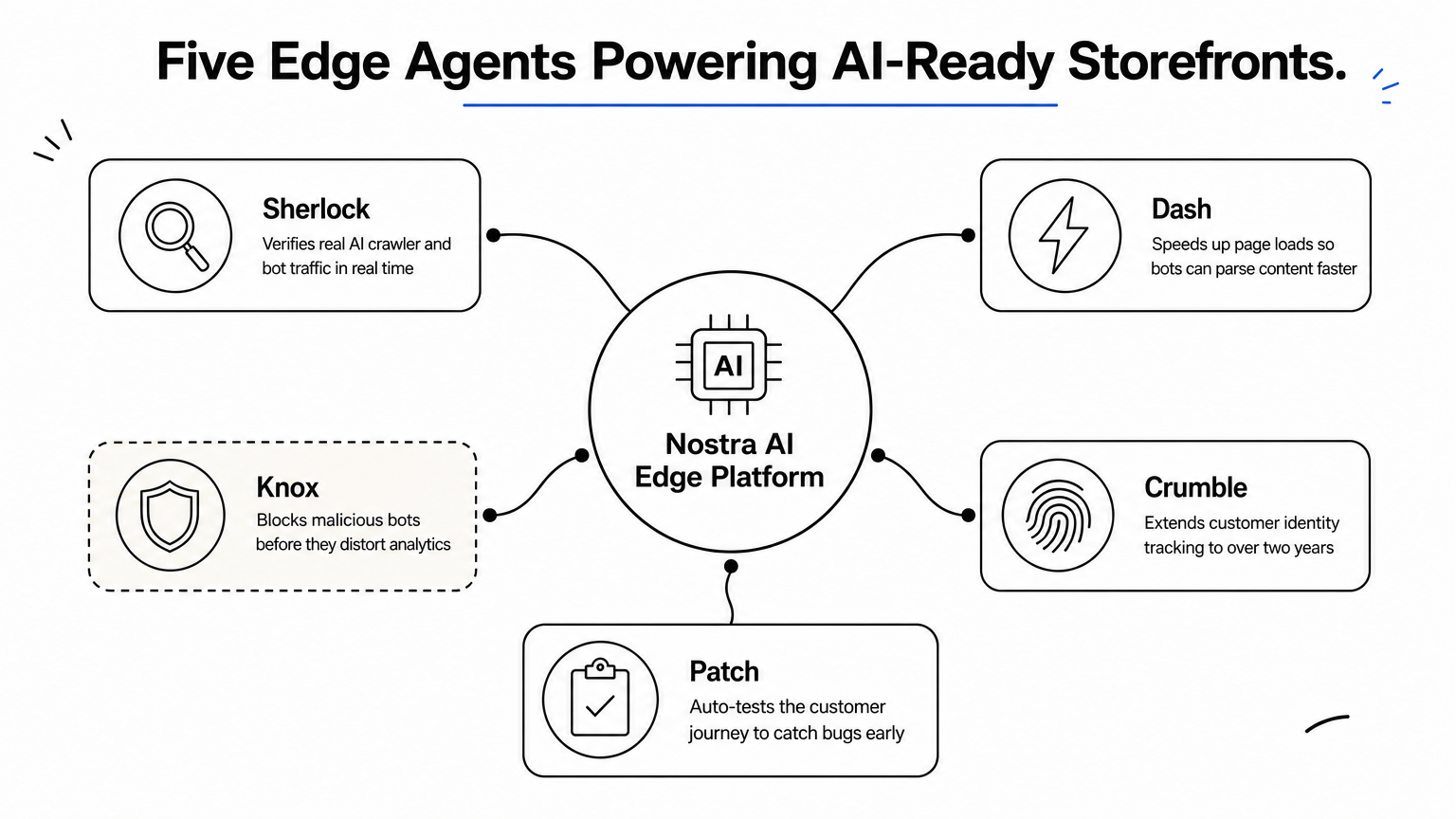
Nostra deploys through a single DNS-level change, no code changes, no replatforming, no engineering sprint required. Once connected, the platform spends roughly two weeks observing your store's traffic patterns and page behavior, then starts acting autonomously. Its Sherlock agent (Edge Detect) is the piece most relevant to AI visibility: it identifies and verifies AI crawler and bot traffic in real time, separating legitimate model traffic like ChatGPT or Claude bots from scrapers and malicious bots, and feeds that verified data into your broader AEO strategy. Meanwhile, Dash (Edge Delivery) accelerates page load times at the edge, making your site more legible to bots, which matters because slow, render-heavy pages are exactly what trip up AI crawlers trying to parse your product and content data.
If AI crawlers can't reliably access, verify, and load your site, no amount of content optimization will get you cited.
Nostra AI suits ecommerce and DTC brands that already have a content or SEO strategy for AI visibility but need the technical infrastructure to back it up. It's built for mid-size to large storefronts in beauty, fashion, and retail where marketing and ecommerce operations leaders want measurable results without adding engineering headcount. If your team is tracking AI mentions with a tool like Profound, which Nostra integrates with directly, or Ahrefs Brand Radar but keeps wondering why crawlers still can't render your pages correctly, Nostra is the missing piece. Brands like U Beauty, Nixon, and Credo Beauty run production stores on the platform today, with over 300 ecommerce brands total, including Omnilux, which grew AI-attributed revenue from 1% to 3% of sales.
Nostra AI doesn't publish flat-rate pricing publicly since deployment scope varies by traffic volume and which agents you activate. The company works on a custom quote model based on your store's size and needs. You can request a walkthrough and pricing details directly through the Nostra AI site, where the team will map out expected impact using the ecommerce revenue uplift calculator, including projected revenue lift, before you commit to anything.
Profound has become one of the most recognized names among ai visibility solutions, largely because it was built from the ground up for teams that need to answer one question: how often does ChatGPT, Perplexity, or Gemini mention us, and what do they say? Enterprise brands and their agencies use it to move past guesswork and into a defensible reporting layer that marketing leadership actually trusts.
Like other answer engine optimization tools for AI visibility, Profound tracks how your brand appears across major AI answer engines, logging citation frequency, sentiment, and the exact source pages models pull from when generating a response. It runs large volumes of simulated prompts across ChatGPT, Perplexity, Gemini, and Copilot, then aggregates the results into a dashboard that shows share of voice against named competitors. That competitive layer is the platform's biggest draw: you can see not just whether you show up, but who's beating you and why.
Knowing your AI share of voice against competitors matters more than knowing your raw mention count.
Profound suits enterprise marketing teams and agencies managing AI visibility for multiple brands or a large portfolio of products. It's a strong fit if you already have a dedicated content or SEO team that needs granular data to justify budget, and if your organization reports metrics up through a formal marketing operations structure. Smaller DTC brands without a full-time analyst to interpret the dashboards may find it more than they need.
Profound doesn't list public pricing on its site. Plans are quoted based on prompt volume, number of tracked brands, and API access needs, and enterprise contracts typically start well above what smaller GEO tools charge. You'll need to book a demo to get a number.
AthenaHQ pitches itself as one of the most effective ai visibility tools because it doesn't stop at reporting mentions, it tries to connect those mentions to actual revenue. Growth teams tired of proving GEO's value with vague share-of-voice charts turn to Athena because it ties AI citations back to sessions, conversions, and dollars, the same language finance teams already speak.

Athena crawls ChatGPT, Perplexity, Gemini, and Google AI Overviews on a recurring schedule, logging every time your brand or product gets cited, then cross-references that data against your analytics to estimate downstream revenue impact. Beyond tracking, the platform generates automated content briefs and structured data recommendations aimed at closing visibility gaps it finds, so teams get a fix alongside the diagnosis instead of just a scorecard.
A visibility report without a revenue number attached rarely survives a budget review.
Companies evaluating top solutions for ai visibility who need to justify a GEO budget line to a CFO or growth lead will get the most from Athena. It fits mid-market to enterprise ecommerce and SaaS brands with an existing analytics setup mature enough to plug into, since the revenue attribution only works well when your tracking foundation is clean. Teams without solid first-party analytics should shore that up first or the attribution numbers will be noisy.
AthenaHQ prices on a subscription model tied to tracked keywords and prompt volume, with published starter tiers in the low hundreds per month and custom enterprise plans above that. Exact figures require checking their current pricing page, since tiers have shifted as the product has matured.
Evertune built its name on brand reputation monitoring long before "GEO" became a category label, and that history shows in how the platform treats AI visibility. Instead of just counting citations, Evertune digs into how language models talk about your brand, your pricing, and your positioning compared to named rivals. Marketing and comms teams lean on it when the question isn't "do we show up" but "what exact narrative is ChatGPT telling people about us."
Evertune runs structured prompt sets across major models, then breaks the responses down by attribute, things like price perception, quality claims, and feature comparisons, so you can see exactly where a model's framing of your brand diverges from reality. The platform flags when a competitor gets described more favorably on a specific attribute, which turns into a concrete brief for your content or PR team rather than a vague visibility score. This makes it one of the more effective ai visibility tools for brands worried about reputational drift, not just missed mentions.
A brand can appear constantly in AI answers and still lose the narrative war if the framing favors a competitor.
Evertune fits brand and communications teams at larger consumer companies where reputation and messaging control matter as much as raw traffic. It suits organizations already running formal brand tracking studies and wanting an AI-era equivalent, rather than performance marketers chasing conversion-linked visibility metrics. Smaller ecommerce teams focused purely on traffic and revenue will likely find sharper value elsewhere on this list.
Evertune doesn't publish self-serve pricing. Plans are quoted per engagement based on the number of tracked brands, attributes, and competitors, with contracts typically structured like traditional brand tracking retainers rather than SaaS subscriptions.
Semrush needs no introduction to anyone who's run traditional SEO, and its AI Toolkit is the company's answer to teams who don't want a separate platform just for GEO. Rather than spinning up a standalone product, Semrush bolted AI visibility tracking onto its existing keyword, backlink, and site audit tools, so you get citation data sitting next to the rankings data you already check every week.
The toolkit monitors how your brand and pages surface in ChatGPT, Google AI Overviews, and Perplexity responses, then maps those citations back to the same keywords and topics you're already tracking in Semrush's core suite. It flags which of your existing pages get pulled into AI answers and which competitor pages beat you to the citation, using the same domain and keyword data Semrush has built its reputation on for over a decade. That link between classic SEO ranking data and AI citation data is the toolkit's real differentiator among best ai visibility products.
Tying AI citation tracking to keyword data you already trust beats starting a GEO program from a blank dashboard.
Teams that already run Semrush for SEO and don't want to manage a second login and a second data source will get the most value here. It suits mid-size marketing teams without a dedicated GEO specialist, since the toolkit rides on workflows staff already know. Brands wanting a purpose-built GEO tool with deeper attribution or narrative analysis should look elsewhere on this list, since Semrush treats AI visibility as an extension of SEO rather than its own discipline.
The AI Toolkit ships as an add-on to existing Semrush subscriptions, which start around $139.95 per month for the base plan. AI visibility features require an additional add-on fee, and exact pricing depends on your current plan tier and tracked query volume.
Ahrefs built its reputation on backlink data, and Brand Radar is the company's attempt to extend that same crawling muscle into AI citation tracking. If your team already lives inside Ahrefs for link building and keyword research, Brand Radar feels like a natural next tab rather than a new platform to learn, which makes it one of the more approachable ai visibility solutions for teams stretched thin.
Brand Radar tracks how often your brand and domain get mentioned across AI Overviews and chatbot answers, then correlates those mentions with Ahrefs' existing backlink and content index. It shows which of your pages are actually driving citations, ranks competitors by mention share within your category, and flags entity gaps where Google or ChatGPT can't clearly tell what your brand does. Because Ahrefs already crawls billions of pages for its core index, the tool can show source pages behind a citation with more depth than smaller standalone trackers.
A citation tool tied to a real web index catches source pages that smaller trackers miss entirely.
Ahrefs Brand Radar suits SEO teams already paying for Ahrefs who want AI mention data without adopting a separate specialist platform. It works well for mid-size ecommerce and content-driven brands that already track backlinks and rankings obsessively and just need a citation layer bolted on. Teams needing deep revenue attribution or attribute-level narrative analysis, the kind Athena or Evertune offer, will find Brand Radar comparatively shallow, since it's still fundamentally an extension of a link and rank tracking tool rather than a purpose-built GEO platform.
Brand Radar comes bundled into Ahrefs' standard subscription tiers, which start around $129 per month, with mention tracking limits scaling up at higher plan levels. There's no separate line-item charge, which makes budgeting simpler than tools that price GEO as an add-on.
Peec AI built its name by staying narrow and cheap, which is exactly what smaller teams want when they're testing whether GEO deserves a real budget line. Rather than bundling AI tracking into a bigger suite, Peec focuses purely on monitoring how your brand shows up across the major chatbots, priced low enough that a single marketer can expense it without a procurement fight.
Peec runs a set of prompts you define across ChatGPT, Perplexity, Gemini, and Claude on a recurring basis, then reports which of your pages get cited, how often your brand name comes up unprompted, and how you compare to a shortlist of competitors you pick yourself. Instead of the black-box prompt libraries larger platforms use, Peec lets you write the exact questions your customers actually ask, which keeps the data closer to your real market than a generic industry template.
A tool that tracks the prompts your own customers ask beats one running a generic template built for someone else's market.
Smaller ecommerce brands and lean marketing teams evaluating top rated generative engine optimization for ai on a tight budget will get the most out of Peec. It suits companies that want a straightforward citation tracker without paying enterprise rates for features like revenue attribution or narrative-drift analysis. Larger organizations needing deep competitive intelligence or API-level data access should look toward Profound or AthenaHQ instead.
Peec AI publishes tiered self-serve pricing starting in the range of $90 to $120 per month for a base plan covering a limited prompt volume, with higher tiers unlocking more tracked prompts and competitors. That transparency alone sets it apart from most enterprise GEO platforms on this list.
Otterly exists for the marketer who's never run a GEO program before and doesn't want a six-week onboarding call to start one. It strips the category down to the basics: which AI engines mention you, how often, and what that trend looks like over time, presented in a dashboard simple enough to hand to a founder without a glossary attached.
Otterly checks your brand's presence across ChatGPT, Perplexity, and Google AI Overviews on a scheduled cadence, then plots visibility as a trend line rather than burying it in a dense report. It also tracks a handful of competitors you name and flags when their mention share moves in a direction worth investigating. The interface skips advanced attribution or narrative modeling, which is exactly the point for teams evaluating ai visibility solutions for the first time.
A team new to GEO learns more from one clear trend line than from a dashboard full of metrics nobody has time to interpret.
Otterly suits small ecommerce teams and solo marketers running their first GEO initiative, particularly brands without a dedicated SEO hire who still need to answer whether AI chatbots even mention them. It's a sensible starting point before graduating to a deeper platform like Profound or AthenaHQ once you've proven the category deserves a bigger budget line. Teams that already need revenue attribution or attribute-level narrative analysis should skip straight past Otterly, since depth was traded for simplicity here on purpose.
Otterly runs a self-serve subscription model with entry plans priced for individual marketers, generally landing below $100 per month for basic tracking. Higher tiers add more tracked prompts and competitors, but pricing stays transparent and published, unlike several enterprise platforms on this list that require a sales call just to see a number.
BrightEdge has spent over a decade selling enterprise SEO software to Fortune 500 marketing teams, and its entry into AI visibility leans hard on that entity-modeling background rather than starting from scratch. Instead of treating GEO as a bolt-on report, BrightEdge frames it as an extension of how search engines and language models understand entities, the people, products, and concepts tied to your brand across the web. That angle makes it one of the more top rated generative engine optimization for ai platforms for organizations that already think in terms of knowledge graphs and structured data rather than simple keyword lists.
BrightEdge maps your brand's entities against how ChatGPT, Gemini, and Google's AI Overviews represent them, then flags where the model's understanding diverges from your actual product catalog or messaging. The platform layers this on top of its existing Data Cube, a massive historical index of search and content data, so entity gaps get benchmarked against real ranking and citation history instead of a fresh, thin sample.
Fixing how models understand your entities matters more long term than chasing individual citation counts.
BrightEdge suits large enterprise brands with complex product catalogs and existing structured data investments, particularly retailers and publishers who already use BrightEdge for core SEO. Smaller ecommerce teams without a dedicated technical SEO resource will likely find the entity-modeling depth more than they need.
BrightEdge doesn't publish pricing publicly. Enterprise contracts are quoted individually based on domain count, content volume, and modules activated, typically requiring a sales consultation before you see a number.
Writesonic started as an AI writing tool and pivoted hard into GEO once brands realized citation-worthy content needs to get produced at volume, not just tracked. Where most platforms on this list stop at diagnosis, Writesonic tries to close the loop by generating the actual pages and briefs that fix a visibility gap, making it one of the best ai visibility products for teams that write their own way out of a problem rather than outsourcing every fix.
Writesonic scans how your brand appears across ChatGPT, Perplexity, and Google AI Overviews, then generates content briefs, full drafts, and structured data recommendations aimed directly at the gaps it finds. Its Chatsonic-powered research layer pulls competitor citation data and drafts articles using the techniques that earn AI citations: clear headers, direct answers up top, and schema markup baked in. Marketing teams shipping dozens of category or comparison pages a month lean on it because the content pipeline and the visibility tracking live in one place instead of two separate logins.
A GEO tool that only flags gaps leaves the hardest part, writing the fix, entirely up to you.
Writesonic fits content and growth teams that need to produce a lot of GEO-optimized pages quickly, particularly ecommerce brands with large catalogs or affiliate-style content operations. It's less suited to brands that already have a strong writing team and just need pure tracking and attribution, since you'll be paying for generation capacity you won't use.
Writesonic prices on tiered subscriptions starting around $39 per month for basic content generation, with GEO tracking and higher-volume plans running higher based on word count and tracked prompts. Enterprise tiers require a custom quote.
Rankscale AI takes a narrower, more technical angle than most names on this list, focusing on how well your site's underlying structure lets AI models parse who you are and what you sell. Instead of leading with citation dashboards, Rankscale starts with the schema, internal linking, and entity relationships that determine whether a model can confidently describe your brand at all. That makes it one of the more technical ai visibility solutions for teams who suspect their crawl and structure, not their content, is the real bottleneck.
Rankscale crawls your site the way an AI model would, mapping entities, products, and topics into a graph, then flags where relationships are unclear or contradictory across pages. It cross-references that graph against actual citations pulled from ChatGPT, Gemini, and Perplexity, so you can see whether a structural gap, like a missing product attribute or an orphaned category page, correlates with a visibility gap. Teams comparing top solutions for ai visibility on technical depth alone tend to shortlist Rankscale specifically for this graph-first approach.
Fixing how a model reads your entity structure fixes more visibility gaps than another round of prompt tracking ever will.
Rankscale suits technical SEO teams and larger ecommerce catalogs where product data is inconsistent across thousands of SKUs. It's a better fit for engineering-adjacent marketers than for teams wanting a plug-and-play mention tracker with minimal setup.
Rankscale AI quotes pricing based on site size and crawl frequency, with no published self-serve tiers. Expect a scoping call before you see a number, since crawl depth varies significantly by catalog size.
Goodie AI closes out this list by tackling the risk nobody wants to talk about: what happens when a chatbot gets your brand wrong. Instead of chasing citation counts, Goodie focuses on catching factual errors and hallucinations before they spread across ChatGPT, Gemini, or Perplexity answers, which makes it one of the more defensive ai visibility solutions on this list rather than a growth-focused one.

Goodie continuously prompts major models with questions about your brand, products, and policies, then compares the responses against a verified source of truth you provide, things like your return policy, ingredient claims, or pricing. When a model states something false or outdated, Goodie flags it with the exact prompt that triggered the error and a suggested correction path, often pointing to a structured data or FAQ fix that reduces the chance of the same hallucination recurring.
A single hallucinated return policy repeated across chatbot answers can generate more support tickets than a whole quarter of missed citations.
Brands in regulated or reputation-sensitive categories, think skincare, supplements, or financial products, get the most from Goodie, since a single wrong claim carries real legal or trust risk. Teams already running a visibility tracker like Profound or Peec but with no system for catching factual drift should add Goodie as a safety layer rather than a replacement. Companies purely chasing citation volume without much reputational exposure will find better value elsewhere on this list.
Goodie AI prices through custom quotes based on the number of tracked claims and monitoring frequency, with no published self-serve tier. Expect a scoping conversation focused on your risk categories before you get a number, since pricing scales more with liability exposure than with simple prompt volume.
Most of the tools on this list answer the same question from different angles: where does your brand show up when someone asks an AI model instead of Google? That's valuable, but citation tracking only works if AI crawlers can actually reach and read your storefront in the first place. A dashboard full of mention data won't fix a page that times out before GPTBot finishes loading it, and it won't stop a bad bot from skewing your analytics before you even get to measure visibility accurately.
Start by matching platform depth to your team's size and budget, whether that's Otterly for a first GEO experiment or Profound for enterprise reporting. Then handle the infrastructure layer these visibility platforms can't touch: crawler verification, bot filtering, and site speed at the edge. That's where the real gap usually sits. Start with Nostra's Edge Protect for real-time AI bot filtering, then let your tracking tool tell you the truth.


.svg)
