Picking the right ecommerce conversion rate optimisation agency feels harder than it should be. Every agency pitch sounds the same: landing page tests, checkout audits, a few percentage points of lift promised in a proposal deck. But conversion problems often start below the surface, in page speed, bot-inflated analytics, and identity tracking that falls apart after a week, issues most CRO shops never touch.
This list is built for teams evaluating an ecommerce conversion rate optimization agency or weighing conversion rate optimization consulting against building the capability in-house. You'll find agencies known for structured testing programs, UX research, and checkout optimization, alongside where technical, automated approaches fit into the picture when clean data and fast load times are the real blockers to lift.
We cover what each agency specializes in, the kind of brand they work best with, and what to ask before signing a contract. If your team has already tried A/B testing without seeing real revenue movement, pay close attention to the sections on data integrity and site performance, since those two factors quietly cap the results any optimization agency can deliver.
Most agencies on this list will run split tests on your product pages. Nostra AI does something different: it fixes the technical foundation that determines whether those tests can even produce reliable results. It's not a traditional agency with strategists and account managers. It's an AI-powered platform that deploys five specialized agents at the edge of your storefront to handle speed, bot traffic, AI crawler detection, customer identity, and QA testing, all without touching your codebase or replatforming.
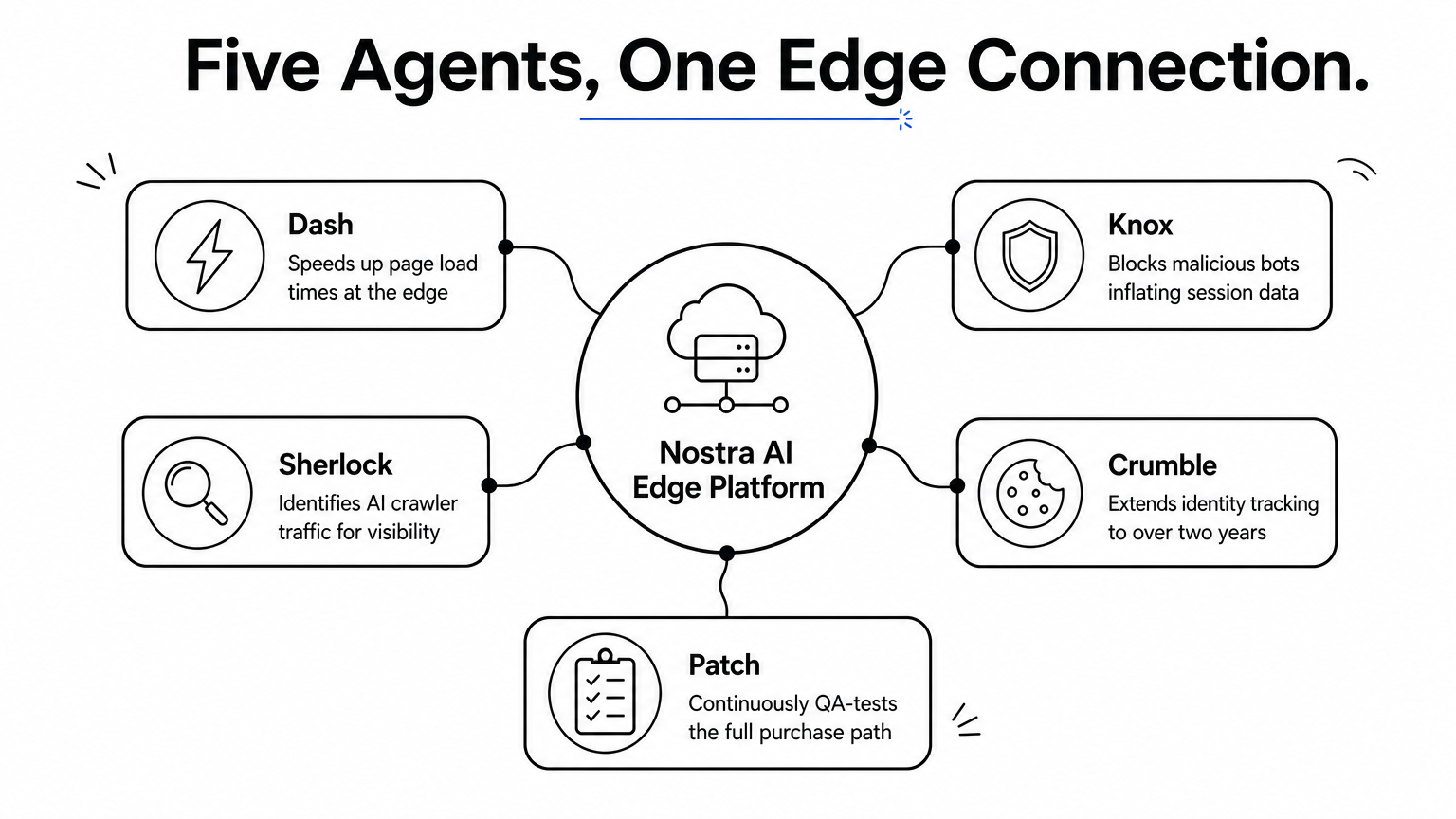
Nostra AI runs through a single DNS-level connection, which means no developers, no sprint planning, and no downtime during setup. Once connected, its agents spend the first two weeks observing your store before shifting into active optimization. Dash accelerates page load times at the edge, often the single biggest lever for conversion since slow pages bleed shoppers before a CRO test can even start. Knox blocks malicious bots that inflate your session counts and waste ad spend. Sherlock identifies AI crawler traffic for AEO visibility. Crumble extends customer identity tracking from about a week to over two years, fixing the attribution gaps that make Meta and Google ad data unreliable. Patch continuously QA-tests the full purchase path and files bug reports with reproduction steps and video.
Clean data and fast pages aren't nice-to-haves for CRO, they're the prerequisite that determines whether any test result can be trusted.
Nostra AI suits ecommerce and DTC brands that have run CRO tests before but couldn't explain the results, or that suspect bot traffic and slow load times are quietly capping their conversion rate. It's a strong fit for growth and ecommerce ops leaders who want measurable technical improvements without dedicating engineering resources.
Across more than 300 brands, Nostra AI reports:
| Metric | Result |
|---|---|
| Page load speed | Up to 47% faster |
| Expected revenue lift | Roughly 3% |
| Bots blocked annually | Over 10 billion |
| Cookie lifetime | Extended from 1 week to 2+ years |
Documented case studies include U Beauty, Nixon, and Credo Beauty, all published on the Nostra AI site.
Pricing is customized based on store traffic and which agents you deploy. Since setup requires only a DNS change, most brands see initial performance data within the first two weeks of the observation window.
Invesp has been a pure-play conversion optimization agency since 2006, long before CRO became a standard line item in ecommerce budgets. Unlike agencies that bolt testing onto broader digital marketing retainers, Invesp builds its entire practice around research-driven experimentation, which means you get a team that lives and breathes hypothesis testing rather than treating it as a side service.
Invesp runs a structured process built on user research and data analysis before any test goes live. Their team conducts heuristic evaluations, session recordings, and customer surveys to identify friction points, then prioritizes a testing roadmap based on potential revenue impact rather than guesswork. Every experiment ties back to a documented hypothesis, so you get a clear rationale, not just a winning variant.
A test without a documented hypothesis is just a guess dressed up in analytics software.
Invesp fits mid-size to enterprise ecommerce brands that want a dedicated conversion rate optimization consulting partner rather than a bundled service inside an SEO or PPC retainer. It works well for teams with enough existing traffic to reach statistical significance within a reasonable testing window.
Invesp publishes case studies showing double-digit conversion lifts across retail and B2B ecommerce clients, often tied to specific changes like checkout redesigns or product page restructuring.
Invesp typically works on retainer, with engagements starting in the low five figures per month depending on testing volume and traffic. Expect a multi-month commitment since meaningful test cycles require sustained traffic and iteration.
SplitBase built its name working almost exclusively with direct-to-consumer brands, the kind that sell through Shopify and live or die on landing page performance and ad-to-site conversion. If your traffic comes mostly from paid social and email, SplitBase understands that funnel better than agencies built around broader ecommerce or B2B testing.

SplitBase pairs conversion research with creative testing, running A/B testing for ecommerce experiments on landing pages, product pages, and post-click experiences rather than treating the whole site as one generic testing surface. Their process starts with a conversion audit that maps drop-off points across the funnel, then moves into a prioritized experiment roadmap built around statistical rigor rather than gut-feel design changes. They lean heavily on qualitative research, including customer interviews and heatmaps, to generate hypotheses before writing a single line of test code.
Testing without a documented drop-off map just optimizes the parts of the funnel you already noticed, not the ones actually losing you revenue.
SplitBase suits DTC brands running significant paid acquisition spend that need their landing pages and product pages to convert at a higher rate before scaling ad budgets further. It's a good match for marketing teams who already have creative and media buying handled but lack in-house testing expertise.
SplitBase case studies highlight conversion lifts in the 20-40% range for DTC clients, often tied to landing page redesigns and checkout flow simplification.
Engagements typically run as monthly retainers, with pricing scaled to traffic volume and the number of concurrent experiments running.
Blend Commerce works almost exclusively within the Shopify and Shopify Plus ecosystem, which shows in how tightly their process fits the platform's quirks, from app conflicts slowing down checkout to theme customizations that break mobile conversion paths. If your store runs on Shopify and you want an agency that already knows the platform's edge cases, that specialization saves you the ramp-up time most generalist agencies need.
Blend Commerce combines CRO audits with ongoing experimentation, focusing heavily on Shopify-specific factors like app bloat, theme performance, and subscription or upsell flows, and every 100ms of load time moves Shopify conversion rates. Their team reviews analytics setup first, since many Shopify stores run flawed tracking that skews test results before a single experiment launches. From there, they build a testing roadmap around product pages, cart flow, and post-purchase upsells, areas where Shopify's default themes often leave revenue on the table.
An experiment roadmap built on broken analytics just produces confident wrong answers faster.
Blend Commerce suits Shopify and Shopify Plus merchants, particularly those running multiple apps that may be quietly conflicting or slowing page load, where auditing your Shopify speed optimization apps pays off first. It's a strong fit for ecommerce teams that want a partner fluent in Shopify's app ecosystem rather than a generalist agency treating the platform like any other CMS.
Blend Commerce highlights case studies showing improved add-to-cart rates and reduced cart abandonment after resolving app conflicts and streamlining checkout flows for Shopify Plus clients.
Pricing runs on a retainer model, typically scoped around audit depth and ongoing testing cadence, with entry packages aimed at smaller Shopify stores and custom quotes for larger Plus merchants.
Conversion Sciences stands out for one reason: they attach a performance guarantee to their engagements, promising measurable lift or continued work until you get there. That's a rare stance in an industry where most agencies hedge their case studies with disclaimers. For brands burned by vague retainers that never showed revenue movement, that guarantee changes the conversation before the contract is even signed.
Working with Conversion Sciences starts with a conversion audit covering analytics accuracy, user behavior, and funnel drop-off, since a guarantee only means something if the baseline data is trustworthy. Their team then builds a testing roadmap prioritized by revenue impact, running experiments across landing pages, product pages, and checkout. Every test ties back to a documented hypothesis, and results get reported against the guaranteed benchmark rather than vanity metrics like click-through rate.
A guarantee only holds up if the agency measures against a trustworthy baseline, not a number that flatters the report.
Conversion Sciences fits brands that want accountability built into the contract, particularly teams that have been disappointed by agencies delivering "insights" without tying them to revenue outcomes. It suits mid-size ecommerce brands with enough traffic to hit statistical significance within the guarantee window.
Published case studies show double-digit conversion lifts across retail clients, with several engagements citing revenue increases directly tied to guaranteed test outcomes.
Engagements run as structured retainers, with pricing scoped to the guarantee terms and testing volume, typically requiring a multi-month commitment to reach measurable results.
OuterBox built its reputation on SEO and paid media, then expanded into conversion optimization as clients asked why traffic gains weren't translating into revenue. That history shows in how they approach CRO: less as an isolated testing discipline, more as the layer that makes acquisition spend actually pay off. If your team already works with OuterBox on search or ads, folding CRO into that relationship avoids the handoff problems that come from splitting acquisition and conversion work across separate vendors.
OuterBox pairs conversion audits with ongoing A/B testing, looking at how organic and paid traffic, shaped by the usual ecommerce SEO checklist work, actually behaves once it lands on your site. Their team reviews analytics setup, heatmaps, and session recordings to flag friction on category pages, product pages, and checkout, then builds a testing roadmap that accounts for how different traffic sources convert differently.
Traffic and conversion live on the same team here, so a lift in rankings doesn't quietly cancel out at checkout.
OuterBox suits ecommerce brands already running SEO or PPC campaigns that want conversion work integrated rather than managed by a separate CRO consulting vendor. It fits mid-size retailers that need one accountable partner across the full acquisition-to-conversion funnel.
Case studies cite improved conversion rates alongside organic traffic growth, with several clients reporting compounding gains once testing and SEO efforts were coordinated under one roadmap.
OuterBox scopes pricing around combined service packages, so CRO-only engagements cost less than bundled SEO, PPC, and testing retainers, which typically run in the mid five figures monthly.
Conversion (formerly Conversion.com) works at the top end of the market, running testing programs for enterprise retailers with the traffic volume to support statistical significance across dozens of concurrent experiments. Where smaller agencies run one or two tests a month, Conversion's infrastructure is built for scale, which matters if your site gets millions of monthly visitors and a single percentage point of lift translates into real revenue.
Conversion combines experimentation platforms with personalization engines, building segmented personalization programs that split traffic by behavior, device, and customer lifecycle stage rather than testing one generic experience for every visitor. Their teams embed with client analytics and engineering groups, which lets them ship tests faster than agencies working purely from the outside. Reporting ties every experiment back to revenue per visitor, not just conversion rate in isolation.
Personalization only pays off when it's built on a testing program large enough to prove which segment actually needs a different experience.
Conversion suits large enterprise ecommerce brands with dedicated analytics teams and enough traffic to run multiple simultaneous tests without diluting significance. It's a poor fit for smaller stores without the volume to support that scale.
Published case studies highlight compounding conversion gains from layered personalization, with enterprise retail clients citing measurable revenue lift across segmented testing programs.
Engagements run as annual or multi-quarter contracts, with pricing scoped to traffic volume and personalization complexity, typically landing in the low six figures annually.
Conversion Rate Experts built its reputation working with companies most agencies only dream of listing as references, including Amazon, Apple, and Google. Founded by Karl Blanks and Ben Jesson, the agency positions itself less as a testing vendor and more as a growth partner that digs into pricing, positioning, and messaging alongside standard enterprise landing page optimization. That breadth appeals to brands that suspect their conversion problem isn't just a button color, it's the entire value proposition.
Conversion Rate Experts starts every engagement with deep customer research, often including direct interviews with buyers and lost prospects to understand why people do or don't purchase. From there, the team rewrites copy, restructures offers, and tests page layouts, treating persuasion strategy as inseparable from the technical testing process. Reporting focuses on revenue impact rather than isolated metrics like bounce rate.
A conversion problem rooted in a weak offer won't get fixed by testing button colors, no matter how many variants you run.
High-growth ecommerce and SaaS-adjacent brands scaling past their first few million in revenue tend to get the most value here, especially teams that suspect messaging and offer structure, not just page design, are capping their growth.
Published case studies cite revenue increases in the tens of millions of dollars for some clients, with several engagements crediting rewritten value propositions for the bulk of the lift.
Engagements are custom-scoped and often require a minimum commitment in the five figures, reflecting the senior-level strategy work involved rather than junior testing labor.
Inflow started as an ecommerce SEO shop before building out a full conversion rate optimization consulting practice, and that history shows in how they treat CRO as one piece of a bigger revenue puzzle rather than an isolated testing discipline. If your team manages Google Shopping, marketplaces, and organic search alongside your own site, Inflow's multi-channel background means they already understand how traffic source shapes on-site behavior.
Inflow runs conversion audits built on customer journey analytics that map how visitors from different channels, paid search, organic, marketplace referrals, actually behave once they land, then builds a testing roadmap around the friction points that matter most for each segment. Their team pairs analytics review with UX testing on product pages, category navigation, and checkout, prioritizing experiments by revenue potential rather than ease of implementation.
A visitor from a Google Shopping ad and one from an organic blog post rarely need the same landing experience, and testing them identically wastes both.
Inflow suits mid-size ecommerce brands running multiple acquisition channels who want CRO consulting integrated with existing SEO or paid search work rather than managed by a separate vendor.
Case studies cite improved conversion rates alongside organic and paid traffic growth, with several retail clients reporting compounding gains once channel-specific testing replaced a one-size-fits-all approach to landing pages.
Inflow scopes pricing around bundled service packages, so CRO-only work costs less than combined SEO, PPC, and testing retainers, which typically run in the low five figures monthly depending on traffic volume.
Sorting through nine options gets easier once you identify what's actually capping your conversion rate. Traffic volume matters first: agencies like Conversion and Conversion Rate Experts need enterprise-level visitors to hit statistical significance, while smaller retainers from Blend Commerce or Invesp fit stores still building toward that scale. Before signing anything, figure out whether your bottleneck is strategic (messaging, offers, UX) or technical (speed, bot-inflated data, broken tracking), since choosing the wrong type of website optimization company wastes months chasing the wrong fix.
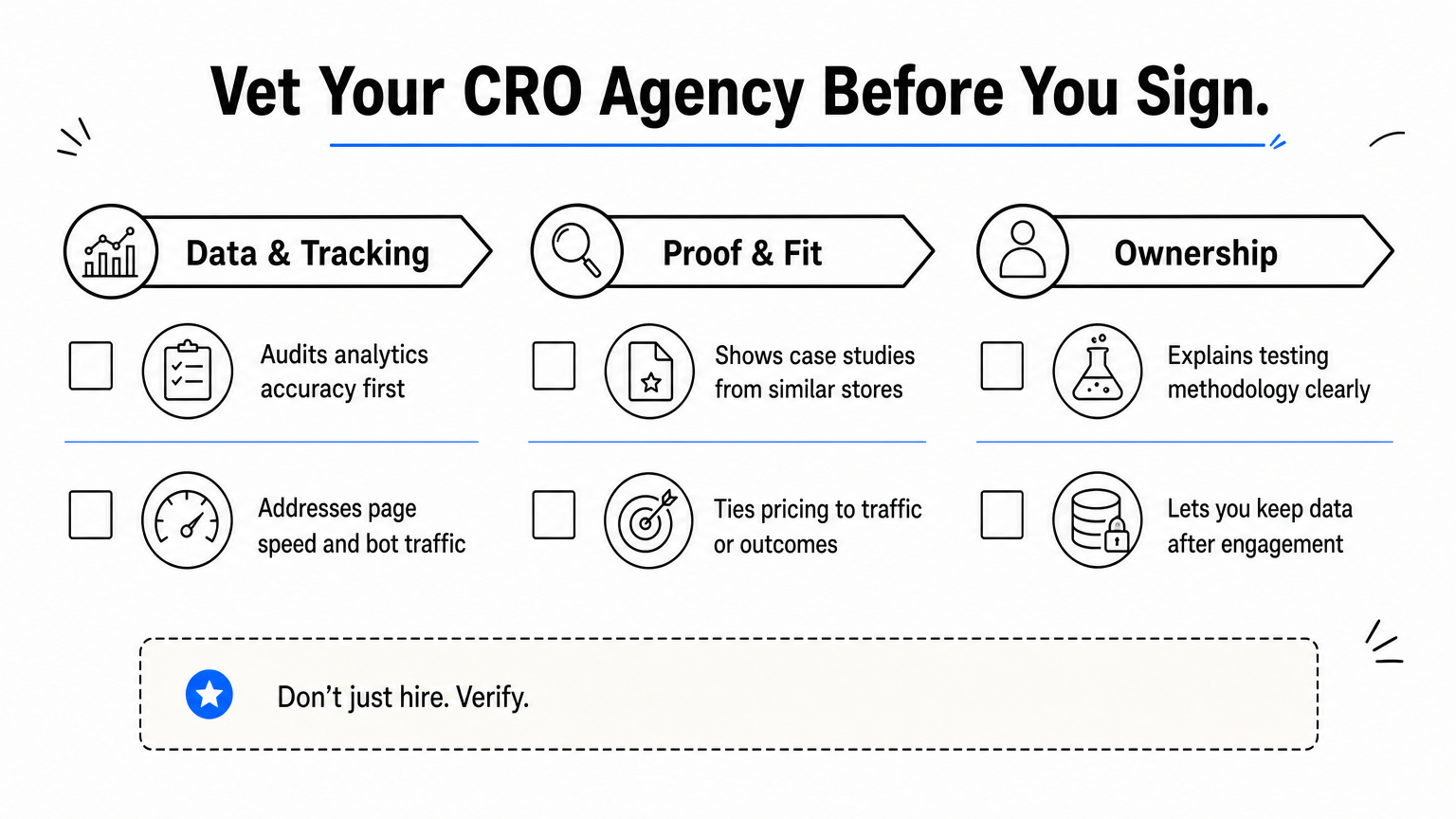
Use this checklist when vetting an ecommerce conversion rate optimization agency:
The best CRO agency for your store is the one built to fix the specific bottleneck actually capping your conversion rate, not the one with the flashiest case study.
Vet references directly rather than trusting published logos alone. Watch for agencies that quote conversion lifts without disclosing baseline traffic or test duration, and compare any promise against average ecommerce conversion rates by industry, since a 40% lift on a low-traffic page rarely survives scaling. Finally, ask how they'd handle conversion rate optimization consulting if your data itself turned out to be unreliable, since that answer reveals whether they understand the difference between testing and guessing.
How much does an ecommerce conversion rate optimization agency cost? Retainers range from low five figures monthly for smaller Shopify-focused shops to six figures annually for enterprise personalization programs. Most agencies scope pricing around traffic volume and testing cadence, so get a quote based on your actual visitor count rather than a generic package price.
What's the difference between a CRO agency and CRO consulting? An agency typically runs the full testing program, from research to build to reporting. Consulting engagements lean more advisory, with your internal team executing the roadmap a consultant designs. Neither model fixes a broken data foundation on its own.
How long before an agency shows results? Expect two to three months minimum before tests reach statistical significance, longer for lower-traffic stores. Agencies promising dramatic lift within weeks are usually testing on a page that already gets heavy traffic, not fixing a systemic problem.
If an agency can't explain how they'll verify your baseline data before testing, the results they report afterward aren't worth trusting.
Should you fix technical issues before hiring a testing-focused agency? Yes. Bot traffic, slow load times, and short cookie lifespans distort the very analytics a CRO program depends on, so learn to spot bot traffic in your Shopify analytics first. Platforms like Nostra AI address that layer directly, which is why pairing automated technical fixes with a strategic testing partner often outperforms either approach alone.
Can you run CRO in-house instead of hiring an agency? Small teams sometimes do, but sustained testing requires dedicated analyst time, engineering support for implementation, and enough traffic to reach significance regularly. Most brands find a hybrid model, automated technical tools plus periodic strategic consulting, delivers better ROI than either extreme.
The right ecommerce conversion rate optimization agency can rewrite your copy, redesign your checkout, and run a disciplined testing roadmap for months. But none of that work matters if the traffic feeding those tests is inflated by bots or the load times are chasing shoppers away before a variant even renders. Whichever agency you choose from this list, treat the technical layer as the foundation, not an afterthought. Clean data and fast pages are what let a strategic partner's test results actually hold up once you scale past the pilot.
Before you sign a retainer, ask how much of your current traffic is even real. Bot activity distorts session counts, wastes ad spend, and quietly caps every lift an agency reports. See how Nostra's Edge Protect keeps bots out of your conversion data so the program you invest in actually measures shoppers, not scrapers.


.svg)
