.svg)
.svg)
.svg)
.svg)
Published April 28, 2026
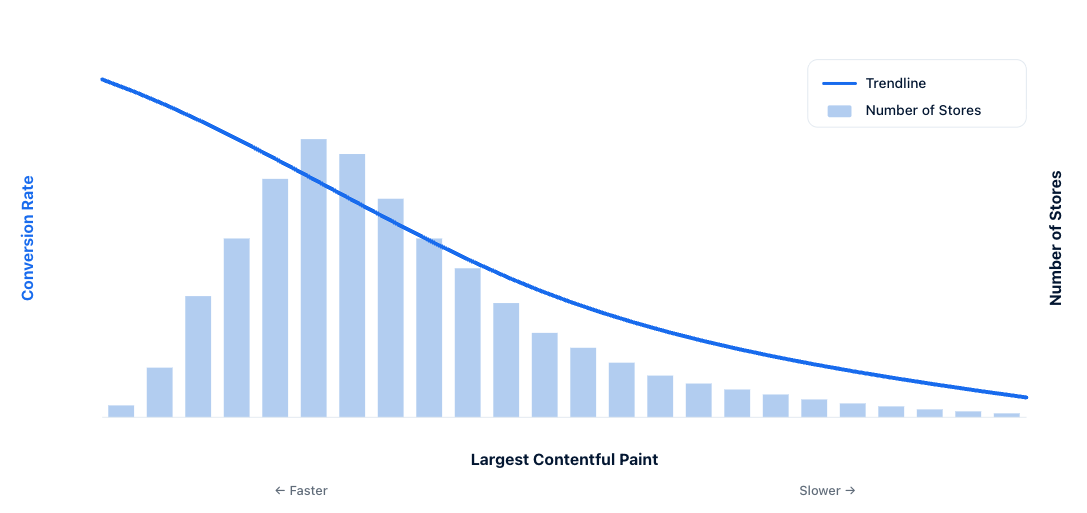
Quick answer: Shopify analyzed tens of thousands of live stores across a 28-day window and found that every 100 milliseconds of slower load time correlates with roughly a 3.5% drop in conversion rate. A store running at 2.5-second LCP converts about 30% worse than the same store running at 1.5 seconds. Their data, drawn from real shoppers on real Shopify storefronts, is the strongest public confirmation yet that Shopify site speed conversion is a direct, measurable revenue lever, and it's the foundation Nostra was built on.
For years, performance teams have been quoting the same handful of speed-and-conversion studies, usually a one-off case study from Amazon, Walmart, or the Aberdeen Group circa 2010. The numbers were directionally right but easy for skeptics to dismiss as outdated or cherry-picked. Shopify just put that argument to bed.
In an analysis published this month covering its full commerce ecosystem, Shopify's data team measured Core Web Vitals across actively-selling stores during a 28-day period straddling January and February 2026, controlled for outliers, controlled for the other Core Web Vitals when isolating each one, and reported a clear, ecosystem-wide pattern: faster stores convert better. Every 100 milliseconds matters. The relationship holds at scale, in the wild, on real shoppers.
This guide walks through what Shopify's findings actually say, what they mean for your revenue, and why brands chasing the speed Shopify's data shows is possible reach for Nostra.
The Stat That Should Change How You Budget for Performance
The single most important number from Shopify's analysis: for every 100 milliseconds slower a store loads, conversion tends to be about 3.5% lower.
Read that again with a calculator open. If your store is doing $20M a year and you're running an LCP of 3.0 seconds when you could be running at 1.5 seconds, that's a 1,500ms gap, a roughly 52% conversion deficit on the math. Even if real-world results land at half that, you're leaving a multi-million-dollar lift on the table. Speed is not a UX nice-to-have. It is one of the highest-leverage revenue levers in your stack, and Shopify's own platform-wide data now says so explicitly.
Shopify's methodology is worth pausing on, because it's the part that makes this finding hard to dismiss. They divided every store into performance buckets, controlled for the other two Core Web Vitals when isolating each one, excluded the slowest 5% to prevent outliers from distorting the trend, and used percentile-based comparisons rather than averages. This isn't a single brand's controlled A/B test. It's an ecosystem-level read across Shopify's platform, many tens of thousands of stores, many millions of shoppers, saying the same thing case studies have always implied.
The 1.5s vs 2.5s Gap: A 30% Conversion Difference
Shopify also translated the per-100ms number into something more visceral: stores with a 2.5-second LCP report roughly 30% lower conversion than stores with a 1.5-second LCP.
That is one second of difference. The kind of difference that comes from one slow third-party script, one unoptimized hero image, one app phoning home to a US-East server while half your traffic is in Europe. And it costs you nearly a third of every conversion that page should produce.
Here is the part most merchants miss when they read this stat: 1.5 seconds and 2.5 seconds are both inside Google's "good" Core Web Vitals threshold. Both pass. Both look fine on a PageSpeed Insights score. The 30% conversion difference exists entirely within the band that conventional SEO tools call "fine." Speed is not pass/fail. It's a continuous gradient, and every step in the right direction shows up in revenue.
This is why brands serious about growth do not stop at "we pass Core Web Vitals." Passing is the floor. The ceiling is sub-second LCP, and the difference between the two is measurable in dollars.
Why Responsiveness Costs You Too
LCP is not the only Core Web Vital Shopify isolated. The second key finding: for every 32 milliseconds slower a store responds to interactions, conversion tends to drop by about 1.5%.
Interaction to Next Paint (INP) measures how long your store takes to react when a shopper taps an Add to Cart button, applies a filter, or interacts with a variant selector. A laggy interaction does not just feel bad — it costs sales. Shopify's data shows the relationship holds even when controlling for load time, which means you cannot offset slow interactivity with a fast initial render. Both matter. Both convert independently.
The INP signal also points directly at the most common culprit Shopify itself called out in the analysis: third-party JavaScript. Apps, tag managers, attribution pixels, A/B testing tools, and chat widgets all add JavaScript that runs on the main thread. Each one increases the time between a shopper's tap and the browser's response. The accumulated cost is invisible until you measure it, and it shows up in your conversion rate before it shows up anywhere else.
Cumulative Layout Shift (CLS), the third Core Web Vital, did not show the same correlation in Shopify's data. Their hypothesis is that most layout shifts happen early in the load and are less visible to shoppers than slow loads or laggy interactions. The practical implication: prioritize LCP and INP. CLS is still worth fixing if it's egregious, but it is not where the biggest dollars live.
Mature Brands: Smaller Percentage, Bigger Dollar Lift
Shopify segmented their analysis by store stage, smaller, growing, and mature, and the results carry a non-obvious lesson for established brands. Smaller and growing stores show the strongest percentage sensitivity to speed. Mature stores show roughly a third of that percentage impact, because brand recognition and customer loyalty start carrying more of the conversion weight.
But mature stores process orders of magnitude more orders. A 1% conversion lift on a brand doing $50M annually is a different number than a 3% lift on one doing $5M. The absolute dollar value of speed optimization is highest at scale, even though the percentage is smaller. This is the stage where a one-second LCP improvement turns into a seven-figure annual lift.
The implication for enterprise brands is direct: do not assume that because brand loyalty cushions you, performance optimization is not worth it. The opposite is true. The bigger your traffic, the bigger the dollar return on every millisecond you reclaim.
Shopify's Built-In Speed Is the Floor, Not the Ceiling
Shopify is rightfully proud of its platform-level performance. Their analysis notes that nearly 80% of Shopify stores pass all Core Web Vitals thresholds out of the box — among the highest of any major ecommerce platform. Managed infrastructure, a global CDN, optimized checkout, automatic image lazy loading, and a steadily improving theme rendering engine give every Shopify store a solid baseline.
That baseline is real. It also degrades the moment a serious brand starts customizing.
The more apps you install, the more integrations you wire up, the more pixels you fire, the more your real-world performance drifts away from the platform average. Shopify acknowledged this in their own analysis: as stores scale and add apps and customizations, the cumulative performance cost becomes visible in the conversion data. The platform's foundation is excellent, but it cannot compensate for the dozens of third-party scripts a sophisticated brand needs to run a modern marketing and commerce stack.
Shopify's own advice, audit your apps, review your integrations, keep your theme updated, monitor your real-user data, is reasonable, but it puts the cleanup burden on your engineering team, app by app, integration by integration. For brands moving fast, that's a treadmill, not a solution.
How Nostra Delivers What Shopify's Data Says Is Possible
Nostra exists for the exact gap Shopify's analysis identifies: the difference between the speed your store could achieve and the speed it actually delivers after years of accumulated app stack, marketing tags, and customizations.
Our Edge Delivery Engine sits in front of your Shopify storefront, intercepts every request, and pre-optimizes the HTML before it reaches the browser. The result is a measurable LCP improvement on every page, usually under 1.5 seconds at the 75th percentile of real users, exactly the threshold Shopify's data shows is associated with the highest conversion rates. Our customers routinely see the 30% conversion delta Shopify's analysis predicts, with no theme rewrite, no platform migration, and no app cull.
Edge Protect, our bot-management layer, removes the bad-bot traffic that wastes server capacity and slows down responses for real shoppers. Edge ID gives you clean first-party attribution that does not depend on third-party pixels, fewer scripts firing on the page, lower INP, and analytics you can actually trust.
Across 300+ enterprise and high-growth Shopify brands, Nostra delivers the speed Shopify's data says is associated with the strongest conversion rates. Shopify validated the math. We deliver the result.
Stop Leaving Conversions on the Floor
Shopify's data is now the foundation for every speed conversation a serious ecommerce brand should be having: every 100ms of slower load time costs you 3.5% in conversion. Every second is roughly 30%. If your store is sitting above 2-second LCP for any meaningful slice of traffic, the dollars are real, the math is Shopify's own, and the fix is not more apps or more code — it's an edge layer that does the heavy lifting for you.
Run a free Nostra speed test to see exactly where your store sits in Shopify's performance distribution, or book a demo to see how our Edge Delivery Engine pushes you into the conversion band Shopify's own data identifies as the highest-revenue tier.
Source: Shopify, "Store Speed and Conversion: What the Data Shows," published April 27, 2026. Read the full analysis at shopify.com/enterprise/blog/store-speed-conversion.


