AI-generated answers are quietly rerouting the traffic your brand used to get from a Google click. ChatGPT, Gemini, and Google AI Overviews now summarize products, compare brands, and answer buying questions before a shopper ever hits your storefront, and if your content isn't structured for those systems, you're invisible in the response. That's why so many ecommerce and marketing teams are searching for the leading generative engine optimization services in AI industry right now, hoping to catch up before competitors lock in the citations.
This article answers that search directly. We break down ten of the top generative engine optimization companies in AI, covering what each one actually does, from content restructuring and schema markup to AI crawler tracking and answer-engine testing, so you can match a service to your team's actual gap.
We also flag the practical differences that matter when you're evaluating leading generative engine optimization services for AI products: pricing models, reporting depth, and whether the vendor gives you real crawler-level data (something we work with daily through Nostra AI's Sherlock agent) or just theoretical best practices.
Nostra AI sits at the top of this list because it approaches generative engine optimization from a different angle than most agencies: it doesn't just advise you on GEO, it runs the infrastructure that makes AI visibility measurable in the first place. Nostra deploys through a single DNS-level connection, no code changes, no replatforming, and puts a suite of specialized edge agents built for agentic ecommerce to work on your storefront within days. Over 300 ecommerce brands already run on the platform, which makes it one of the more battle-tested options among the leading generative engine optimization services in AI industry.
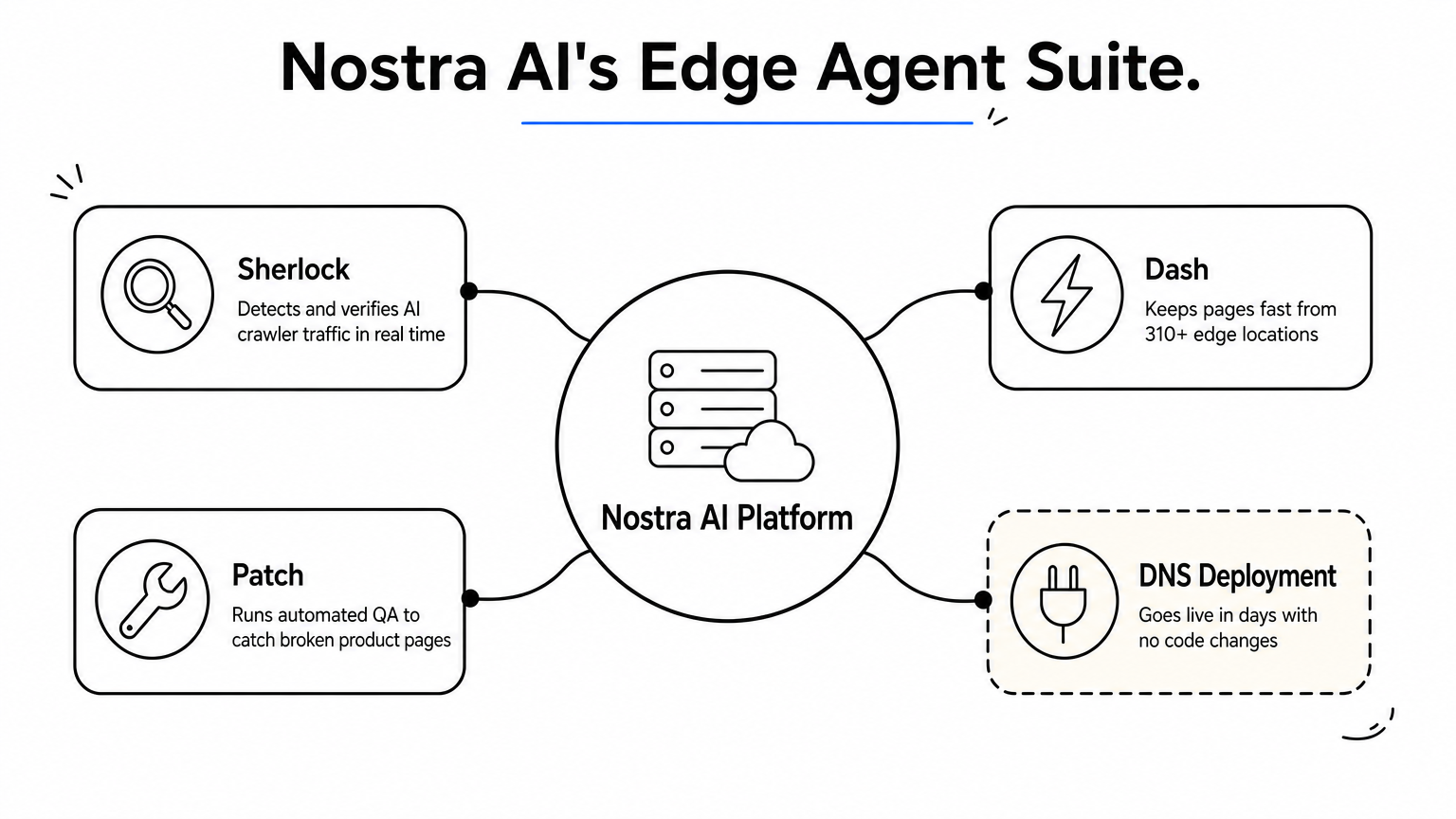
The agent most relevant to GEO is Sherlock, the Edge Detect AI agent, which identifies and verifies AI crawler and bot traffic hitting your storefront in real time. Instead of guessing whether GPTBot, Google-Extended, or PerplexityBot actually crawled your product pages, you get verified logs showing which AI systems visited, what they accessed, and how often, which is also the data you need when deciding which AI crawlers to allow or block. That data feeds directly into your AEO strategy, telling you whether your schema and content changes are actually being picked up by the engines you're trying to influence. Nostra pairs this with Dash, the agent that keeps every page fast from 310+ edge locations, since slow-loading pages get deprioritized by crawlers just as they get abandoned by shoppers, and with Patch (Edge Assurance) for automated QA that catches broken product pages before they hurt your citations.
Verified crawler data beats guesswork every time you're trying to prove AI visibility is real.
Nostra fits mid-size to large ecommerce brands that need proof, not just theory, that their GEO efforts are working. If your team already produces solid product content but has no way to confirm whether ChatGPT or Gemini is actually reading it, this is the missing layer. It also suits ecommerce operations leaders who want to avoid handing engineering resources over to a GEO vendor for months of implementation work.
Nostra AI is priced for established ecommerce brands running meaningful traffic volumes rather than small storefronts testing GEO for the first time. Because the platform bundles speed, bot protection, AI detection, identity tracking, and QA into one deployment, the cost reflects infrastructure value, not just a monthly reporting retainer. Brands evaluating it should request a demo to see actual crawler data from their own domain before committing, since that visibility is the differentiator worth paying for. You can review current plans and request access directly through Nostra AI's site.
Thrive Internet Marketing Agency built its reputation on traditional SEO before generative engine optimization existed as a category, and it now folds AI answer-engine work into that same full-service model. The agency treats GEO as an extension of content strategy and technical SEO rather than a standalone discipline, which shows in how it structures engagements: strategy, content production, and technical audits all run through the same account team.
Thrive builds out structured content and schema markup aimed at getting client pages surfaced in AI Overviews and chatbot answers, alongside its existing SEO, PPC, and web design services. Reporting typically covers traditional rankings alongside newer AI-visibility metrics, so you're not buying a pure-play GEO product but a broader marketing retainer with GEO layered in.
Thrive suits small to mid-size businesses that want one agency handling SEO, paid media, and AI visibility together rather than juggling multiple vendors. It's a reasonable fit if your team lacks in-house marketing capacity entirely and wants a single point of contact managing everything.
Bundling GEO into a general marketing retainer works fine until you need crawler-level proof, not just content recommendations.
Thrive typically works on monthly retainers rather than project-based GEO fees, with pricing scaled to the scope of services bundled in. Because generative engine optimization is one piece of a larger package rather than the sole focus, brands looking specifically for deep AI-crawler analytics may find the GEO component thinner than the overall retainer price suggests. Request a scoped proposal before comparing it against dedicated GEO vendors.
Siege Media made its name producing content that earns links and rankings the old-fashioned way, through original research, design-heavy assets, and long-form guides. As generative engine optimization moved from theory into agency offerings, Siege extended that same content-first philosophy into AI visibility work, betting that pages built to be genuinely citable will keep winning whether the citation comes from a search snippet or a chatbot answer.

Siege focuses on content production and digital PR aimed at getting brand pages cited across both traditional search and AI answer engines. Their teams build data-driven studies, calculators, and visual assets designed to attract backlinks, then layer in structural changes like clearer headers, summary boxes, and schema so the same content reads well to a language model summarizing an answer. It's less about crawler diagnostics and more about producing the kind of authoritative content AI systems tend to pull from.
Siege suits content-heavy brands in competitive niches where original research and thought leadership already drive traffic, and where the marketing team wants an agency partner rather than an internal content operation. It's a strong match if your gap is content quality rather than technical infrastructure.
Content built to earn links naturally tends to earn AI citations too, but neither happens without real research behind it.
Siege Media typically runs on project-based or retainer content engagements, priced according to the volume and complexity of assets produced each month. Because the agency's strength is content rather than crawler tracking or technical GEO diagnostics, brands should budget separately if they also need verified AI-traffic data or technical schema audits.
Victorious grew out of technical SEO consulting, and that engineering-first background carries into how the agency approaches generative engine optimization today. Rather than treating AI visibility as a content add-on, Victorious builds it around structured data, site architecture, and measurement infrastructure, the same discipline it applied to traditional organic search rankings for years before AI Overviews existed.
Victorious runs technical audits aimed at making sure a site's structure, schema, and internal linking give AI crawlers a clean path to the content worth citing. Their teams also build custom tracking dashboards that attempt to correlate AI Overview appearances and chatbot mentions with existing analytics, so clients can see directional shifts even without direct crawler logs. Strategy work typically pairs technical fixes with targeted content updates on high-value pages rather than a full content overhaul.
Victorious fits mid-size to enterprise brands that already have a mature SEO program and want to extend it into AI visibility without starting from scratch. It suits teams with in-house content resources who mainly need technical guidance and reporting infrastructure, rather than a vendor to produce content from zero.
Technical fixes only pay off in AI answers when the crawler data confirms the engines actually noticed the change.
Victorious prices engagements as custom retainers, scoped after an initial technical audit rather than published as flat packages. Because the agency leans heavily on strategy and dashboard-building rather than verified crawler-level data, brands should ask directly how AI-visibility metrics are sourced before assuming they're seeing confirmed bot activity rather than modeled estimates. Enterprise budgets should expect a proposal process similar to other full-scale technical SEO retainers rather than a quick monthly quote.
EWR Digital has run search marketing campaigns for over two decades, and that longevity shows in how the agency approaches generative engine optimization: as a natural extension of local and enterprise SEO rather than a rebranded service line. The team leans on its history with multi-location brands and franchise clients, applying the same structured, location-aware content strategies to AI answer engines that it once built for local pack rankings.
EWR Digital audits existing content and site structure to identify gaps that keep pages out of AI Overviews and chatbot answers, then rebuilds product and location pages with clearer entity signals, FAQ schema, and consistent NAP (name, address, phone) data. Their process also includes competitor benchmarking, checking which brands already show up in AI-generated comparisons so clients know exactly what content gap they're closing.
Organizations with multi-location or franchise footprints get the most value here, since EWR's core strength is structuring content at scale across dozens or hundreds of near-duplicate location pages. It also suits brands migrating from a local-SEO-only strategy into broader AI visibility work, since the agency already understands how to avoid duplicate content penalties across similar pages.
Franchise-scale content structuring only works in AI answers if every location page carries distinct, verifiable entity data.
EWR Digital scopes pricing around monthly retainers tied to the number of locations or pages involved, which means costs scale up quickly for large franchise networks. Brands should confirm whether AI-visibility reporting is included by default or billed as an add-on, since the agency's core packages historically centered on local search rather than generative engine metrics.
Power Digital Marketing built its business around a proprietary tech stack called Nova, which pulls together data across paid media, SEO, and content to guide strategy decisions. That data-first approach carries directly into how the agency handles generative engine optimization, treating AI visibility as another channel to model and measure rather than a separate creative exercise bolted onto existing SEO work.
Power Digital runs cross-channel attribution that tries to connect AI Overview appearances and chatbot citations back to actual revenue, not just visibility metrics. The agency's teams audit content for structure and schema, then use Nova to flag which pages are worth prioritizing based on existing traffic and conversion data, so GEO work gets tied to a business case rather than treated as an isolated experiment. Reporting typically rolls AI-visibility metrics into the same dashboards clients already use for paid and organic performance.
Power Digital suits growth-stage ecommerce and consumer brands that already run sophisticated paid media programs and want GEO folded into that existing measurement framework rather than managed separately. It's a good fit for marketing leaders who think in terms of revenue attribution and want AI visibility justified with the same rigor as an ad spend decision.
AI visibility only matters to a growth team when it's tied to revenue, not just impressions in a chatbot answer.
Power Digital typically structures engagements as custom retainers scaled to the number of channels involved, since GEO rarely gets sold as a standalone service here. Brands mainly looking for AI-crawler diagnostics rather than full attribution modeling may find the retainer priced for more breadth than they actually need, so scoping the engagement tightly matters before signing.
Brafton built its agency around in-house content production at scale, staffing writers, editors, and strategists as full-time employees rather than relying on freelance networks. That structure matters for generative engine optimization because AI answer engines reward consistency and depth, and Brafton's model is built to produce a steady volume of long-form, well-researched content month after month rather than occasional bursts tied to a campaign calendar.
Brafton produces editorial content and technical guides designed to answer specific buyer questions in the format AI systems tend to extract and summarize. Their teams research the questions people actually ask ChatGPT and Google AI Overviews around a client's category, then build content around those exact phrasings, pairing it with schema markup and clear answer boxes near the top of each page. Ongoing reporting tracks both traditional keyword rankings and where content starts appearing in AI-generated summaries.
Companies that need consistent content velocity benefit most from Brafton, especially B2B and mid-market brands without a large internal editorial team. It suits marketing leaders who want a dependable content pipeline covering both SEO and GEO goals without managing freelancers or building an in-house team from scratch.
Consistent content velocity beats sporadic brilliance when AI engines are constantly re-crawling for fresh answers.
Brafton sells monthly content retainers priced by volume, typically a set number of articles or assets per month rather than a flat GEO fee. Because the agency's core product is content production, brands mainly needing technical schema work or verified AI-crawler data should confirm those services are included, since they're sometimes scoped as separate add-ons rather than part of the base retainer.
Percepture built its practice around answer engine optimization specifically, positioning itself as one of the newer agencies that never treated GEO as an SEO add-on but as its own discipline from day one. The team frames its work around a simple premise: AI answer engines summarize, they don't rank, so content has to be structured for extraction rather than for a ten-blue-links results page.
Percepture runs AI visibility audits that map how a brand currently appears (or fails to appear) across ChatGPT, Perplexity, Gemini, and Google AI Overviews for a defined set of buyer questions. From there, the team rewrites and restructures pages using answer-first formatting, direct question-and-answer blocks, and schema aimed specifically at extraction rather than traditional ranking signals. Ongoing monitoring tracks citation frequency across the major AI platforms so clients see whether specific pages start getting pulled into generated answers over time.
Brands that already tried a generic SEO agency's version of GEO and found it thin tend to land here next. Percepture suits marketing teams focused specifically on AI visibility rather than a broader retainer, since the agency doesn't bundle in paid media, web design, or unrelated services.
An agency built only for AI answer engines will always out-focus a generalist SEO shop bolting GEO onto an existing retainer.
Percepture typically prices around project-based audits followed by ongoing monitoring retainers, rather than a bundled full-service marketing contract. Since the agency's model depends on repeated content rewrites as AI platforms shift their extraction patterns, brands should clarify how many revision cycles are included before signing, since that's where scope tends to expand mid-engagement.
Directive Consulting made its name in performance marketing for B2B and SaaS companies, running paid search and SEO campaigns tied tightly to pipeline and revenue metrics. That performance-marketing background shapes how the agency approaches generative engine optimization: it treats AI visibility as another lever in a demand-generation funnel, not a standalone content exercise, and it reports on it the same way it reports on paid campaigns.
Directive builds AI search strategy around the buyer questions that show up in a client's sales cycle, then restructures product and comparison pages so those exact questions get answered clearly near the top of the page. Their teams pair this with structured data implementation and internal linking cleanup, and they track how pages perform in AI Overviews and chatbot answers alongside existing paid and organic channels in a single reporting view. Much of the work leans on Directive's existing SEO playbook, extended rather than rebuilt for generative engines.
SaaS and B2B companies with complex, longer sales cycles get the most out of Directive, since the agency's strength is connecting AI visibility to pipeline stages rather than storefront conversion. It suits marketing leaders who already run performance-driven SEO and want GEO folded into that same reporting cadence instead of managed as a separate initiative.
AI visibility only earns budget from a performance marketing team when it shows up next to pipeline numbers, not vanity impressions.
Directive sells custom retainers scoped after a discovery call, typically priced against the number of channels and pages involved rather than a flat GEO fee. Ecommerce brands without a B2B sales cycle should ask directly whether the agency's pipeline-attribution model still applies, since much of its reporting infrastructure was built for longer, higher-consideration purchases.
Profound takes a different shape than most agencies on this list because it's built primarily as an analytics platform, not a content or consulting shop. The company positions itself as one of the leading generative engine optimization companies in AI specifically because it focuses on measuring how brands show up across ChatGPT, Gemini, Perplexity, and Google AI Overviews, then hands that data to internal marketing teams to act on rather than executing the content changes itself.

Profound tracks brand mentions and citations across major AI platforms, showing which prompts trigger a mention, how often a brand appears relative to competitors, and which source pages the AI systems pulled from when generating an answer. Dashboards break this down by topic, competitor, and platform, so a marketing team can see exactly where a citation gap exists before deciding what content to fix. Some plans include prompt-volume estimates, giving a sense of how frequently real users ask the questions a brand cares about.
Profound suits marketing and analytics teams that already have in-house content or SEO resources and mainly need visibility data, not execution help. It fits larger organizations running enough brand awareness campaigns that tracking AI-answer share of voice justifies a dedicated tool rather than a periodic agency audit.
A platform that only measures citations still leaves you writing and fixing the pages yourself.
Profound sells software subscriptions rather than agency retainers, typically tiered by the number of tracked prompts, competitors, and platforms included. Brands should budget separately for the content and technical work needed to act on the data, since Profound reports the gap without closing it, unlike vendors that feed edge-level traffic data straight into Profound's AI discovery analytics alongside actual site-level fixes.
Choosing among the leading generative engine optimization services in AI industry starts with an honest look at where your content actually breaks down. Some brands need someone to write and structure content from scratch, others already have strong content but no way to confirm whether GPTBot or Google-Extended ever crawled it, and a few just need an AEO tool for AI search visibility that shows where competitors are winning citations. Naming that gap first saves you from paying for a full content operation when what you actually need is verified crawler data, or vice versa.
Budget and reporting cadence matter just as much as specialty. Agencies bundling GEO into a broader SEO or paid media retainer tend to price it as one line item among many, which keeps costs predictable but can leave AI-visibility work thin. Platforms and specialists, by contrast, usually charge for exactly what they deliver, whether that's a monitoring subscription or a project-based content rewrite, so you can see the GEO spend clearly instead of guessing how much of a bigger retainer goes toward it.
A vendor that can't show you real crawler logs is asking you to trust a guess about AI visibility.
Before signing anything, run the vendor through a short checklist:
| Question to ask | Why it matters |
|---|---|
| Do you show verified AI crawler activity, or modeled estimates? | Confirms whether reporting reflects real bot visits |
| Is GEO a standalone service or bundled into a general retainer? | Clarifies how much budget actually goes toward AI visibility |
| Who executes content and technical fixes, you or us? | Sets expectations for internal resourcing |
| How many platforms do you track (ChatGPT, Gemini, Perplexity, AI Overviews)? | Determines coverage breadth |
| What's the typical time to see citation changes? | Sets realistic reporting timelines |
Ultimately, the right partner matches your actual gap, whether that's execution, measurement, or both, rather than the flashiest pitch deck in the room.
Brands researching the leading generative engine optimization services in AI industry tend to ask the same handful of questions before signing anything, so it helps to answer them plainly.
Is generative engine optimization the same as SEO? No, though the two overlap. Traditional SEO chases rankings on a results page; GEO focuses on getting a brand mentioned, quoted, or cited inside an AI-generated answer, which means structure, extractability, and verified crawler activity matter more than keyword density alone.
How long does it take to see results? Most agencies on this list report early movement within 60 to 90 days, though citation frequency depends on how often the specific AI platform re-crawls your category. Sites already indexed well by Google tend to see AI Overview mentions faster than brand-new domains.
Do I need a dedicated GEO vendor, or can my current SEO agency handle it? Depends on the gap. If your content is strong but you have zero visibility into whether GPTBot or Google-Extended actually crawled it, a specialist or a platform with verified crawler data closes that gap faster than a generalist adding GEO as a side service.
The fastest way to waste a GEO budget is paying for content fixes when the real problem is you can't see what AI crawlers are doing.
Can small ecommerce brands afford this? Yes, though pricing varies widely. Subscription-based platforms scale with tracked prompts and competitors, while agencies scope retainers around content volume, so a smaller brand can start with monitoring before committing to a full content rebuild.
Which platforms actually matter for tracking? ChatGPT, Gemini, Perplexity, and Google AI Overviews cover most consumer buying questions today, and any of the top answer engine optimization solutions worth hiring should track all four rather than just one.
Understanding these basics before you shortlist vendors keeps the conversation focused on what your brand actually needs, not what a sales deck happens to emphasize that quarter.
Getting cited by ChatGPT or Google AI Overviews starts with the same question every vendor on this list forces you to answer honestly: do you need content, measurement, or proof that AI crawlers even visited your pages? The leading generative engine optimization services in AI industry split cleanly along that line, from content-first agencies like Siege Media and Brafton to pure analytics platforms like Profound. Pick based on your actual gap, not the vendor with the loudest pitch.
Whatever you choose, none of it matters if bad bots are already distorting the traffic and analytics you're trying to optimize for AI visibility in the first place. Clean data has to come before clean content strategy. If bot traffic is inflating your sessions and wasting ad spend before you even get to the GEO question, start by stopping bad bots at the edge, before they reach your funnel.


.svg)
