The best AEO and GEO tools show whether ChatGPT, Perplexity, Google AI Overviews, and Gemini mention or cite your brand, then tell you what to fix. A good pick covers the engines your buyers actually use, tracks real prompts daily, shows which sources the answers cite, and costs what your team can sustain. Profound and AirOps suit enterprise teams. Ahrefs Brand Radar and Semrush suit teams already living in those suites. Peec AI and Otterly.AI suit lean teams that only want tracking. HubSpot's grader is the free place to start. Nostra AI's Sherlock covers a different layer: verified AI crawler traffic on ecommerce storefronts.
The problem is that your Google rankings can look healthy while AI answers send shoppers to a competitor. Standard SEO dashboards do not show that. Tools that do range from $29 a month to several thousand, and the labels AEO, GEO, and "AI visibility" blur together. That makes it hard to tell which product does which job.
This article defines both terms, then reviews 10 tools in the same format: what each does, who it suits, and what it costs. After that you get a comparison table, a short method for choosing, and a look at why bot traffic can distort the AI data you collect. Nostra AI protects and speeds up 300+ ecommerce storefronts at the edge, so the crawler side of this topic is one we work with daily.
AEO and GEO are two names for nearly the same job: getting AI systems to name and cite your brand in their answers. You only need to know the difference to read vendor pages, not to buy the right tool.
Answer engine optimization (AEO) covers anything that produces a direct answer, including Google AI Overviews, featured snippets, voice assistants, and chatbots. Generative engine optimization (GEO) aims at generative platforms such as ChatGPT, Perplexity, Gemini, and Claude. Some teams also expand AEO as "AI engine optimization."
Is AEO part of GEO? Treat them as overlapping. Vendors use the terms interchangeably, and every tool below serves both. Do not pay extra for a product because it uses one label over the other.
Google's documentation on AI features in Search says no special optimization is required beyond sound SEO fundamentals. Good content, crawlable pages, and clear structure still do the heavy lifting. The tools measure the results.
AEO and GEO are one discipline with two names, so judge tools by what they measure, not by their label.
"AEO tool" hides several different jobs. Knowing which one you need prevents the most common buying mistake.

| Job | Question it answers | Examples on this list |
|---|---|---|
| Prompt tracking | Does AI cite my brand for the questions my buyers ask? | Profound, Peec AI, Otterly.AI |
| Content optimization | What should I publish or fix to get cited? | AirOps |
| Grading | What is my score and what do I fix first? | HubSpot AEO Grader |
| Suite module | Can I add AI visibility to my SEO stack? | Semrush, Ahrefs, SE Ranking |
| Crawler and traffic data | Which AI systems actually read my site? | Nostra AI Sherlock, Scrunch AI |
A classic rank tracker cannot do the first job. Prompts are conversational, and the same prompt can return different answers from one run to the next. So dedicated AEO and GEO tools run each prompt repeatedly and report rates, such as how often you are mentioned or cited.
Sherlock is the one entry here that does not track prompts. It verifies which AI crawlers and bots really visit your ecommerce storefront. We list it first because AEO tracking tells you what AI says about you, while Sherlock shows which AI systems are actually reading your store.
Sherlock is the AI discovery agent inside Nostra AI. It identifies and verifies AI crawler and bot traffic, so you can tell a genuine GPTBot or PerplexityBot visit from a script borrowing its name. It supplies server-side evidence that prompt trackers cannot see, because they only observe AI answers.
Prompt trackers show what AI says about you. Sherlock shows who is reading your store.
Sherlock fits mid-size and large ecommerce and DTC brands that care about AI search visibility but have no engineers to spare. Deployment is a DNS-level change on day 1. The agents then spend days 2 to 14 learning your store, and ongoing optimization follows. No code changes or replatforming are needed, and the platform is SOC 2 compliant.
Skip it if you do not run a storefront, or if all you want is a prompt dashboard. Most teams pair Sherlock with one of the trackers below, so the tracker reports the answers and Sherlock reports the traffic.
Pricing comes through the Nostra team, so ask for a quote based on your storefront.
Profound is built for large brands that need wide engine coverage and crawler data. It is the most capable option here at the top tier, and the least friendly to small budgets.
Profound monitors brand visibility across up to nine answer engines on its Enterprise tier, including Claude. Its Agent Analytics shows how AI crawlers interact with your site, and Conversation Explorer draws on a large real-prompt dataset.
Profound's breadth is real, but you only get it at the Enterprise tier.
Global brands tracking several markets get the most from Profound. The demand data and crawler analytics help a team that already has people to act on the findings.
Smaller teams will find the self-serve ladder steep. Check which tier includes the engines you need before you sign anything.
Published self-serve plans start at about $99 a month for Starter. Pricing changes often, so confirm on the vendor's page.
Brand Radar's edge is its prompt database, built from real search behavior rather than invented prompt lists. It sits on top of an Ahrefs subscription.
Brand Radar tracks mentions, citations, and share of voice across AI Overviews, AI Mode, ChatGPT, Perplexity, Copilot, and Gemini, with Grok on the top tier. Its index covers 470 million monthly prompts, so you see what people actually ask. It also reports citation sources, including YouTube and Reddit, which answer engines cite heavily.
The prompt index is the product, so you pay for it whether or not you need it.
Teams already paying for Ahrefs get the neatest fit, with AI data beside keyword, traffic, and backlink data. Research-heavy teams that want to know which prompts matter before they track anything will also value the database.
It is a poor fit for a small team that only wants a basic dashboard. The add-on costs more than many full dedicated tools.
The add-on starts at about $398 a month for select platforms and $699 for all platforms. Custom prompt tracking comes with paid Ahrefs plans.
Semrush folds AI visibility into its main subscriptions. The argument for it is one login and one bill for both SEO and AI search.
Semrush tracks brand visibility across ChatGPT, Gemini, Perplexity, Google AI Mode, and AI Overviews, next to your keyword and backlink data. Its AI Search Site Audit checks whether major AI crawlers can reach your content. Sentiment tracking works at location and language level, which few tools match.
Semrush wins on convenience, not on prompt volume.
Marketing teams that already work in Semrush every day should start here. Adding AI visibility costs less than adding a second vendor.
Teams that only need AEO will pay for a lot of SEO they will not use. Prompt quotas also trail dedicated platforms at similar prices.
AI search features begin with the roughly $139 a month SEO plan. Plans branded SEO + AI Search start near $199 a month with 50 daily prompts.
Peec AI is a Berlin-built platform with the strongest language and country breakdowns on this list. It suits brands that sell in several markets.
Peec tracks visibility, position, and sentiment across ChatGPT, AI Mode, AI Overviews, Copilot, Perplexity, Gemini, and Grok. It scrapes the engines' web interfaces, so results reflect what a real user sees. Multilingual analytics cover 14+ languages with country-level citation share.
If your buyers search in more than one language, Peec's breakdowns are hard to beat.
International ecommerce brands and agencies with clients across countries get the most from Peec. Seeing citation share by country can reveal that you win in the US and vanish in Germany.
Single-market brands pay for strengths they will not use. Brands that need Claude coverage should also look elsewhere.
Starter runs about $95 a month for 50 prompts, one project, and three engines of your choice.
Otterly.AI is a focused prompt-monitoring tool with an inexpensive entry plan. It tracks and reports well and stays out of your content workflow.
You build prompt sets from real customer questions, and Otterly reruns them daily across ChatGPT, Google AI Overviews, AI Mode, Perplexity, Gemini, and Copilot. It stores historical responses and reports share of voice, average brand position, and citation frequency. Its Citation Analysis shows which publishers and URLs AI engines cite most within a topic, useful for digital PR.
Otterly tells you where you stand cheaply, but it will not fix anything for you.
Agencies and mid-market teams that want clean AEO and GEO reporting without a big contract will like it. It is also a safe first purchase, since you can move up in prompt volume later.
It has no traditional SEO features, so keep your current SEO tools. Report customization is lighter than at enterprise vendors.
Lite starts at $29 a month. Standard runs about $189 for 100 prompts, and Premium about $989 for 1,000 prompts.
HubSpot offers the easiest first step on this list. Its free grader gives you a score in minutes, and the paid product adds continuous monitoring.
The AEO Grader scores any brand across five weighted dimensions: sentiment, presence quality, brand recognition, share of voice, and market competition. It uses how ChatGPT, Perplexity, and Gemini describe the brand. It needs no account and accepts any brand name, so it also works as a competitor probe.
A free score will not replace tracking, but it shows you whether tracking is worth paying for.
Run the grader if you are new to AI visibility and want a baseline before spending anything. Competitor checks make a strong first slide for an internal pitch.
Teams already on HubSpot get the tightest integration. Teams that need Claude, Copilot, or Google AI Mode coverage will outgrow it.
The grader is free. HubSpot AEO runs about $50 a month standalone, with no HubSpot subscription required.
AirOps is an enterprise platform that links AI visibility data to content execution. It aims to close the loop from finding a gap to publishing the fix.
Its Insights module tracks citation rate, mention rate, sentiment, and competitive position across ChatGPT, Claude, Perplexity, Gemini, and other engines. Page360 ties that signal to Google Search Console and GA4 at the URL level. Quill, its AI agent, runs playbooks for content creation, refresh, and offsite mention building against the gaps Insights finds.
AirOps is worth the money only if your team will act on the gaps it finds.
Enterprise SEO and content teams running many pages across brands or markets benefit most. If your bottleneck is producing updates, not spotting gaps, the execution layer matters more than the dashboard.
A small team that wants a simple visibility report will find the scope larger than needed.
Pricing is tiered, with custom enterprise plans, so check the vendor for current options.
Scrunch AI pairs brand monitoring with crawler analytics that name individual bots. That technical angle is its real differentiator.
Scrunch reports which AI crawlers, such as ClaudeBot, GPTBot, and PerplexityBot, visit which pages, how often, and what they take. It adds persona-based prompt sets, page-level audits, and citation and sentiment tracking. Its Agent Experience Platform serves AI-optimized versions of content on the Enterprise tier.
Scrunch is for teams that want to treat AI crawlers as a technical audience.
Technical SEO teams and agencies that need crawl-level evidence will get the most from Scrunch. It pairs well with a verified-traffic layer on the server side.
Smaller teams may find the entry price high for four engines.
Published entry pricing has ranged from about $100 a month for a ChatGPT-only plan to $250 for four engines. Enterprise is custom.
SE Ranking adds AI search tracking to a full SEO platform. It stands out because it tracks both Google AI surfaces.
The AI Search add-on tracks AI Overviews, AI Mode, ChatGPT, Gemini, and Perplexity. That matters for local and service businesses, where Google's AI answers often outweigh chat tools. Data is collected by UI-based monitoring, so it reflects what real users see.
Covering both Google AI surfaces is SE Ranking's best reason to be on a shortlist.
Small and mid-size teams that want one subscription for rank tracking, audits, and AI visibility fit well. Brands whose customers lean on Google rather than chatbots get the most from the Google AI coverage.
If you only need AEO, the full SEO platform adds cost and a learning curve.
The add-on runs about $89 a month, but it requires a Core plan, so the practical floor is roughly $218 a month. A 14-day trial is available on Core.
Choose by job first, then engine coverage, then price. Skipping the first step is how teams end up with a dashboard nobody acts on. Prices below were published at the time of writing and change often, so confirm before you buy.
| Tool | Best for | Engines covered | Entry price |
|---|---|---|---|
| Nostra AI Sherlock | Verified AI crawler data for ecommerce | Crawler and bot traffic, not prompts | Contact Nostra |
| Profound | Enterprise multi-engine programs | 1 on Starter, up to 9 on Enterprise | About $99/mo |
| Ahrefs Brand Radar | Real-search prompt data | 6 to 7 | About $398/mo |
| Semrush | Teams already on Semrush | 5 | About $139/mo |
| Peec AI | Multilingual brands | 7, choose 3 | About $95/mo |
| Otterly.AI | Budget citation tracking | 6 | $29/mo |
| HubSpot AEO | Free diagnostic, cheap monitoring | 3 | Free / $50/mo |
| AirOps | Tracking plus content execution | 4+ | Custom |
| Scrunch AI | Named crawler analytics | 4 to 9 | About $100 to $250/mo |
| SE Ranking AI Search | SEO plus AEO in one | 5 | About $218/mo realistic |
Pick by team type, then test with the free options before you commit.
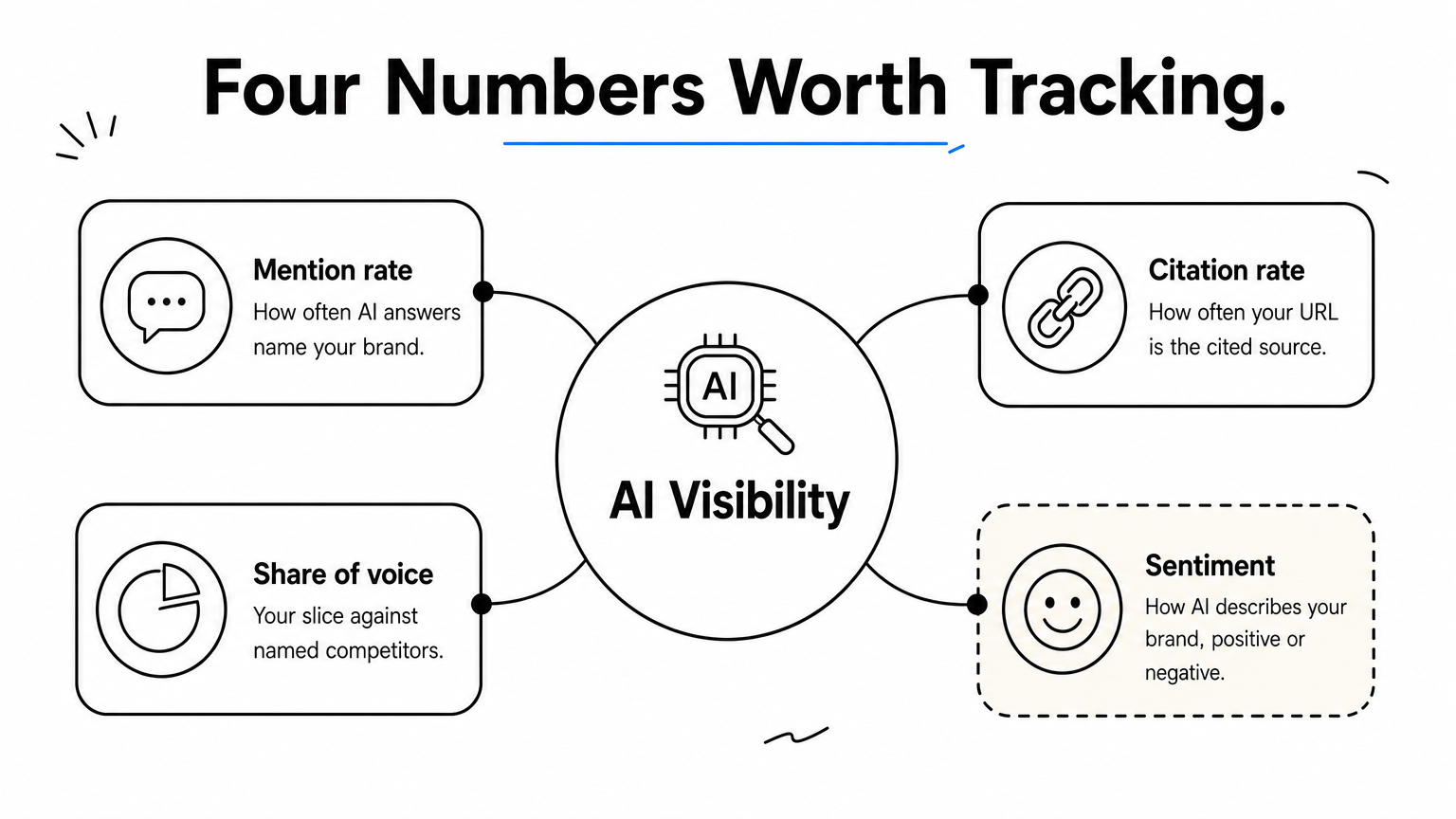
Do not chase a single score. Track mention rate (how often you appear), citation rate (how often your URL is the source), share of voice against named competitors, sentiment, and AI referral sessions in GA4. Review them monthly, because answers shift run to run and weekly swings are mostly noise.
Compare tools on prompts per dollar and engine fit, not on feature lists.
Prompt trackers show what AI says about you. They do not show what happens on your site when AI systems, and everything pretending to be one, show up. That gap matters most for ecommerce.
AI crawlers such as GPTBot, ClaudeBot, and PerplexityBot are real, and you want them reading your product pages. But user-agent strings can be spoofed, so a log line labeled with a trusted name proves little. Malicious bots can also inflate sessions and burn ad spend, which corrupts the analytics you use to judge your AEO and GEO tools.
Think of two datasets. One says how often AI engines cite you. The other says who is actually visiting. You need both to know whether a rise in citations led to a rise in real shoppers.
Start by separating verified AI crawlers from everything else, then block the rest before it reaches your analytics. Sherlock handles the verification, and Knox, Nostra's Edge Protect agent, blocks malicious bots before they distort reports. Both run at the edge, so they need no code changes.
Then compare. If a tracker shows citations climbing but verified AI traffic stays flat, check which pages AI systems are reading. If sessions jump without matching crawler activity, check whether those sessions are bots.
Clean traffic data is what makes your AEO and GEO numbers believable.
The best AEO and GEO tools differ less in features than in the job they do. Pick a tracker that covers your buyers' engines and fits your budget, and use a free grader to test the waters first. Then add a crawler and bot layer so the traffic data behind your results is real.
For ecommerce brands, that second layer is often the missing one. If bots are already skewing your analytics, see how Edge Protect screens out bad bots before they reach your storefront.


