AI engine optimization is the practice of shaping your content, your site, and your brand so that AI tools such as Google's AI Overviews and AI Mode, ChatGPT, and Perplexity mention and cite you in the answers they write. You will also see it called generative engine optimization (GEO) or answer engine optimization (AEO). The best strategy is the same in every case: write clear answers that are easy to quote, keep your pages crawlable, earn mentions on sites that AI tools trust, and measure how often you appear. Most of it builds on good SEO rather than replacing it.
At Nostra AI we run agents at the edge of ecommerce storefronts, and one of them, Sherlock, identifies and verifies AI crawler traffic. That gives us a practical view of this topic. AI systems are already visiting stores, and whether they can read your pages decides whether you can be cited at all.
This guide explains why AI engine optimization matters, how to do it step by step, and how to write and structure content that AI answers can lift. It also covers the technical access problems that quietly block citations, how generative AI can help with your SEO work, and how to measure results when there is no ranking position to check.
AI engine optimization matters because a growing share of searches now end with a written answer instead of a list of links, and the brands named inside that answer get the attention. If an AI tool does not mention you, a shopper comparing options may never see you.
In a classic search result, ten blue links compete and the user picks one. In an AI answer, the system reads several sources, writes one response, and names a few of them. You are competing to be part of the answer, not to hold position four on a page. Google has said that AI Overviews reach more than a billion people each month, and people also ask ChatGPT and Perplexity for product advice, comparisons, and how-to steps directly.
This changes what a "win" looks like. A mention in the answer builds consideration even when nobody clicks. A citation with a link sends a visitor who has already read a summary of your view and still wants more. Both outcomes matter, and neither shows up in a traditional rank tracker.
If an AI answer names your competitors and not you, you were not in the comparison at all.
SEO and AI engine optimization share a foundation: useful content, a crawlable site, and a trustworthy reputation. The differences are in the goal and the proof of success.
| SEO | AI engine optimization | |
|---|---|---|
| Goal | Rank a page in a results list | Be cited or named inside a generated answer |
| Unit of competition | The page | The passage, the fact, and the brand |
| Key tactics | Keywords, links, crawlability, intent match | Quotable answers, specific facts, crawler access, brand mentions across the web |
| How you measure | Rankings, organic clicks | Mention rate, citations, AI referral traffic, AI crawler activity |
So is SEO dead? No. AI tools often draw on traditional search indexes to find pages, and Google says its AI features rely on the same foundational SEO practices. A page that Google cannot index will not be a supporting link in an AI Overview. Treat AI engine optimization as a second layer on top of SEO, not a replacement.
Generative AI engine optimization, gen AI engine optimization, generative AI search engine optimization, GEO, and AEO all point at the same work. GEO names the technology that writes the answer. AEO names the behavior you want: being chosen as the answer. Some writers use "AIO" for yet another meaning, and others use it for Google's AI Overviews, so check which one a source means. The tactics below apply whichever label you prefer.
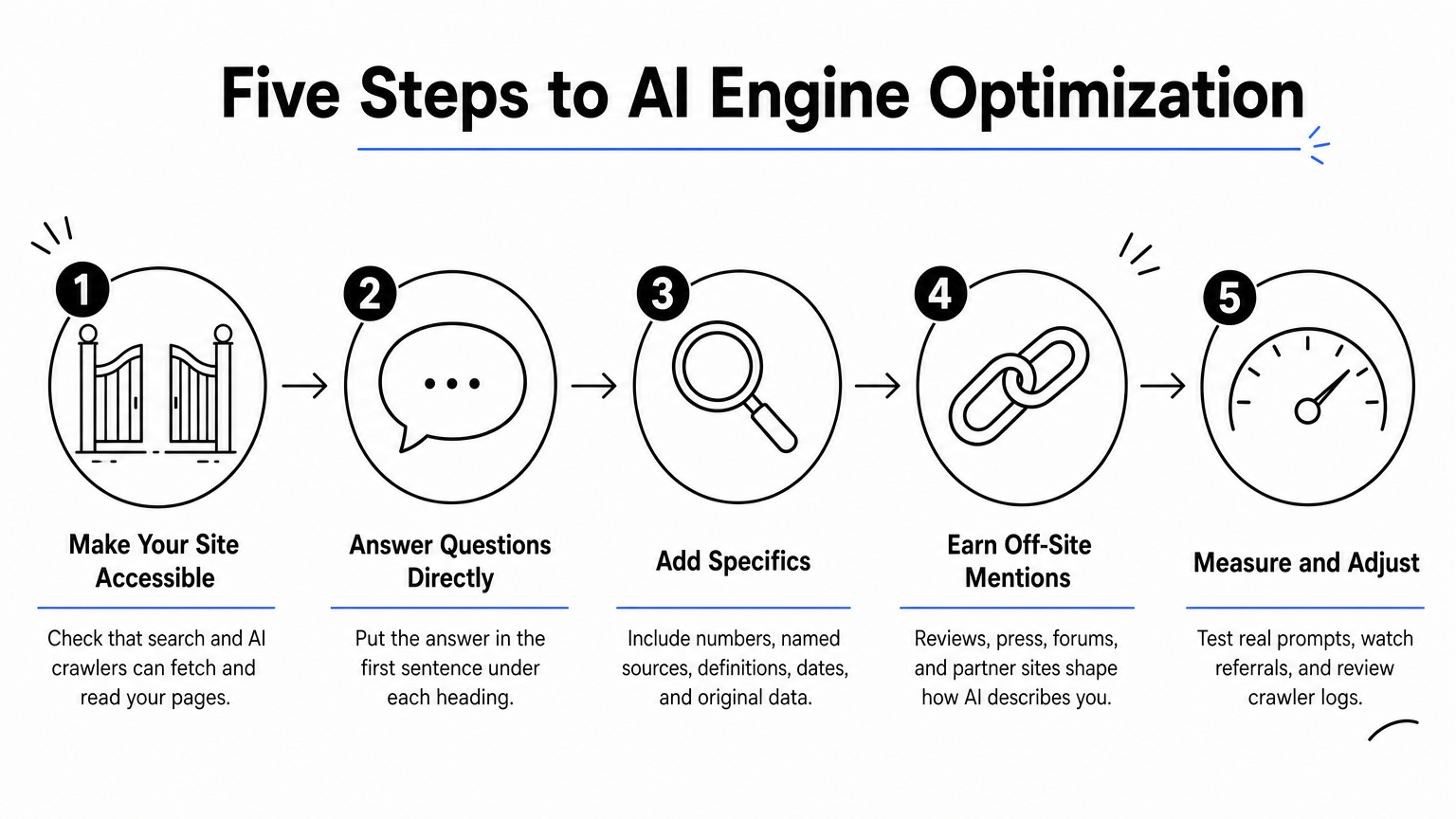
The best generative engine optimization strategy for most sites has five steps: make pages accessible, answer questions directly, add specific facts, earn mentions elsewhere, and measure. Do them in that order, because each step depends on the one before it.
An AI answer comes from two places. The model has absorbed patterns from its training data, which is why well-known brands show up by name. For current or specific questions, many tools also retrieve live pages, often through a traditional search index, and write the answer from the passages they pull.
Retrieval usually involves what Google calls query fan-out. The system takes one question and runs several related searches behind the scenes. A question like "best moisturizer for dry skin" may spawn searches on ingredients, price ranges, and reviews. Your page can be cited for a sub-question the user never typed. This is why covering a topic in depth with clear sub-answers beats targeting one keyword.
For Google specifically, a page must be indexed and eligible to appear in Search with a snippet to be a supporting link in AI features. Google's own documentation says no special markup or extra file is required.
AI tools cite passages, not pages, so every section of your content needs to stand on its own.
Sections below cover each step in practice.
Skip tricks. Hidden text, stuffed statistics, and pages built only to bait citations do not hold up, and they hurt human readers. Semrush's own guidance names overloading content with quotes and statistics, without real value, as the main risk of GEO. Also skip separate "AI versions" of your pages for human visitors. One strong page serves both audiences. The one exception is technical delivery, covered below, where a prerendered copy helps crawlers read the same content your shoppers see.
Content that gets quoted opens with the answer, uses specific facts, and is organized so a single passage makes sense on its own. This is closer to writing a good reference entry than to writing marketing copy.
Start each section with one or two sentences that answer the heading outright. Then add the reasoning, caveats, and examples. This mirrors featured snippet writing, and it works because an AI system looking for a passage to quote finds a complete answer at the top of your section instead of having to assemble one from your paragraph.
Use headings that match how people ask. "How long does shipping take to Canada?" beats "Delivery details". Keep answers plain: no filler, no vague claims, no "it depends" without saying on what.
Here is a template you can copy for any answer-first paragraph:
[Direct answer in one or two sentences.]
[Specific number, condition, or limit that makes it true.]
[Who it applies to, and the case where it does not.]
[Source, date, or how you know.]
Vague copy gives an AI tool nothing to lift. Compare these two statements:
The second version states criteria, which is what a shopper's prompt is asking for. An academic study that introduced the term generative engine optimization in 2023 tested nine tactics across thousands of queries, and found that adding quotations, statistics, and cited sources increased visibility in generated answers by roughly 30 to 40 percent in its tests. Treat those figures as directional, since real engines differ and change often, but the principle is sound: specific, attributable facts get used.
Original material goes furthest. Your own data, a tested process, pricing ranges you actually charge, or an interactive tool cannot be fully summarized by an AI answer, so it still earns the click.
Break long pages into sections that each answer one question. Use tables for comparisons, numbered lists for steps, and short FAQ blocks for the questions your support team hears every week. Keep terms consistent, because a model that sees you call the same product three different names will describe it less confidently.
Add author names, credentials, and dates where readers expect them. Trust is the heaviest factor in Google's own guidance, and the same signals help an AI tool decide whether to rely on you. Refresh pages when facts change, and change the date only when the content actually changed.
Write each section so that, copied alone into an AI answer, it still makes complete sense.
Your site is readable to AI crawlers when robots.txt allows them, your content appears in the plain HTML response, and no firewall or bot filter silently turns them away. A page they cannot fetch cannot be cited, however good it is.

AI companies run several crawlers with different jobs, and blocking one does not necessarily block the others. Training crawlers collect data for models. Search crawlers build the index behind answers. User-triggered fetchers load a page when someone asks a tool about it.
| Crawler | Operator | Main job |
|---|---|---|
| Googlebot | Crawls for Search, including AI Overviews and AI Mode | |
| Google-Extended | Control token for use in Gemini training and grounding, not a Search ranking factor | |
| OAI-SearchBot | OpenAI | Builds the index for ChatGPT search results |
| GPTBot | OpenAI | Collects content for model training |
| ChatGPT-User | OpenAI | Fetches a page when a user asks about it |
| PerplexityBot | Perplexity | Builds Perplexity's search index |
| ClaudeBot | Anthropic | Collects content for model training |
If you want citations, allow the search and user-triggered crawlers. Whether you allow training crawlers is a business decision, since it affects whether future models learn from your content. An explicit allow rule looks like this:
User-agent: OAI-SearchBot
Allow: /

User-agent: ChatGPT-User
Allow: /

User-agent: PerplexityBot
Allow: /

User-agent: Googlebot
Allow: /
Do not block Googlebot to keep out AI features. That removes you from Search entirely. Crawler names and behavior change, so confirm current details in each operator's documentation.
Googlebot renders JavaScript. Many other AI crawlers do not run it reliably. If your product descriptions, prices, or reviews load only after client-side scripts run, an AI crawler may see an empty shell. The fix is server-side rendering or prerendered pages for the content that matters.
Many ecommerce stores built on JavaScript-heavy themes run into this. Nostra's Edge Optimization service directs search engine bots to a version of the site without JavaScript and serves prerendered, cached pages, so new and edited pages are indexed faster. If you handle this yourself, test by viewing the raw HTML source of a key page and checking whether the text you want cited is present.
Bot protection and AI visibility can work against each other. A firewall rule tuned to stop scrapers can also stop OAI-SearchBot or PerplexityBot, and your robots.txt will still say they are welcome. The result is an invisible block that no one notices until citations never appear.
The answer is verification, not blanket blocking. Real crawlers can be verified against published IP ranges and reverse DNS, while imposters copy the name and fail the check. Nostra's Knox agent blocks malicious bots at the edge before they distort analytics or waste ad spend, and it lets verified crawlers such as Googlebot, ChatGPT, and Claude through. Sherlock verifies AI crawlers and streams that data to your AEO and analytics tools, so you can see which AI systems actually reached your pages.
A robots.txt file that says yes does not help if your firewall says no.
You earn AI mentions by being described the same clear way across many credible places, not only on your own site. AI tools build their picture of a brand from every review, comparison, forum thread, and article that mentions it.
AI systems associate brands with the problems and contexts they appear in. A brand that shows up consistently around one need, say "fragrance-free skincare for sensitive skin," is easier to recommend than one that appears around ten unrelated needs. Ann Smarty, a long-time SEO practitioner, describes this as clear positioning: ambiguity blurs your significance, and clarity gets you picked sooner.
Write one plain sentence stating who you serve and what problem you solve. Use it on your homepage, About page, partner profiles, and press materials. Then check that your product pages, FAQs, and help center do not contradict it.
Sources that AI tools often draw on include review sites, Reddit threads, YouTube, industry publications, and comparison pages. Unlinked mentions seem to count, so a credible article that names your brand without linking still helps. The practical steps:
Wikipedia can matter if your brand genuinely meets its notability rules, but never write or edit your own entry to promote yourself.
AI tools that retrieve live pages favor sources with current information, especially for prices, specs, and policies. Review your top pages on a schedule. Update facts, remove expired claims, and keep structured data such as product schema accurate. Stale or conflicting facts across your site and third-party listings make an AI tool less likely to trust any of them.
Consistent facts repeated across credible sites do more for your AI visibility than any single page.
Generative AI assists search engine optimization by speeding up research, drafting, analysis, and technical chores, while people still own strategy, accuracy, and original insight. Used that way it saves hours. Used to mass-produce pages, it creates risk.
These are the jobs where AI tools earn their place:
Google's guidance is clear that using automation, including AI, to produce content mainly to manipulate rankings violates its spam policies. The test is purpose and value, not the tool. A page written with AI help, reviewed by an expert, and full of first-hand detail can be helpful. A thousand thin pages generated from keyword lists are not.
AI tools also state wrong facts confidently. Never publish a price, spec, legal point, or statistic without checking it against a primary source. And remember that your own AI-written, generic content competes with every other generic page that AI tools can write. Originality is your edge: your data, your testing, your customer questions, your photographs.
Use AI to speed up the work, and use your own experience to make the work worth citing.
You measure AI engine optimization with a mix of prompt testing, referral traffic, crawler logs, and Search Console, because no single report shows AI visibility the way a rank tracker shows positions. Expect noisy data and judge trends over weeks.
Pick 20 prompts a real buyer would type. Include category questions, comparison questions, and problem questions, not just your brand name. Run them on a fixed schedule in ChatGPT, Perplexity, and Google's AI features, and record whether you are mentioned and whether your page is cited with a link.
Here is a worked example with illustrative numbers for a store tracking 20 prompts:
| Measure | Before changes | After 8 weeks |
|---|---|---|
| Prompts where the brand is mentioned | 6 of 20 (30%) | 11 of 20 (55%) |
| Prompts where a page is cited with a link | 3 of 20 (15%) | 7 of 20 (35%) |
Answers vary from run to run, so repeat each prompt a few times and use the average. Dedicated AI visibility tools can automate this at larger scale, but a spreadsheet works for a first pass.
In GA4, look for referral sessions from sources such as chatgpt.com and perplexity.ai, and compare their conversion rate with other channels. AI referral volume is often small, but visitors who arrive after reading a summary can be well qualified. Google's Search Console performance report includes traffic from AI features within its Web search totals, so you will not see it split out.
Server logs tell you the other half: which AI crawlers fetched which pages and how often. Falling crawler visits to key pages point to a block or rendering problem. Verified bot data, like what Sherlock streams to analytics tools, keeps that picture free of spoofed traffic.
AI visibility fluctuates as models and retrieval methods change, and no one can guarantee a citation. Judge your work by whether the inputs are right: pages crawlable, answers clear, facts specific, mentions growing. If those hold, outputs tend to follow. Review the prompt test monthly, fix what the logs reveal, and update your top pages when answers about you turn out wrong or out of date.
Measure the trend across many prompts, because any single AI answer can change tomorrow.
AI engine optimization comes down to being easy to find, easy to understand, and easy to trust. Open your pages to the right crawlers, answer questions first, back claims with specifics, and build a consistent presence beyond your own site. Then test real prompts and keep improving what the data shows.
Start with access, because it is the cheapest fix and the most common failure. Check your robots.txt, your rendered HTML, and your firewall rules this week. If bad bots are distorting your analytics while you try to stay open to good ones, Edge Protect filters malicious bot traffic in real time and lets verified crawlers through, so your store stays visible to the AI systems that matter.


