Your Shopify store loads slow, your conversion rate shows it, and you're done guessing which app or theme tweak might fix it. Every extra second of load time bleeds revenue, and mobile shoppers bounce faster than anyone else. That's exactly why a shopify speed optimization service exists: to hand the problem to people who fix it for a living instead of leaving it to trial and error in your theme editor.
This list answers the real question you're asking: which providers actually deliver faster Shopify storefronts, and what should you expect to pay and get in return. We compared shopify speed optimization agency options ranging from freelance Liquid developers to full platforms that work automatically at the edge, so you can match the fix to your store's size, tech stack, and budget.
Below, you'll find ten services worth evaluating for 2026, including how each one approaches mobile speed optimization, what kind of load time gains merchants report, and where automated edge-based optimization like Nostra AI's Dash agent fits compared to manual, code-heavy audits. By the end, you'll know exactly which option matches your store's needs.
Nostra AI takes a fundamentally different approach than most speed vendors. Instead of a one-time audit or a developer poking at your theme code, it runs a set of specialized agents that run your storefront at the edge, continuously monitoring and fixing performance issues in real time. The speed agent, called Dash, sits between your shoppers and your Shopify server, intercepting requests and accelerating page delivery without you touching a single line of Liquid.

Deployment starts with a DNS-level change, nothing more. There's no app install, no theme edit, no replatforming. Once connected, Nostra AI enters a 14-day observation window where its agents learn your store's traffic patterns, asset load order, and rendering bottlenecks. After that, Dash accelerates page delivery from 310+ edge locations automatically, compressing images, deferring non-critical scripts, and caching intelligently at the edge to shave seconds off load time.
A shopify speed optimization service that requires zero code changes removes the biggest reason merchants delay fixing site speed in the first place.
This model suits mid-size to large ecommerce and DTC brands that don't have a dedicated engineering team to babysit performance fixes, or that don't want to burn engineering hours on something a machine can handle continuously. It's also a strong fit for growth and ecommerce leaders who care about measurable revenue impact, not just a PageSpeed score, since Nostra AI ties speed gains directly to conversion data.
Nostra AI doesn't publish a flat rate because pricing scales with store traffic and which agents you activate. Brands typically start with Dash for speed alone, then layer in Knox, Sherlock, or Crumble as needs grow. Case studies with brands like U Beauty, Nixon, and Credo Beauty's 3.1% revenue lift show load time improvements of up to 47% and an average expected revenue lift near 3%, numbers that make the ROI conversation straightforward when you request a quote. If your team wants a plan tailored to your specific storefront and traffic volume, book a demo directly with Nostra AI to get exact figures before committing.
Aureate Labs positions itself as a Shopify-focused agency that promises a specific outcome: a Google PageSpeed score of 75 or higher, backed by a written guarantee, though it's worth knowing first what a good Shopify speed score really tells you. That's a different pitch than most shopify speed optimization services, which talk about percentage improvements without committing to a number you can screenshot and hold them to.
Typically, the engagement starts with a manual audit of your theme code, apps, and third-party scripts. Developers then go section by section, rewriting bloated Liquid, lazy-loading images, and stripping out CSS and JavaScript your pages never use until your store clears the 75-point threshold on both mobile and desktop tests.
A guaranteed score gives you a concrete benchmark, but it says nothing about whether that score actually moves your conversion rate.
Merchants who want a one-time, project-based fix rather than ongoing management will find this appealing. It suits smaller stores with a single problematic theme or a handful of heavy apps dragging down load times, especially teams that don't have in-house developers and want a defined start and end date for the work.
Aureate Labs quotes projects individually based on theme complexity and app count, so expect a custom estimate rather than a published rate card. Because it's a one-time engagement, you'll want to budget separately for future fixes if new apps or theme updates slow the store back down after delivery.
Amasty built its reputation as a Shopify app developer, and its speed optimization arm applies that same app-level expertise to performance audits. Rather than treating your storefront as one big black box, the team breaks it down into theme code, installed apps, and third-party scripts, then scores each layer separately for its impact on load time. This makes it a solid pick if you already suspect a specific app is the culprit but can't prove it, since Shopify apps quietly destroy page speed through the scripts they inject.
Audits start with a full inventory of every app and script running on your store, cross-referenced against Core Web Vitals and PageSpeed data. From there, developers recommend which apps to remove, replace, or defer, and rewrite theme sections that block rendering. It's a manual, developer-led process rather than automated monitoring.
Knowing which app is slowing you down only helps if someone actually fixes it, not just flags it.
Stores running a heavy app stack, ten or more third-party integrations, tend to get the most value here. It also suits merchants who want a website speed optimization service shopify teams can point to as proof of due diligence before a big traffic event like Black Friday and Cyber Monday.
Amasty quotes audits per project, typically scaled to app count and theme complexity, with no published flat fee. Expect a range that widens fast once you request custom development beyond the initial audit.
BSS Commerce started as a Shopify app and development shop, and its speed work leans heavily on that engineering background. Instead of a generic audit checklist, the team digs into your store's actual codebase, theme templates, custom sections, and app scripts, then rebuilds the pieces that hurt your Core Web Vitals scores the most. If your store has heavy custom development already, this shopify speed optimization agency tends to understand the code better than teams that only work with stock themes.
Engagement starts with a technical audit that measures Largest Contentful Paint, Cumulative Layout Shift, and First Input Delay against Google's published Core Web Vitals thresholds. Developers then rewrite render-blocking code, restructure image loading, and refactor custom Liquid sections that were built without performance in mind. Because BSS Commerce also builds Shopify apps, they can spot when a third-party app's own code is the bottleneck rather than just flagging it.
Fixing Core Web Vitals scores matters only if the fix survives your next theme update.
This fits merchants running heavily customized Shopify or Shopify Plus stores with bespoke sections, custom checkout extensions, or legacy code from past developers. It suits teams that need a partner comfortable reading and rewriting code, not just installing an app or adjusting settings.
BSS Commerce prices projects based on scope, so a full codebase overhaul costs considerably more than a targeted Core Web Vitals fix. Expect a custom quote after an initial technical review, with ongoing maintenance retainers offered separately for stores that update themes frequently.
EcomBack targets a specific gap: growing stores that have outgrown DIY app fixes but aren't ready to hire a full-time developer. The pitch is simple, hand over the speed problem entirely and get monthly reports instead of a to-do list. For merchants who want a shopify speed optimization service that runs quietly in the background, this fits better than an agency that expects you to manage the project.
Onboarding starts with a baseline speed test across your top landing pages, then EcomBack's team makes changes directly in your theme on a recurring schedule rather than a single pass. They monitor for regressions after app updates or theme changes and roll fixes back in without you filing a ticket. It's closer to a managed subscription than a project engagement.
Speed fixes that don't get maintained after launch tend to decay the moment you install your next app.
This suits growing DTC brands adding apps and features quickly, where speed keeps slipping because nobody owns it full-time. Merchants who want website speed optimization services shopify stores can rely on without checking in constantly will find the hands-off model appealing, especially teams under 20 people without dedicated ecommerce engineering.
EcomBack sells monthly retainer packages rather than one-off projects, with tiers based on store traffic and how frequently you push theme or app changes. Expect the lowest tier to cover basic monitoring and minor fixes, with larger retainers needed for stores that update their theme weekly or run seasonal campaigns requiring rapid turnaround.
Meditodigital frames speed work as a conversion project first and a technical project second. Instead of chasing a PageSpeed number, the team ties every fix back to checkout completion and add-to-cart rates, arguing that a faster product page only matters if it actually sells more, an idea backed by the data on how page speed affects conversion rate. For merchants tired of vanity metrics, this shopify speed optimization service reframes the whole engagement around revenue.

Projects start with a conversion funnel review layered on top of a standard speed audit, so developers know which pages carry the most revenue weight before touching any code. From there, the team prioritizes fixes on high-traffic landing pages and product pages first, deferring lower-impact template work until later phases. A/B testing often runs alongside the speed changes to confirm the fix actually moved the needle, not just the load time, an approach the founder of Heatmap.com uses for end-to-end CRO.
A faster page that doesn't convert better wasn't worth optimizing in the first place.
This fits marketing-led teams and growth leaders who need to justify a speed budget with revenue numbers, not just technical scores. It suits mid-size stores running active paid traffic campaigns, where every second of load time has a measurable cost tied to ad spend, and where the team already tracks conversion rate closely enough to notice small lifts.
Meditodigital scopes projects around funnel complexity and traffic volume rather than a flat rate, so expect a custom quote after an initial conversion and speed audit. Ongoing optimization retainers are available for stores that want ongoing A/B testing layered on top of the initial fixes.
Presidio works higher up the stack than most agencies on this list, treating speed as one piece of a broader Shopify Plus engineering relationship rather than a standalone project. The team handles migrations, custom app development, and performance tuning under the same roof, so speed fixes get built alongside your architecture instead of bolted on afterward. If your store already runs custom infrastructure, this shopify speed optimization agency understands the tradeoffs between speed and functionality better than a firm that only touches themes.
Engagements typically start with a technical discovery phase covering your entire stack, checkout customizations, headless frontends, third-party integrations, and hosting setup, not just the storefront theme. From there, engineers rebuild slow components at the architecture level, restructure API calls, and optimize server-side rendering where applicable. Because Presidio also handles platform migrations, they can recommend structural changes, like moving to Hydrogen or a headless setup, when theme-level fixes won't be enough.
Speed problems rooted in your architecture never get solved by theme tweaks alone.
This fits Shopify Plus merchants with complex, custom-built storefronts, headless frontends, or heavy backend integrations where a generic speed audit won't touch the real bottleneck. It suits enterprise teams with in-house technical stakeholders who need a partner capable of architecture-level conversations, not just Liquid cleanup.
Presidio prices engagements as custom technical projects, typically scoped over weeks or months rather than a fixed audit fee. Expect costs closer to enterprise consulting rates than a typical theme audit, reflecting the depth of the engineering work involved.
The4 built its name as a Shopify theme developer, and its speed optimization work grows directly out of that background. Rather than auditing whatever theme you already have, the team often recommends pairing performance fixes with a switch to one of its own lightweight, speed-tested themes, arguing that a bloated third-party theme is frequently the root cause no amount of patching can fully solve. For merchants comparing shopify speed optimization services, this is the one built around design and theme architecture rather than backend code.
Work usually starts with a review of your current theme's structure, asset weight, and app-driven code bloat, benchmarked against The4's own optimized theme builds. If your existing theme is salvageable, developers strip unused code, optimize image delivery, and tighten CSS and JavaScript. If it isn't, they'll propose a theme migration built for speed from the ground up, then rebuild your design inside it.
Sometimes the fastest fix for a slow store isn't a patch, it's a better-built theme underneath it.
This suits merchants who are already unhappy with their theme's design and open to a refresh, not just a speed fix. It fits smaller to mid-size stores without heavy custom development, where switching themes is realistic without breaking custom checkout logic or bespoke sections.
The4 prices theme licenses separately from optimization services, with migration and customization work quoted per project based on design complexity and how much custom functionality needs rebuilding in the new theme.
C2 Digital positions itself differently from agencies that outsource work to contractors between projects. The company keeps a dedicated in-house development team focused specifically on ecommerce performance, which means the same engineers who audit your store also build the fixes, rather than handing recommendations off to a separate build team. For merchants burned by agencies that subcontract the actual coding, this shopify website speed optimization service offers more continuity from diagnosis to delivery.
Projects begin with a full performance audit covering theme code, app stack, and hosting configuration, run entirely by C2 Digital's own staff. Developers then prioritize fixes based on impact, tackling render-blocking scripts and oversized images first, before moving into deeper theme refactoring. Because the team stays in-house, you get a single point of contact throughout the engagement instead of rotating contractors.
A single accountable team from audit to build catches fewer things falling through the cracks than a handoff between separate contractors.
Growing brands that want a shopify speed optimization agency with consistent staffing throughout the project will find this appealing. It suits merchants who've had bad experiences with outsourced dev work disappearing after the invoice clears, and who value being able to reach the same engineer for follow-up questions months later.
C2 Digital quotes projects individually based on store complexity, with no published flat rate. Expect ongoing support to cost less than the initial audit and build phase, since the team already knows your codebase by that point.
MLVeda works almost exclusively with Shopify Plus merchants running large catalogs, multiple storefronts, or B2B and wholesale layers on top of their consumer store. The company built its reputation on Shopify Plus migrations and custom app development, so speed optimization here comes packaged as part of a broader enterprise support relationship rather than a standalone audit. If your store has outgrown the fixes that work for a standard Shopify plan, this shopify speed optimization agency is built for that scale.
Engagements start with a technical review of your entire Plus environment, multi-storefront setups, B2B pricing logic, ERP integrations, and custom checkout extensions included. From there, MLVeda's developers optimize server-side rendering, clean up API calls between your storefront and connected systems, and restructure theme code that wasn't built to handle enterprise-level traffic spikes.
Enterprise stores need speed fixes that survive integration complexity, not just a lighter theme.
This fits large Shopify Plus merchants managing multiple storefronts, wholesale channels, or heavy ERP and CRM integrations where generic speed audits miss the real bottlenecks. It suits enterprise teams that already have technical stakeholders in-house and need a partner fluent in Plus-specific infrastructure, not just theme cleanup.
MLVeda scopes projects as enterprise engagements, so pricing runs well above standard theme-audit rates and depends heavily on integration count and storefront complexity. Expect a multi-week discovery phase before you get a firm quote, with ongoing retainers priced separately for continued support.
Before you sign a contract with any shopify speed optimization service, spend an afternoon testing your website speed to check whether your slowdown has an obvious cause. Plenty of stores lose seconds to problems any merchant can fix without touching code, and knocking those out first means you walk into vendor conversations with a cleaner baseline and a more accurate quote.
Start with your app stack, and check it against the best Shopify speed apps for 2026 before adding anything new. Every installed app injects its own script, and most stores accumulate apps they stopped using months ago. Uninstalling dead weight often recovers more load time than any single theme edit.
The fastest speed fix costs nothing: delete the apps you forgot you installed.
Run through this checklist before requesting proposals:
Once you've cleared these basics and your store still lags, that's your signal a website speed optimization service shopify developers can't fix in an afternoon is worth the investment. Merchants who skip this step often pay an agency to fix problems a five-minute app cleanup would have solved for free. Treat this checklist as due diligence, not a substitute for professional work if your bottleneck turns out to be architectural rather than cosmetic.
Picking between ten providers gets easier once you stop comparing marketing pages and start asking which type of website optimization company fits your store, based on how each one matches your actual complexity. A shopify speed optimization service built for a single-theme store with a handful of apps won't serve a Shopify Plus merchant running headless checkout and three storefronts, and vice versa. Before you request a quote, map your store against the factors below so you're not paying for engineering depth you don't need, or worse, hiring a theme shop for an architecture problem.
Grouping the providers above by what they actually solve, the same way you'd compare performance optimization software, makes the decision faster than reading case studies one by one.
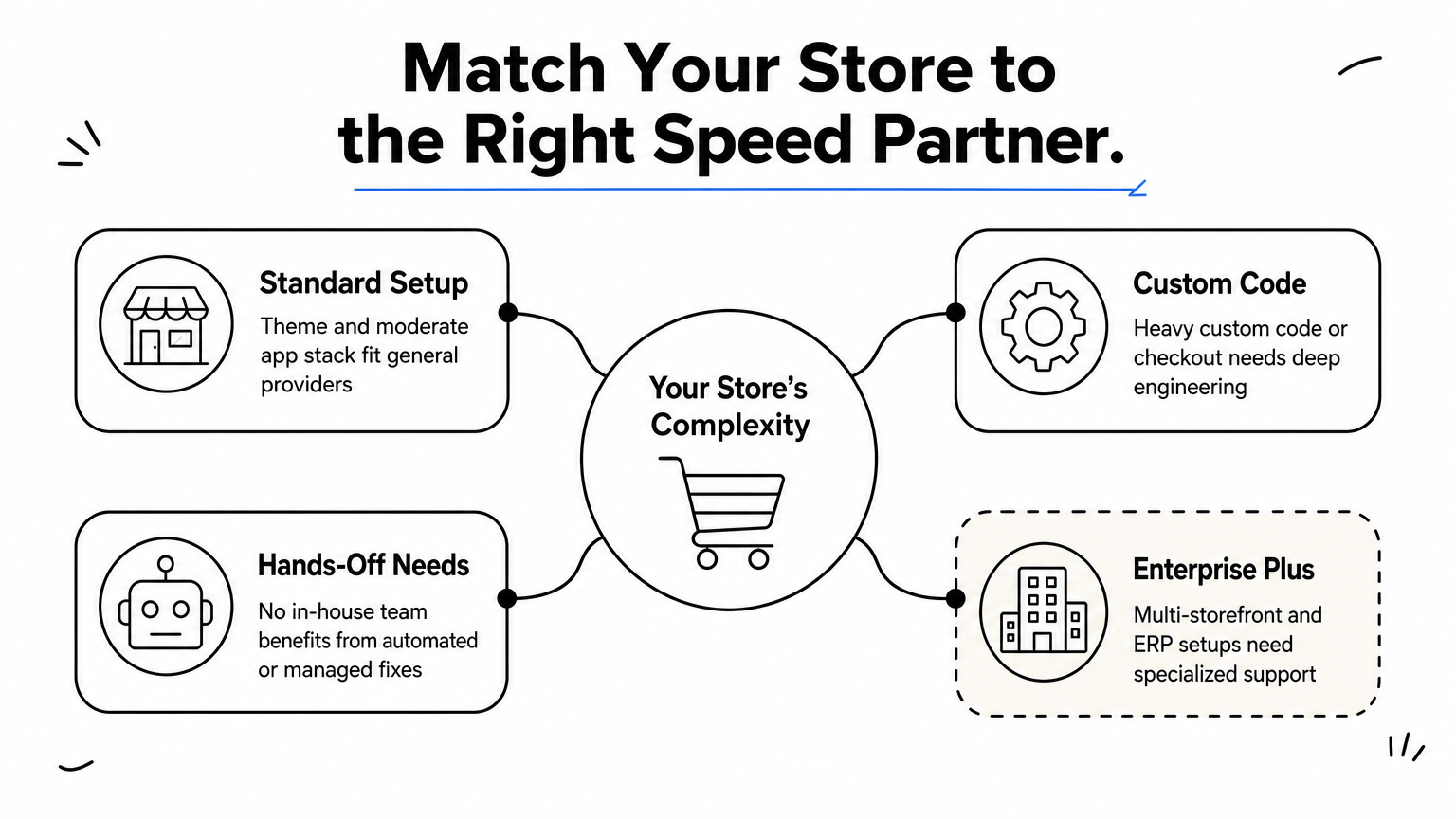
| Your situation | Best-fit provider type |
|---|---|
| Standard theme, moderate app stack | Aureate Labs, Amasty |
| Heavy custom code or checkout extensions | BSS Commerce, Presidio |
| No in-house engineering, want hands-off | Nostra AI, EcomBack |
| Shopify Plus, multi-storefront, ERP integrations | MLVeda |
| Open to a theme refresh alongside speed fixes | The4 |
Choosing a provider built for your store's actual complexity matters more than choosing the one with the best case studies.
Confirm whether you're buying a one-time project or an ongoing retainer, since a single audit won't stop your store from slowing down again after the next app install or theme update. Push every vendor for a written reporting cadence, weekly, monthly, or per release, so you can catch regressions before they cost you conversions. Finally, ask how they measure success. A provider chasing a PageSpeed number alone isn't the same as one tying fixes to conversion rate and revenue per visitor, and it helps to know why lab scores and real-user field data disagree before that distinction shows up in the contract rather than just the sales pitch.
Setting expectations before you sign a contract saves you from a frustrating conversation three months in. Most shopify speed optimization services should move your Largest Contentful Paint and Time to First Byte into measurable improvement within four to six weeks, not just shrink a PageSpeed number that doesn't translate to revenue. Realistic benchmarks look like this:
| Metric | Baseline (typical slow store) | Target after optimization |
|---|---|---|
| Largest Contentful Paint | 4.5s+ | Under 2.5s |
| Mobile PageSpeed score | 30-50 | 75+ |
| Time to First Byte | 800ms+ | Under 400ms |
| Conversion rate lift | N/A | 2-5% |
Tracking these numbers yourself matters just as much as trusting a vendor's dashboard. Pull a baseline from Google's PageSpeed Insights before work starts, then re-run the same five landing pages every two weeks during the engagement so you catch backsliding early. Comparing shopify mobile speed optimization services claims against your own mobile test results, not desktop numbers, matters most since mobile traffic usually carries the bulk of your bounce risk, so learn how to optimize your site for mobile devices as you measure.
A speed score means nothing until you can point to the revenue number it moved.
Revenue is the number that actually justifies the spend, so tie every speed report back to conversion rate and revenue per visitor in your analytics platform, not just load time. Watch for regressions after every new app install or theme update, since a single unoptimized script can undo weeks of work overnight. Vendors who report on both technical and revenue metrics, without you asking twice, are the ones worth renewing.
Speed problems rarely have one cause, and the ten providers above prove there's no single fix that works for every store. A shopify speed optimization service built for a bootstrapped DTC brand won't match the needs of a Shopify Plus merchant running headless checkout, and pretending otherwise wastes both your budget and your patience. What matters most is matching provider depth to your actual complexity, then holding them accountable to revenue numbers, not just a PageSpeed score you can screenshot once and forget.
Before you sign anything, remember that bot traffic skews the very metrics you're paying to improve. Fake sessions inflate bounce rates, distort load-time averages, and waste ad spend chasing visitors who were never going to buy. Pair your speed fix with a filter that keeps that traffic out in the first place. See how Nostra's bot filtering at the edge stops fake traffic before it reaches your store, so every optimization dollar you spend actually reflects real shoppers.


.svg)
