ChatGPT, Perplexity, and Gemini now send real shoppers to ecommerce sites, but most brands have no idea whether those AI engines even know their products exist. If you've been searching for the top answer engine optimization options for ai visibility products, it's because you've noticed the gap: your SEO dashboards look fine, yet you can't tell if an AI crawler ever verified your storefront or cited your pages in an answer.
This article gives you a straight comparison of the tools actually built for this problem, not generic SEO platforms with an AI label slapped on. You'll see which options handle AI crawler verification, which focus on citation tracking across engines, and which of the AEO tools for AI search visibility fold that data into a broader edge infrastructure stack so you're not adding another disconnected dashboard to your stack.
We built this list from hands-on experience running AEO-adjacent infrastructure for over 300 ecommerce brands, so expect specifics: what each tool measures, where it falls short, and who it fits. Nostra AI's own Sherlock agent shows up here because identifying and verifying AI bot traffic at the edge is exactly what feeds AEO strategy with real data instead of guesses. By the end, you'll know which of the answer engine optimization solutions for AI tech deserves a spot in your stack this year.
Most AEO tools tell you which prompts mention your brand, but almost none tell you whether an actual AI crawler visited your storefront in the first place. Nostra AI closes that gap with Sherlock, its AI discovery agent that runs at the edge of your storefront and verifies AI crawler and bot traffic before it ever hits your analytics. Instead of guessing based on referral data, you get confirmed, real-time detection of GPTBot, PerplexityBot, and ClaudeBot, dozens of other AI agents, plus the malicious bots pretending to be them. Because Sherlock sits inside the same edge layer as Nostra AI's speed, security, and identity agents, you're not bolting on another standalone AEO dashboard, you're adding verified traffic data to infrastructure you likely already run.
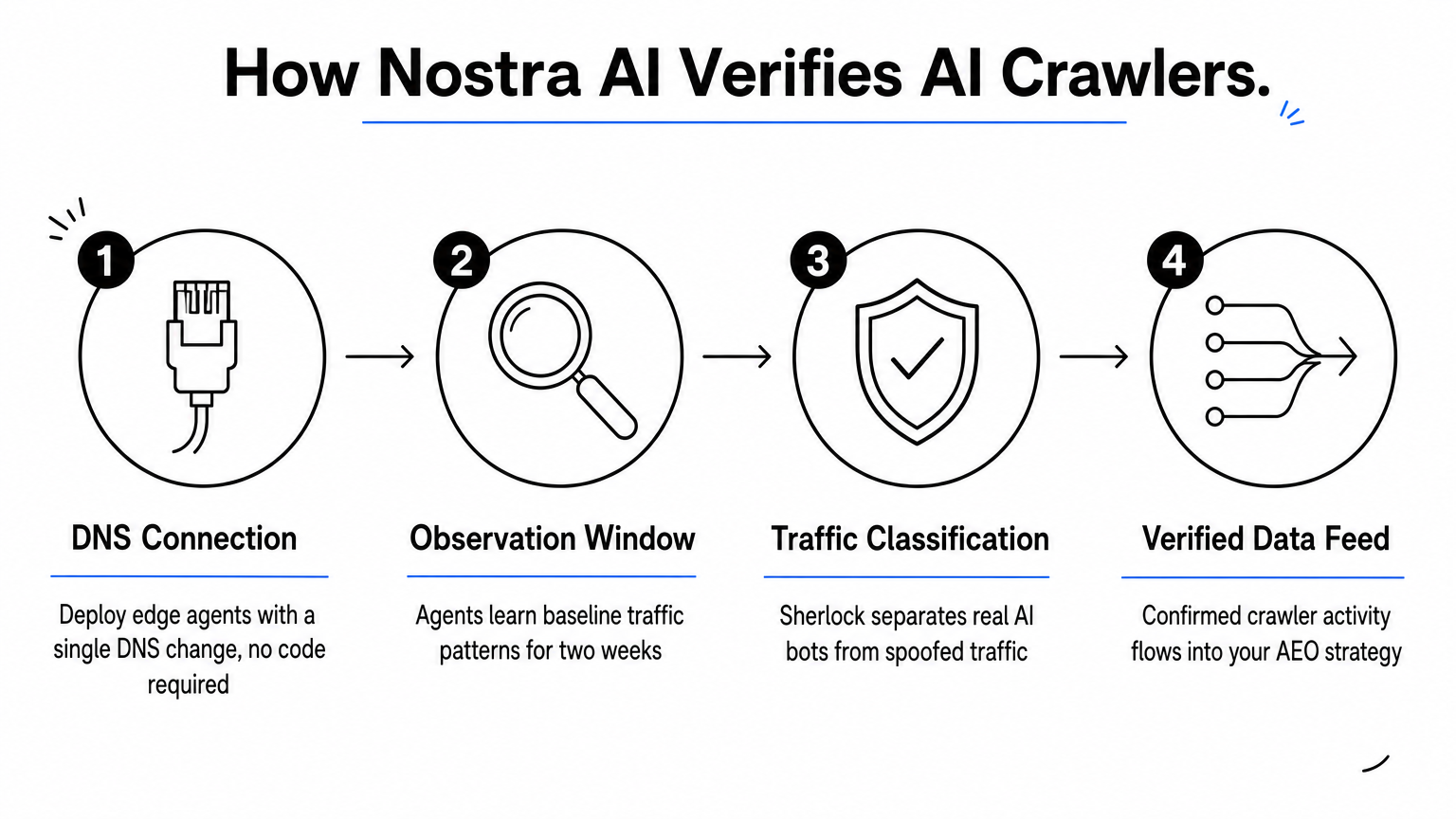
Deployment happens at the DNS level, so there's no code to ship and no replatforming required. Once connected, Nostra AI enters a two-week observation window where its agents, including Sherlock, learn your store's traffic patterns and baseline behavior. From there, Sherlock classifies every request hitting your edge, separating legitimate AI crawlers from the bad bots spoofing their user agents to scrape pricing or inventory data. That verified edge traffic data then feeds directly into your AEO strategy: you finally know which pages AI engines actually crawl, how often, and whether your product and content pages are even reachable by them.
You can't optimize for AI engines you can't confirm are actually visiting your site.
What separates Sherlock from prompt-tracking tools is that it works at the traffic layer, not the content layer. Here's what stands out:
Nostra AI fits ecommerce and DTC brands that already care about site speed, bot protection, or identity tracking and want AI crawler verification added to that same infrastructure rather than managed separately. It's a strong match if your growth or ecommerce ops team wants hard data on AI bot behavior without asking engineering to instrument anything new. Brands running pure content-marketing AEO plays with no storefront infrastructure to protect will get less out of it than brands with real revenue on the line at checkout.
Nostra AI doesn't publish flat-rate pricing publicly since packages scale with traffic volume and which agents you activate. Most brands start with a scoped conversation covering current traffic, bot exposure, and speed benchmarks. You can request a walkthrough directly through Nostra AI to get pricing specific to your storefront's size and stack.
Profound built its name tracking how brands show up across ChatGPT, Gemini, Perplexity, and Copilot, then pairing that visibility data with content recommendations. It's one of the most popular answer engine optimization platforms among mid-market and enterprise marketing teams because it doesn't stop at reporting; it tells you what to publish or fix to close the citation gap it finds. If your team wants a single dashboard tracking both brand mentions and competitor mentions across AI engines, Profound, which Nostra feeds edge-level AI discovery data, is usually the first name that comes up in that conversation.

Profound runs thousands of representative prompts through major AI engines on a recurring basis, capturing whether your brand gets cited, how you're described, and which competitors show up instead. The platform then maps those citations back to the source pages AI models pulled from, so you can see which of your own pages are actually influencing answers versus sitting invisible.
Knowing which of your pages actually feed AI answers matters more than knowing your overall visibility score.
Profound's strongest feature is its content gap analysis, which flags topics where competitors get cited and you don't. Other notable capabilities include:
Profound suits marketing and content teams at brands with dedicated resources to act on its recommendations. It's a heavier lift than a pure monitoring tool, so it fits teams already running structured content programs rather than solo operators looking for a quick visibility check.
Profound doesn't list public pricing; enterprise plans are quoted based on prompt volume and engine coverage, and typically start in the low thousands per month, putting it well above lighter-weight monitoring tools on this list.
Similarweb already owns a huge share of the web analytics and competitive intelligence market, and it's now layering AI search visibility on top of that existing data pipeline. Instead of building AEO tracking from scratch, Similarweb extends its traffic panel and digital research tools to show how much referral traffic AI engines like ChatGPT and Perplexity actually send to your site and your competitors. If you already use Similarweb for market research, adding its AI visibility module means one less new vendor to onboard.
Similarweb pulls from its massive panel of web traffic data to estimate how much traffic AI chat engines drive to a given domain, then layers in prompt-based tracking to show which brands get cited for category-relevant queries. Because the platform already tracks direct, search, and referral traffic at scale, it can place AI-driven visits in context against your other channels rather than reporting them in isolation.
Traffic estimates only matter when you can compare them against every other channel feeding your site.
Similarweb's edge is context: you're not just seeing an AI visibility score, you're seeing it next to organic search, paid, and social traffic for both your domain and named competitors. Notable capabilities include:
Similarweb fits brands that already pay for its market intelligence suite and want AI visibility folded into reports they're already running for leadership. It's a weaker standalone choice if you have no existing Similarweb relationship, since you'd be buying a broad competitive intelligence platform mainly for one feature.
Similarweb doesn't publish flat pricing for its enterprise plans; costs depend on the modules and traffic volume you need, and quotes typically run into the thousands per month once you add AI visibility on top of core plans.
Rankscale.ai positions itself as a multi-engine tracking tool built specifically to answer one question: where does your brand show up when someone asks ChatGPT, Gemini, Claude, or Perplexity about your category? Unlike broader competitive intelligence suites, Rankscale keeps its scope narrow, which makes it one of the best rated answer engine optimization for ai applications among teams who want a focused tool rather than a bundled platform with AEO tacked on.
Teams start by defining the topics, brands, and competitor names they want tracked, then Rankscale runs a rotating set of prompts against each supported engine on a recurring schedule. The platform logs whether your brand appears, where in the answer it lands, and which sources the engine cites alongside you, then organizes that data into engine-by-engine views so you can spot where you're strong in one model and invisible in another.
A brand that dominates ChatGPT citations can still be completely absent from Gemini, and you won't know unless you track both separately.
Rankscale's dashboard breaks visibility down by engine rather than blending everything into one score, which matters since each AI engine sources answers differently. Other notable features include:
Rankscale suits teams that already know which engines matter most to their customers and want granular, engine-specific data rather than a single blended score. It's a good fit for lean marketing teams that need clear reporting without the heavier content workflows that platforms like Profound require.
Rankscale.ai offers tiered plans based on prompt volume and the number of engines tracked, with entry-level plans priced for smaller teams and custom quotes for enterprise accounts running larger prompt libraries.
PromptWatch splits its focus evenly between two things most tools treat separately: what prompts trigger a mention of your brand, and which crawlers actually show up on your site afterward. That combination makes it one of the best answer engine optimization for enhancing ai visibility picks for teams who want prompt-level detail without switching to a second tool for server log analysis. It's built for marketers who already track keywords the traditional way and want a similar workflow applied to AI engines.
You feed PromptWatch a list of seed prompts and category terms relevant to your business, and it runs those queries against ChatGPT, Perplexity, and Gemini on a set schedule. Alongside that, the platform ingests your server logs or CDN data to flag AI crawler visits, then lines up the two data sets so you can see whether a spike in prompt mentions actually correlates with more crawler activity on your pages.
Prompt mentions without crawler visits usually mean the AI engine is citing a source other than your own site.
PromptWatch's log correlation is its clearest differentiator from pure prompt-tracking tools. Other notable capabilities include:
Smaller marketing teams that want a lighter, more hands-on tool fit PromptWatch well, especially those comfortable building and refining their own prompt lists rather than relying on an automated prompt library. Larger teams needing sentiment analysis or content recommendations will likely outgrow it quickly.
PromptWatch runs on tiered monthly plans based on prompt volume, with its entry plan priced for single-brand tracking and higher tiers adding competitor prompts and extended log history.
AthenaHQ takes a different angle than most trackers on this list: instead of stopping at a visibility score, it hands you a ranked list of fixes to close the gap. That prescriptive layer makes it one of the best rated answer engine optimization for ai applications for teams that don't have an in-house strategist translating dashboards into action items. You still get citation tracking across engines, but the product treats that data as an input to a to-do list, not the final deliverable.
AthenaHQ runs prompt sets against ChatGPT, Perplexity, and Gemini, then cross-references your citation results against pages already ranking well in traditional search to spot where the two diverge. When a page ranks on Google but never surfaces in an AI answer, the platform flags the likely cause, whether that's missing structured data, thin sourcing, or a competitor page AI models trust more, and queues it as an action item with a priority level attached.
A visibility score tells you where you stand; a prioritized fix list tells you what to do about it.
AthenaHQ's action queue is the standout, turning raw citation gaps into ranked tasks your team can actually assign. Other notable capabilities include:
AthenaHQ suits lean marketing teams without a dedicated AEO strategist who still want clear direction rather than raw data to interpret themselves. It's less useful for teams that already have strong internal analysis capability and just want the underlying citation numbers, since you're paying partly for the recommendation layer on top.
AthenaHQ prices plans around prompt volume and the number of tracked pages, with published starter tiers aimed at single-brand teams and custom quotes for agencies managing multiple client accounts.
Scrunch takes a different approach than the trackers above: instead of just measuring how AI engines cite you, it changes what those engines actually receive when they crawl your site. The platform generates a structured, machine-readable version of your content and serves it to AI crawlers, so models pull cleaner, more complete information than they'd get parsing your regular HTML. That makes Scrunch one of the best answer engine optimization for enhancing ai visibility picks for teams who suspect their content is fine for human readers but hard for AI models to parse correctly.
Once installed, Scrunch scans your existing pages and builds a parallel content layer optimized for AI consumption, things like clarified product specs, structured FAQs, and explicit entity relationships that crawlers often miss in standard page markup. When a recognized AI crawler requests a page, Scrunch serves this optimized version alongside the original, then tracks whether that change correlates with better citation rates over the following weeks, an approach that raises the usual question of whether optimizing the crawled version of your site is gaming the system.
Feeding crawlers cleaner content matters as much as knowing whether they showed up at all.
Scrunch's core differentiator is that it acts on your content rather than just reporting on it. Other notable capabilities include:
Scrunch suits brands with large content libraries and a hunch that formatting, not visibility, is the real blocker. Teams that already publish clean, well-structured content will see less lift here than teams with sprawling, inconsistent product pages.
Scrunch prices based on page volume and crawl frequency, with tiered plans scaling up for larger catalogs and custom quotes for enterprise sites needing full-catalog optimization.
Evertune focuses on something the citation-counting tools above mostly skip: whether AI engines describe your brand correctly and favorably once they do mention you. Getting cited matters less if the answer misstates your pricing, misrepresents your product line, or leans on outdated claims pulled from a stale review site. That focus on accuracy and sentiment makes Evertune one of the best answer engine optimization for enhancing ai visibility picks for brands worried about reputation risk as much as raw visibility.
Evertune runs recurring prompt sets across major AI engines and captures the full text of each response, not just whether your brand name appears. It then scores those responses for factual accuracy against a reference profile you supply (pricing, specs, positioning) and flags mismatches, alongside a sentiment read on whether the tone skews positive, neutral, or negative. Results get tracked over time so you can see whether corrections you make upstream, on your site or in press coverage, actually shift how models describe you.
A citation that misrepresents your brand can do more damage than no citation at all.
Evertune's fact-checking layer is its clearest differentiator from pure mention-tracking tools. Other notable capabilities include:
Evertune fits brands in regulated or reputation-sensitive categories, plus any team that has already been burned by an AI engine repeating outdated or inaccurate information about pricing or claims. It's less necessary for brands with simple, low-risk product lines where a wrong detail in an AI answer wouldn't cause real damage.
Evertune doesn't publish flat pricing; plans are quoted based on the number of tracked prompts and engines, with enterprise brands typically paying for expanded competitor benchmarking on top of core monitoring.
Peec AI keeps its focus narrow: track brand and competitor citations across ChatGPT, Perplexity, and Gemini, then present that data in a dashboard that doesn't require a training session to read. Where some platforms bury you in overlapping charts, Peec AI strips the interface down to what growth teams actually check weekly, making it one of the best rated answer engine optimization for ai applications among teams that just want dependable numbers without a steep learning curve. It's less about depth and more about daily usability.
A tool you actually open every week beats a feature-rich dashboard that sits ignored.
Once you set up brand and competitor tracking, Peec AI runs a fixed prompt library against major AI engines on a recurring schedule and logs every citation, along with the surrounding answer text. Results roll into a dashboard organized by engine and by topic, so you can see at a glance whether your visibility is holding steady or slipping in a specific category.
Peec AI's interface is deliberately simple, and that simplicity extends to how it surfaces changes worth acting on. Notable capabilities include:
Growth and ecommerce ops leads who want a quick, reliable read on AI visibility, without digging through a cluttered interface, will get the most from Peec AI. Teams needing deep content recommendations or fact-checking layers should look elsewhere on this list.
Peec AI offers tiered monthly plans based on tracked prompts and competitor count, with a lower-cost starter tier aimed at single-brand tracking and higher tiers adding expanded competitor benchmarking.
Otterly earns its spot as the budget pick on this list, built for teams that need reliable citation tracking without an enterprise contract attached. It skips the fact-checking layers, content recommendations, and prescriptive workflows that push up pricing elsewhere, focusing instead on the core question every brand starts with: does ChatGPT or Perplexity mention us at all. That stripped-down scope makes Otterly one of the most popular answer engine optimization for ai products among solo marketers and small teams testing the AEO waters before committing to a heavier platform.
You set up a small library of prompts tied to your brand and category, and Otterly runs them against ChatGPT, Perplexity, and Gemini on a recurring basis. The platform logs each mention, notes which competitors show up alongside you, and rolls the results into a simple dashboard you check weekly rather than daily. There's no crawler-log correlation or content-layer optimization here, just consistent, repeatable citation tracking at a price point smaller teams can justify.
A lightweight tracker you actually check every week beats a full platform sitting unused because the price scared off the team that needed it.
Otterly's biggest advantage is accessibility, both in price and in how quickly you can get it running. Other notable capabilities include:
Otterly fits solo marketers, small ecommerce teams, and brands testing whether AEO monitoring is worth a bigger budget before upgrading to a tool like Profound or AthenaHQ. Teams needing sentiment scoring, fix recommendations, or crawler-level data will hit Otterly's ceiling fast.
Otterly publishes transparent, low-cost monthly plans scaled by prompt volume, with its entry tier priced well below most competitors on this list and no long-term contract required to get started.
Most brands don't need all ten of these tools. Start with what you're missing today: if you have zero visibility into whether AI engines even reach your storefront, verified crawler data beats another prompt-tracking dashboard. If you already know you're getting cited but the answers misrepresent your pricing, Evertune's accuracy checks matter more than a broader visibility score. Match the tool to the actual gap, not the longest feature list.
Budget shapes this too. Otterly and Peec AI make sense for teams testing the waters, while Profound and AthenaHQ fit brands ready to act on prescriptive recommendations at scale. Whatever you pick, none of it works if you can't confirm AI crawlers are safely reaching your pages in the first place, and that's the layer most AEO platforms simply assume is fine.
If you want that confirmed before spending on citation tracking, start by filtering bad bots in real time at the edge and see what's actually hitting your storefront.


.svg)
