Google isn't the only search engine reading your product pages anymore. ChatGPT, Perplexity, and Gemini crawl your storefront constantly, and if your site can't tell a real shopper from an AI crawler, you're flying blind on where your traffic actually comes from, let alone on whether to let AI crawlers through at all. That's why so many ecommerce and marketing teams are hunting for ai search engine optimization tools that go beyond keyword rankings and actually show how AI engines discover, crawl, and cite your content. This shift toward AI visibility is forcing brands to rethink their whole SEO stack.
If you're trying to figure out which platform deserves your budget in 2026, you want a straight comparison, not another vague roundup. This list breaks down the 13 best AI SEO tools on the market right now, what each one actually does well, and who it fits, whether you're chasing traditional rankings, tracking bot and AI crawler behavior, or auditing content for large language model citations. We built this comparison around real feature differences, not marketing copy.
You'll find tools for keyword research, technical audits, content generation, and AEO monitoring for AI search visibility, including edge-based platforms like Nostra AI's Sherlock agent that verify AI crawler traffic at the DNS level. By the end, you'll know exactly which combination fits your storefront and your team's bandwidth.
Most SEO tools tell you what keywords you rank for. They don't tell you whether ChatGPT's crawler actually rendered your product page, or whether a bot spoofing Googlebot just hammered your checkout flow 40,000 times last night. Nostra AI sits at the edge of your storefront and answers exactly that question, making it one of the few ai search engine optimization tools built specifically for ecommerce traffic, not blog traffic.
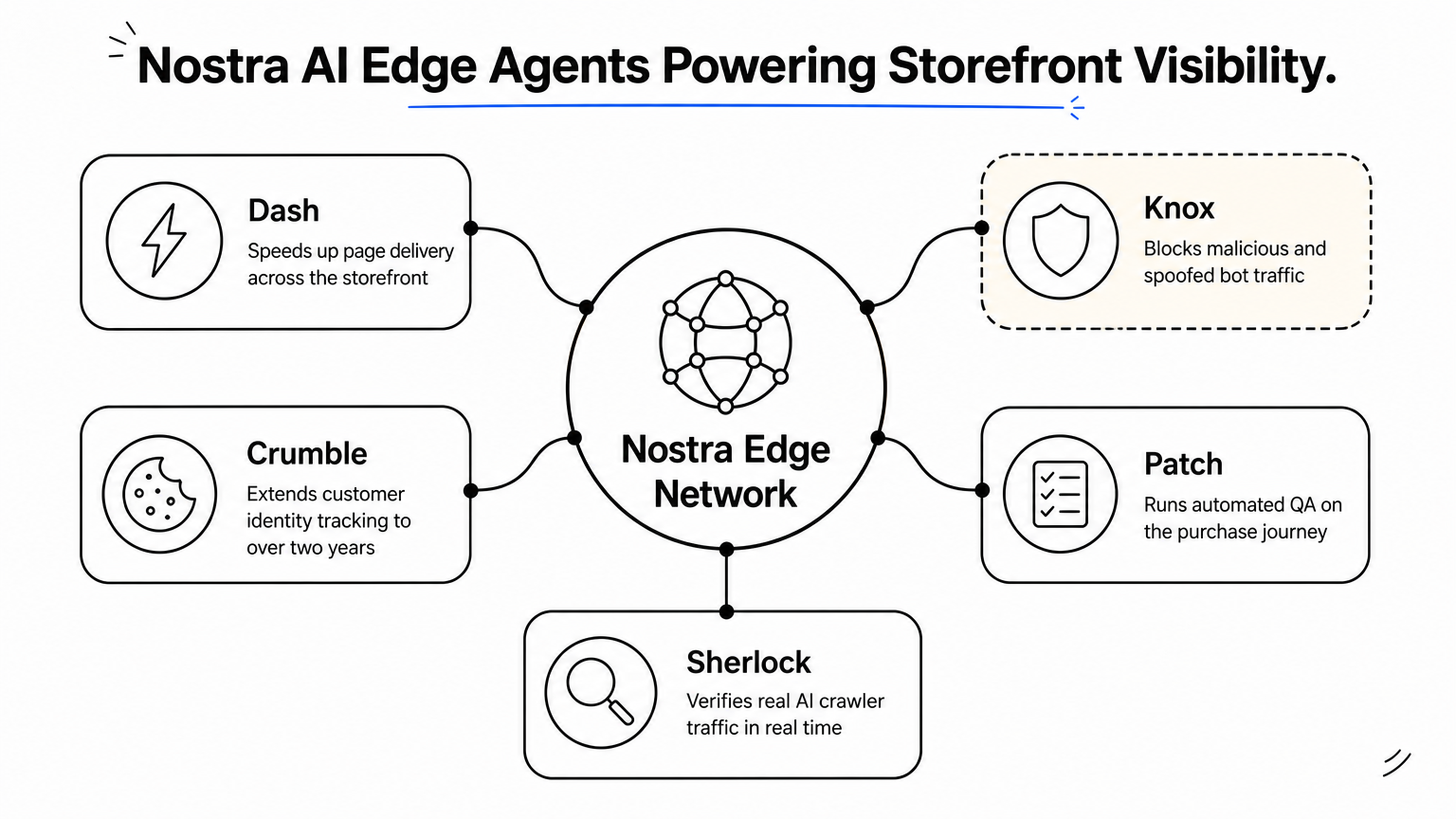
Nostra deploys through a single DNS-level change, no code touches, no replatforming, no dev sprint, which is edge computing applied to SEO rather than another plugin. Once connected, the agents that run your storefront go to work: Dash speeds up page delivery, Knox blocks malicious bots, Crumble extends customer identity tracking from about a week to over two years, and Patch runs automated QA on the full purchase journey. For AI visibility specifically, the Sherlock agent behind Edge Detect is the one that matters. It identifies and verifies AI crawler and bot traffic in real time, separating genuine LLM crawlers like GPTBot or PerplexityBot from spoofed traffic, then feeds that verified data into your AEO (AI engine optimization) reporting.
If you can't verify which crawlers actually touched your product pages, your AI visibility data is a guess, not a metric.
After the DNS switch, there's a 2-week observation window where the agents learn your store's traffic patterns before enforcement kicks in. From there, it runs autonomously in the background.
Nostra fits mid-size to large ecommerce and DTC brands whose growth, ecommerce ops, or engineering teams don't have the bandwidth to build custom crawler-detection scripts or babysit a bot-management dashboard. Beauty, fashion, and retail brands running on high-volume Shopify Plus stores or similar platforms tend to see the fastest wins, especially ones already losing ad spend to bot-inflated sessions. If your team cares about AI traffic detection as much as classic organic rankings, this is the closest thing to a purpose-built solution:
Nostra AI prices based on store size, traffic volume, and which agents you activate, since not every brand needs all five running at once. There's no self-serve tier listed publicly. You'll need to book a demo to get a quote, but the company points to concrete numbers to justify the conversation: up to 47% faster load times, roughly a 3% expected revenue lift, and over 10 billion bots blocked annually across its 300-plus brand customer base. Case studies from U Beauty, Nixon, Credo Beauty, and Omnilux, which tripled AI-attributed revenue, back those figures with real before-and-after data, which is more transparency than most AI SEO vendors offer before a sales call.
Semrush has spent over a decade building the closest thing to an SEO Swiss Army knife, and its newer Semrush One suite bolts on AI visibility tracking so you're not juggling a separate tool just to see how ChatGPT or Gemini surface your brand. It's a reasonable pick if you want one login for keyword research, technical audits, and AI search engine optimization tools style monitoring, rather than stitching together five point solutions.

Semrush One combines the classic Semrush toolkit, keyword tracking, site audits, backlink analysis, with an AI Visibility Toolkit that monitors how often your domain shows up in AI-generated answers across ChatGPT, Perplexity, and Google's AI Overviews. It scores your brand's presence against competitors and flags content gaps where AI engines are citing someone else instead of you. The reporting layer pulls everything into shared dashboards, which matters if your team already lives in Semrush for traditional rank tracking and doesn't want to retrain on new software.
A tool that tracks rankings but ignores AI citations is only telling you half the story in 2026.
Semrush One suits marketing teams and agencies that need broad SEO coverage, not a narrow specialty tool. It works well for:
It's less suited to teams that specifically need edge-level bot verification or crawler-level traffic data, since Semrush tracks visibility from the outside in, not from your server logs.
Semrush's core plans start around $139.95 per month for Pro, scaling up through Guru and Business tiers near $249.95 and $499.95. The AI Visibility Toolkit and Semrush One features are bundled into higher tiers or sold as add-ons, so expect your actual bill to land higher than the entry-level sticker price once AI tracking is included.
Surfer built its reputation on one thing: telling writers exactly what a page needs to rank while they're still typing it, not after publishing. That real-time feedback loop makes it one of the more practical ai search engine optimization tools for content teams who need to ship articles fast without guessing at word counts or heading structure.
Surfer's Content Editor scores your draft against the top-ranking pages for a target keyword, checking things like term frequency, heading usage, and content length, then updates the score live as you edit. The AI Outline and SERP Analyzer features pull structure from competing pages so you're not starting from a blank doc. Surfer also ships a Grow Flow feature that suggests weekly optimization tasks based on your existing content's performance, which helps teams that don't have a dedicated SEO strategist reviewing every post.
Real-time scoring only works if you still apply judgment. Chasing a perfect score can flatten writing that a human actually wants to read.
Content marketers, freelance writers, and small in-house teams producing high volumes of blog and landing page content get the most value here. It suits:
It's a thinner fit for ecommerce brands whose biggest visibility gaps are technical or crawler-related rather than content-quality related, since Surfer doesn't touch site speed, bot traffic, or AI crawler verification.
Surfer's Essential plan starts around $89 per month, with Scale and Enterprise tiers climbing based on how many content briefs and articles you generate monthly. Add-ons like the AI Detector and extra Content Editor credits push the bill higher for heavier publishing schedules.
Ahrefs built its name on one of the largest link indexes in the industry, and that data set still gives it an edge when you need to understand why a competitor outranks you or which AI engines are pulling from their backlink profile instead of yours. It's less of an all-in-one AI visibility suite and more of a specialist tool that other ai tools for search engine optimization end up complementing rather than replacing.
Ahrefs crawls the web on its own schedule and stores backlink, keyword, and traffic data going back years, which lets you run historical competitive analysis most tools can't match. Site Explorer shows you exactly which domains link to a competitor's top pages, Content Explorer surfaces what topics are earning links right now, and the Keywords Explorer estimates click volume and difficulty for any query. Ahrefs recently layered in Brand Radar, a feature that tracks how often AI answer engines mention your brand versus competitors, giving you a rough proxy for AI citation share without needing a separate platform.
A backlink index is only useful if you actually act on the gaps it reveals, not just admire the data.
Ahrefs suits SEO specialists, agencies, and content strategists who need deep competitive research more than they need content generation or crawler verification. It fits:
It's a weaker match for ecommerce teams whose main pain point is bot traffic or site speed, since Ahrefs doesn't touch either.
Ahrefs starts at $129 per month for the Lite plan, with Standard, Advanced, and Enterprise tiers climbing well past $999 monthly depending on crawl credits and seat count.
Most AEO tools stop at reporting: they show you that ChatGPT mentioned a competitor instead of you, then leave you to figure out what to do about it. ChatFeatured tries to close that gap by pairing AI visibility monitoring with actual content execution, positioning itself as one of the more action-oriented ai search engine optimization tools in the AEO space rather than another dashboard you check and forget, and it competes directly with the generative engine optimization services now filling that category.
ChatFeatured tracks how your brand and product pages appear across ChatGPT, Perplexity, and Gemini responses, then flags specific content gaps where a competitor's page is getting cited instead of yours. From there, it generates draft content, FAQ blocks, structured summaries, comparison pages, built to match the format AI engines tend to pull from when constructing answers. The platform also runs prompt-level testing, letting you see the exact queries where your brand shows up or disappears, which gives you a concrete target instead of a vague "improve AI visibility" goal.
Monitoring tells you where you're losing. Execution is what actually closes the gap.
ChatFeatured fits marketing teams that already understand traditional SEO but are new to AEO and want a tool that shortens the distance between diagnosis and fix. It suits:
It's a thinner fit for teams needing crawler-level verification or technical site fixes, since ChatFeatured focuses on content and citation, not infrastructure.
ChatFeatured runs on tiered monthly plans based on tracked keywords and content volume, with entry pricing aimed at small to mid-size teams and custom quotes for agencies managing multiple client brands. Exact figures shift often enough that you'll want to check current rates directly before budgeting.
Agencies juggling a dozen client accounts need something different than a single-brand SEO tool: white-label reports that look like your agency built them, not a vendor's dashboard with someone else's logo. SE Ranking built its whole pitch around that need, and it's earned a spot among ai search engine optimization tools mostly because it lets agencies rebrand the entire platform, not just export a PDF.
SE Ranking bundles keyword tracking, site audits, backlink monitoring, and an AI-powered content assistant into one dashboard, then lets you slap your own domain and branding on client-facing reports. Its AI Overview tracking module shows whether your client's pages get pulled into Google's AI Overviews, alongside standard rank data. The platform also includes automated audit scheduling, so agencies can set recurring technical checks per client without manually rerunning crawls every week.
A tool only earns its keep for an agency if clients see your brand on it, not the vendor's.
SE Ranking suits agencies and freelance consultants managing multiple client accounts who need reporting that looks custom-built. It fits:
It's a weaker fit for a single ecommerce brand managing its own site in-house, since much of its value comes from multi-client management features a solo brand won't use.
SE Ranking's Essential plan starts around $65 per month, with Pro and Business tiers scaling toward $189 monthly based on keyword volume and number of managed projects. White-label options and additional user seats typically require the higher tiers, so agency-focused features push the real cost above the entry price.
Small ecommerce shops and solo-run brands often get priced out of the AI visibility conversation entirely, since most platforms charge enterprise rates for features a five-person team barely uses. RabbitSEO built its pitch around that gap, positioning itself as one of the more affordable ai search engine optimization tools for shops that need AI citation tracking without a five-figure annual contract.
RabbitSEO tracks how your brand shows up across ChatGPT, Perplexity, and Google AI Overviews, then pairs that with standard keyword rank tracking so you're not paying for two separate subscriptions. The dashboard flags which product or category pages get cited by AI engines and which ones lose ground to competitors, then suggests specific on-page fixes, added FAQ blocks, clearer product schema, more direct answer language, rather than a vague optimization score. Setup runs through a simple domain connection with no crawler configuration required, which matters for teams without a dedicated technical hire.
Small teams don't need every feature an enterprise platform offers, they need the handful that actually move visibility.
RabbitSEO fits solo ecommerce operators, small DTC brands, and lean marketing teams that need AI visibility tracking without hiring a specialist to run it. It suits:
Enterprise brands managing multiple domains or needing deep backlink data will likely outgrow it fast, since RabbitSEO trades depth for accessibility.
RabbitSEO's plans start well under $50 per month for core AI visibility and rank tracking, with higher tiers adding more tracked keywords and domains. It's positioned as one of the cheapest entry points into AEO monitoring currently on the market, though it lacks the deeper competitive and technical audit tools that pricier platforms like Semrush or Ahrefs offer.
Writers who need a content brief in minutes, not hours, tend to land on Frase. It pulls SERP data and turns it into an outline fast enough that you can brief a freelancer before your coffee gets cold, which makes it one of the quicker ai search engine optimization tools for teams that write a lot and don't want research to eat the whole day.
Frase scrapes the top-ranking pages for any target query and compresses them into a content brief with suggested headings, common questions, and target word counts pulled straight from what's already ranking. Its built-in AI writer can draft sections from that brief, and the Answer Engine feature test-runs your content against common AI search prompts to see whether it would likely get pulled into a generated answer. A topic score updates as you write, similar to Surfer, but Frase leans harder into the research and question-mining side than the on-page scoring side.
A brief that takes ten minutes to build beats a perfect brief nobody has time to write.
Frase fits content teams and freelance writers who need briefs fast and don't need deep technical audit features. It suits:
Larger ecommerce operations needing crawler verification or backlink data will need a separate tool alongside it.
Frase's Solo plan starts around $15 per month for light use, with the Basic and Team plans running roughly $45 and $115 monthly as you add more briefs, documents, and seats. Add-on AI word credits can push monthly costs higher for heavy publishing schedules.
Large content teams publishing hundreds of pages a quarter run into a different problem than solo writers: nobody can see the whole content inventory at once, let alone spot which topics are thin and which ones are cannibalizing each other. MarketMuse built its platform around that scale problem, and it's earned a place among ai search engine optimization tools aimed at enterprises managing content libraries too large for manual audits.
MarketMuse crawls your entire domain and builds a content inventory scored against topic authority models, flagging pages that overlap, underperform, or leave gaps a competitor could fill. Its Research application maps every subtopic a comprehensive page on a given query should cover, then scores your draft against that model in real time. The Optimize module works similarly to Surfer or Frase for individual pages, but MarketMuse's real strength is the Content Planning layer, which projects which clusters of topics will move the needle across hundreds of URLs instead of one article at a time.
Auditing a thousand pages by hand isn't a strategy, it's a bottleneck. MarketMuse exists to remove that bottleneck.
MarketMuse suits enterprise content teams and publishers managing large sites where manual topic audits stopped being realistic years ago. It fits:
Smaller teams publishing a handful of posts a month will find the platform more than they need, since its pricing and feature depth assume real content-ops scale.
MarketMuse doesn't publish flat self-serve pricing for its higher tiers. Its Standard plan starts in the low hundreds per month, while Team and Enterprise pricing requires a custom quote based on domain size, seat count, and how many content briefs you run monthly.
Teams that need dozens of product descriptions or category pages written this month, not this quarter, run into a wall with brief-and-review tools like Frase or Surfer. Koala AI skips the brief step entirely and focuses on producing publish-ready drafts fast, which puts it in a different lane among ai search engine optimization tools: less research assistant, more content factory.
Koala generates full articles, product pages, and comparison posts from a single keyword or prompt, pulling live SERP data so drafts reflect what's currently ranking rather than stale training data. Its Koala Writer feature builds an outline, drafts sections, and inserts internal links automatically, while a separate bulk mode lets you queue dozens of articles at once, useful for ecommerce catalogs needing category descriptions across hundreds of SKUs. A built-in AI detector checks output before you publish, since Google still penalizes low-effort mass-produced text even when a tool markets itself as SEO-friendly.
Speed only helps if what you publish still reads like something a person wanted to write, not something a queue spat out overnight.
Koala fits teams prioritizing volume over deep strategic planning. It suits:
Enterprise teams needing topic authority modeling or agencies needing white-label client reporting will find Koala thinner on strategy than MarketMuse or SE Ranking.
Koala's plans start around $25 per month for limited word credits, with mid tiers near $65 and higher tiers past $150 monthly as generation volume and bulk features scale up. Lifetime deals have circulated periodically, though standard monthly billing remains the default option.
Small teams often end up paying for four separate subscriptions, one for keyword research, one for briefs, one for writing, one for optimization, when a single cheaper platform could cover most of that ground. Scalenut built its pitch around consolidating that stack, landing it among the more budget-conscious ai search engine optimization tools for teams that want breadth without four separate invoices.
Scalenut bundles keyword clustering, AI-generated content briefs, a long-form AI writer, and an on-page optimization checker into one workspace. You start with a keyword planner that groups related terms into clusters, feed a cluster into the brief builder, then hand that brief straight to the writer, which drafts full articles with headings and internal link suggestions already in place. A Cruise Mode feature automates the whole pipeline from keyword to draft with minimal manual steps, and an SEO score updates as you edit, similar to Surfer's live scoring.
Consolidating four tools into one only pays off if the weakest link in that chain still holds up under real use.
Scalenut suits small marketing teams and solo content operators who want research, briefing, and drafting under one login rather than stitched-together subscriptions. It fits:
It's a thinner fit for enterprise teams needing topic authority modeling at MarketMuse's depth, or anyone needing crawler-level AI traffic verification, since Scalenut stays focused on content production rather than infrastructure.
Scalenut's Essential plan starts around $39 per month, with Growth and Pro Lite tiers climbing toward $79 and higher as word credits and user seats increase. Custom enterprise pricing applies for agencies needing multiple brand workspaces.
Millions of WordPress sites already run Yoast in the background, quietly checking whether a page has a meta description, a readable URL, and a keyword in the title tag. It's not flashy, and it doesn't monitor AI crawlers or generate content, but Yoast earns its spot among ai search engine optimization tools because it catches the basic on-page mistakes that undermine everything else on this list before they ever ship.
Yoast plugs directly into the WordPress editor and scores each page against a checklist: keyword placement, internal linking, readability, image alt text, and schema markup. Its AI-powered features, including AI-generated meta descriptions and title suggestions, cut down the time spent staring at a blank SEO fields box. The plugin also handles technical basics automatically, generating XML sitemaps and structured data markup that help both traditional crawlers and AI engines parse your page content correctly, something Google's own structured data guidelines treat as a baseline expectation, not a bonus.
On-page basics don't win rankings by themselves, but skipping them guarantees you lose ground you didn't need to.
Yoast fits any WordPress-based site that wants a repeatable on-page checklist without hiring a technical SEO for every post. It suits:
Sites built on Shopify, headless commerce platforms, or anything outside WordPress won't be able to use it at all, since Yoast is a WordPress plugin, not a standalone platform.
Yoast's free version covers the core on-page checklist and readability analysis. Yoast SEO Premium runs about $99 per year per site and adds AI-generated suggestions, redirect management, and internal linking tools, with multi-site discounts available for agencies managing several WordPress installs.
Every SEO team now needs to understand how AI answer engines actually pull and cite information, and there's no better way to learn that than watching one work in real time. Perplexity Pro isn't a traditional SEO platform, it's an AI research assistant that shows its sources for every answer, which makes it one of the more revealing ai search engine optimization tools for reverse-engineering what gets cited and what gets ignored.
Perplexity answers a query by pulling live sources from across the web, then lists every citation next to the claim it supports, so you can click through and see exactly which pages it trusted. Its Pro tier adds deeper research modes, more source citations per query, and access to multiple underlying models, useful when you want to compare how different AI systems weigh the same set of sources. For SEO work specifically, you can query your own brand or product category directly and see whether your pages show up in the citation list at all, which doubles as a manual AI visibility check without a dedicated tracking tool.
Watching which pages an AI engine cites teaches you more about answer engine optimization techniques than any dashboard summary ever will.
Perplexity Pro suits SEO practitioners and content strategists doing hands-on research rather than automated monitoring at scale. It fits:
It won't replace a dedicated AEO tracking platform for teams monitoring hundreds of queries automatically.
Perplexity Pro runs about $20 per month, or roughly $200 billed annually, with a limited free tier available for occasional queries. There's no enterprise SEO tier, since it's built as a research tool first, not a monitoring platform.
No single platform on this list covers everything, and that's fine. Content teams need Surfer or Frase for briefs, agencies need SE Ranking's white-label reports, and enterprise publishers need MarketMuse's topic modeling. But AI search engine optimization tools built for content strategy can't tell you whether the traffic hitting your product pages is a real shopper, a verified AI crawler, or a bot spoofing Googlebot to scrape your prices. That gap sits underneath every other tool on this list, and it's exactly where most ecommerce brands lose visibility they never see reported anywhere.
Start by mapping your actual pain point: content quality, backlink gaps, or crawler-level traffic you can't currently verify. If it's the last one, you're dealing with an infrastructure problem no content tool solves. That's the layer Nostra AI was built for: Edge Protect stops bad bots before they ever touch your storefront, so every metric feeding your AI visibility strategy is actually real.


.svg)
