Your customers are asking ChatGPT and Google AI Overviews for product recommendations, and if your brand doesn't show up in those answers, you're losing sales before a shopper ever hits your homepage. That's why so many ecommerce teams are now hunting for the top answer engine optimization services for ai industry players, hoping to find a partner who can get their brand cited instead of a competitor's. The problem is most lists online are thin, recycled, or written by the agencies themselves.
This article breaks down the best answer engine optimization services for ai visibility, covering full-service AEO agencies, specialized crawler-verification platforms, and technical tools that show you exactly how AI bots interact with your storefront. Each entry includes what the service actually does, who it fits best, and where it falls short, so you can match a provider to your budget and technical setup rather than guessing.
We built this list from direct experience working with ecommerce brands on AI crawler traffic and site infrastructure, including the same AI traffic detection challenges these services claim to solve. You'll find a mix of household-name SEO agencies pivoting into AEO and newer, purpose-built AEO tools for AI search visibility that verify AI crawlers and give you data instead of promises. By the end, you'll know which option fits your team's size, budget, and how fast you need results.
Most AEO tools tell you whether ChatGPT or Gemini mentioned your brand. Nostra AI takes a different angle: it verifies which AI crawlers and bots actually touched your storefront in the first place, then feeds that data into your AEO strategy. If you don't know whether GPTBot, ClaudeBot, or a spoofed scraper hit your product pages, you're optimizing for visibility on incomplete data. Nostra sits at the edge of your site, so it sees every request before it reaches your servers, giving you a ground-truth view that dashboard-only tools can't match.
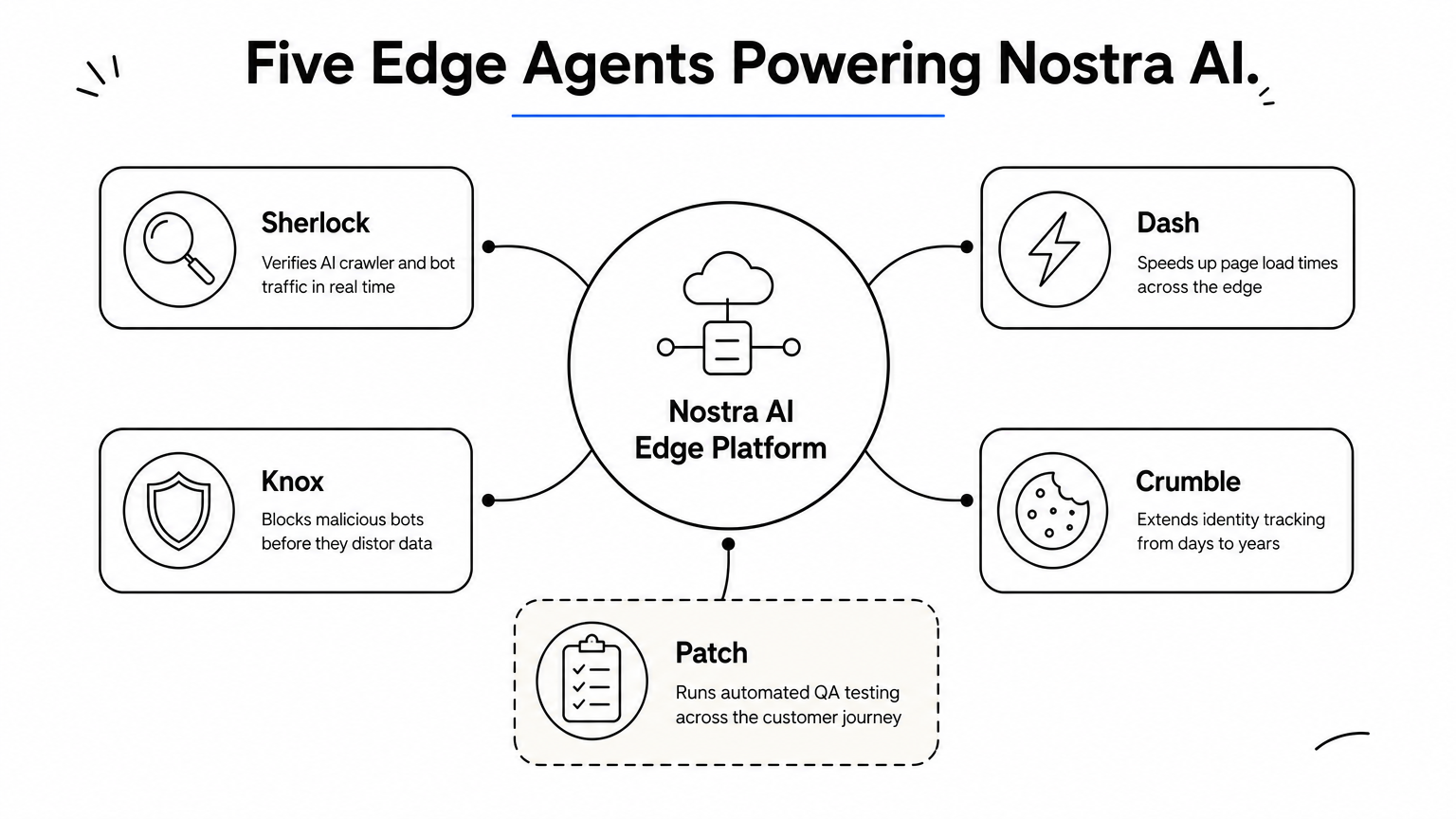
Nostra deploys through a DNS-level change, no code edits, no replatforming, and no engineering sprint required. Once connected, the platform runs a 14-day observation window to learn your store's traffic patterns, then its agents start acting automatically. The agent relevant to AEO is Sherlock, the AI agent that identifies and verifies AI crawler and bot traffic in real time, distinguishing legitimate AI engines from bots impersonating them. That verified data then streams into whatever AEO or analytics tools you already use.
If you can't verify which AI crawlers touched your site, you're guessing at your AI visibility instead of measuring it.
This fits ecommerce brands that already have a site speed, bot protection, or analytics headache and want AEO visibility bundled with infrastructure-level fixes rather than a standalone reporting tool. It suits growth and ecommerce ops leaders who don't have spare engineering hours for another integration, since the whole platform runs on a single DNS record. Teams juggling Meta, Google, Klaviyo, and GA4 also benefit, because Nostra's other edge agents (like Crumble for identity tracking) extend the customer data these platforms depend on.
Nostra AI doesn't publish flat-rate pricing publicly, since deployment scales with traffic volume and which agents you activate. Brands typically start with a call to scope which agents solve their immediate problem, whether that's AI crawler verification, speed, or bot protection, then expand from there. You can request a walkthrough directly through Nostra AI to get pricing specific to your storefront's traffic.
AirOps started as a content operations platform and expanded into AEO once its customers started asking why their pages weren't showing up in ChatGPT answers. The platform pairs AI visibility tracking with content generation workflows, so instead of just telling you that a competitor got cited for a product query, it helps you draft and publish the page that could win that citation next. That combination makes it less of a monitoring tool and more of a production pipeline built around AI search.
AirOps connects to your existing content and analytics stack, then runs prompts across major AI engines to track where your brand appears and where it doesn't. Its workflow builder lets marketing teams chain research, drafting, and optimization steps together, using the visibility data to prioritize which pages to update first. Teams that need a broader baseline comparison across multiple AI engines before drafting anything often pair this with one of the answer engine optimization tools for AI visibility built purely for monitoring, then use AirOps to act on what they find.
Visibility data without a content workflow just tells you what's wrong. It doesn't fix anything.
Brands with an in-house content or SEO team will get the most value here, since AirOps assumes you have people ready to publish what it recommends. Marketing leaders who already run content operations through similar tools will adapt quickly, but solo operators without a content pipeline may find the workflow builder more complex than they need.
AirOps publishes tiered plans starting in the low hundreds of dollars per month, with custom enterprise pricing for larger content teams.
Profound built its reputation on breadth. The platform tracks your brand across ChatGPT, Perplexity, Gemini, and Copilot in one dashboard, so you're not stitching together screenshots from five different chat windows to figure out where you stand. It's one of the more established answer engine optimization solutions, and enterprise marketing teams often reach for it first simply because it covers the most engines out of the box.
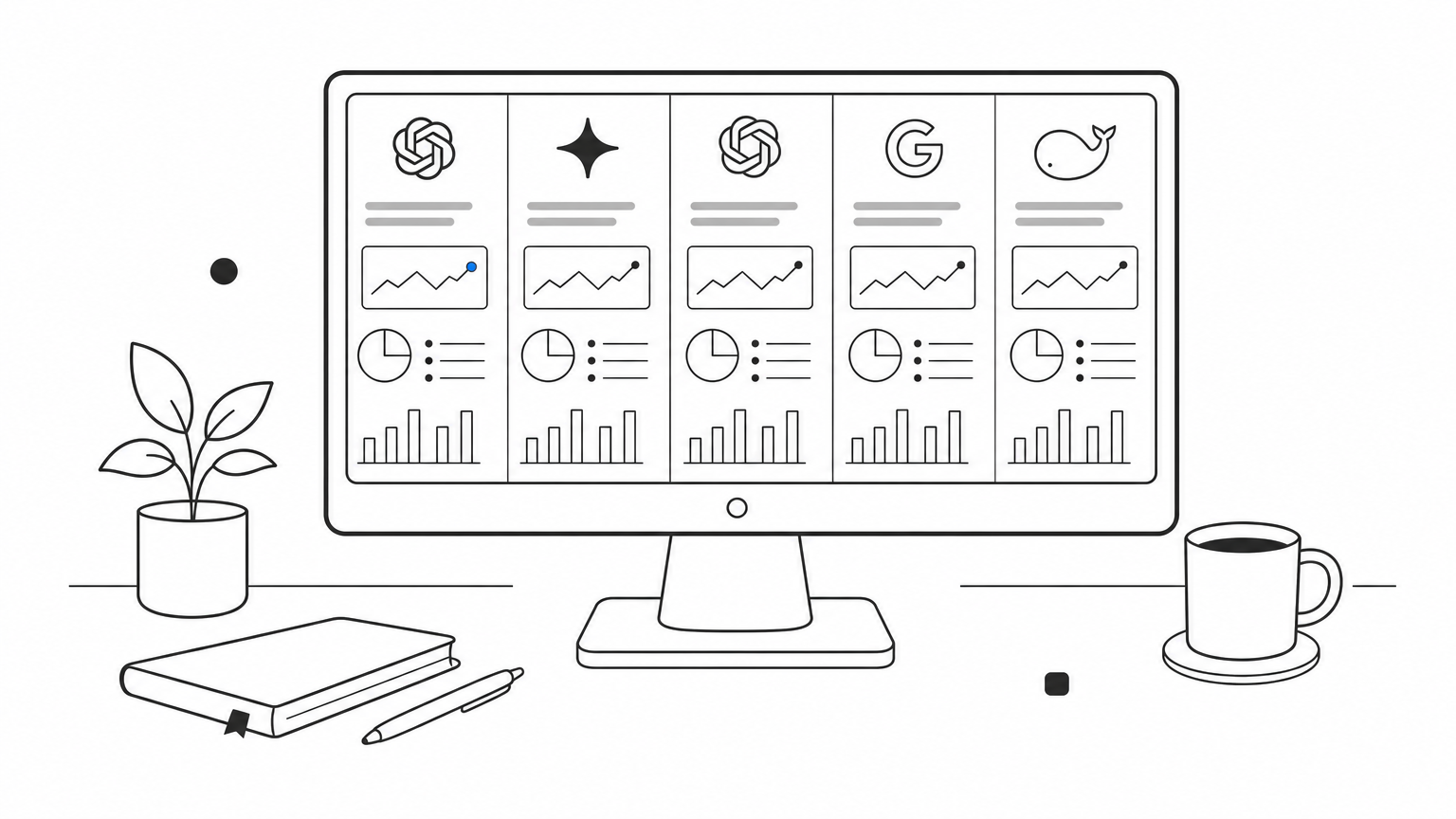
Profound runs a library of prompts across each AI engine on a schedule, then logs every mention, citation, and ranking position for your brand and your competitors. The dashboard breaks results down by engine, topic, and query type, so you can see whether you're losing ground specifically on comparison queries or product recommendation prompts. It also flags share of voice trends over time, which matters more for tracking momentum than any single snapshot.
A dashboard that shows you're losing visibility on ten competitor queries is only useful if someone acts on it within the week.
This suits enterprise marketing and brand teams that need board-ready reporting across multiple AI engines and already have analysts who can turn the data into action. Smaller teams without a dedicated analyst often find the sheer volume of data harder to operationalize than a narrower tool would be.
Profound doesn't list public pricing. Plans are quoted per engagement, and enterprise contracts typically run into the thousands per month depending on query volume and engine coverage.
Peec AI narrows its focus to one job: tracking exactly how and where your brand gets cited inside AI-generated answers. Instead of a sprawling dashboard covering everything from content drafting to competitor analysis, Peec AI sticks to citation-level detail, showing you the exact sentence an AI engine used, which source it pulled from, and whether that source was your site or a competitor's. For teams tired of vague "visibility scores," this precision is the draw.
Peec runs a set of tracked prompts across ChatGPT, Perplexity, and Gemini, then parses each response to identify citations rather than just brand mentions. It links every citation back to the source page that got quoted, so you can see which of your blog posts or product pages the AI engine trusted enough to cite. That level of detail helps you spot patterns, like whether AI engines consistently pull from your comparison pages but ignore your product descriptions.
Knowing you got mentioned means little. Knowing which exact page earned the citation tells you what to build more of.
Content and SEO teams that already publish regularly will get the most out of Peec, since the tool's real value shows up once you have enough pages to compare citation performance across them. It suits marketers who want granular, page-level feedback over broad brand-level scores, but teams without a content library to analyze won't have much data to work with yet.
Peec AI offers tiered monthly plans, with entry pricing aimed at small teams and higher tiers scaling by prompt volume and tracked domains. Custom pricing applies for agencies managing multiple client accounts.
Otterly AI built its name on doing one thing without charging enterprise prices for it. Otterly AI tracks brand mentions across ChatGPT, Perplexity, and Google AI Overviews, then gives you a straightforward score of how often you show up compared to competitors. It skips the elaborate dashboards and workflow builders that padded out earlier entries on this list, which makes it a natural fit for teams that just want a clean answer to "are we visible or not" without a steep learning curve.
Setup starts with a list of prompts you expect customers to ask, the kind of questions that show up before a purchase decision. Otterly runs those prompts on a schedule across each supported AI engine, then logs whether your brand appeared, where it ranked in the answer, and which competitors showed up alongside you. The reports stay simple on purpose, favoring weekly visibility snapshots over deep query-level breakdowns.
A simple visibility score beats a complex dashboard nobody checks.
Smaller ecommerce brands and lean marketing teams get the most value here, especially those testing whether AEO monitoring is worth a bigger investment before committing to a pricier platform. Agencies managing several small clients also lean on Otterly because the per-brand cost stays low even as you add accounts, though larger enterprises tracking hundreds of queries will outgrow it quickly.
Otterly AI publishes its plans openly, starting at a low monthly rate for a handful of tracked prompts, with mid-tier plans scaling for agencies managing multiple brands.
Scrunch AI leans hard into competitive framing. Rather than just telling you whether your brand shows up in AI answers, Scrunch AI measures how much space you occupy relative to named competitors across the same set of prompts. That share-of-voice framing appeals to marketing leaders who already think in competitive terms from traditional SEO and want the same lens applied to ChatGPT and Gemini results.
Scrunch builds a competitor set alongside your brand, then runs a shared prompt library across multiple AI engines on a recurring schedule. Every result gets scored not just for whether you appeared, but for how your share of voice compares to each named competitor on that specific query. Trends over time show whether a competitor is gaining ground on comparison-style prompts, which matters more for budget conversations than a single mention count.
Visibility only matters relative to who's beating you for the same query.
Brands operating in crowded categories, think beauty, apparel, or consumer electronics, get the most value here, since the competitive benchmarking only works when there are real rivals to track against. Marketing teams reporting up to leadership benefit from the side-by-side framing, but single-competitor niches won't find much use for the comparative layer.
Scrunch AI quotes pricing per engagement rather than publishing flat tiers, with cost scaling by the number of tracked competitors and prompt volume. Expect a sales call before you see a number, especially for multi-brand or agency use cases.
Athena HQ pairs AI visibility tracking with automated content agents that draft the pages meant to close the gaps it finds. Athena HQ doesn't stop at telling you which prompts you're missing from; it spins up draft copy, briefs, or page updates aimed at those exact gaps, so your team reviews and publishes instead of starting from a blank doc. That agent layer sets it apart from pure monitoring tools that hand you a report and leave the writing to you.

Setup begins with a prompt library built around your product category and customer questions, run across ChatGPT, Perplexity, and Gemini on a recurring schedule. Once the platform flags a missed citation or a competitor gaining ground, its content agents generate a draft response, whether that's a comparison page, an FAQ block, or a product update, based on what earned the citation elsewhere. Your team edits and ships from there rather than researching from zero.
A visibility gap only closes once someone publishes the page that fills it.
This fits marketing teams that want visibility tracking and content production bundled together, especially brands without a dedicated AEO writer on staff. It suits growth teams comfortable editing AI-generated drafts rather than writing from scratch, though teams with strict brand voice requirements may find the drafts need heavier editing than expected.
Athena HQ quotes pricing based on prompt volume and the number of content agents activated, with plans generally landing between mid-tier and enterprise depending on team size.
Semrush added AI visibility tracking directly into the platform most SEO teams already open every morning. Instead of adopting a separate tool for AEO, Semrush AI Toolkit surfaces how your brand appears across ChatGPT, Gemini, and AI Overviews right next to the keyword and backlink data you're already reviewing. For teams already paying for Semrush, that bundling matters more than any single feature, since it means one login instead of five.
The toolkit pulls from Semrush's existing keyword database to identify prompts likely to trigger AI-generated answers relevant to your category, then tracks your citation rate against that list. It layers this on top of traditional rank tracking, so you can compare AI visibility side by side with your organic search position for the same query. That overlap helps you spot whether a page ranking well in classic search is also earning citations in AI answers, or falling short in one channel while succeeding in the other.
AEO data means more when it sits next to the SEO metrics your team already trusts.
This suits teams already running Semrush for keyword research and rank tracking who want AEO visibility without adding another subscription or login. Marketing leaders reporting on both organic search and AI visibility in one deck benefit most, though brands without an existing Semrush account may find better standalone AI search engine optimization tools elsewhere on this list.
The AI Toolkit ships as an add-on to existing Semrush subscription tiers, with cost scaling based on your current plan and tracked query volume rather than a standalone flat rate.
BrightEdge has sold enterprise SEO software for years, and its AI visibility module builds on that same infrastructure rather than launching as a separate product. BrightEdge tracks how your brand appears in AI Overviews, ChatGPT, and Perplexity alongside the content performance and rank tracking data it already collects, aimed at large organizations that need one platform covering both classic search and answer engines. If your team already reports through BrightEdge dashboards, adding AEO here means one fewer vendor to manage.
The platform runs its existing content performance engine against a set of AI-triggering prompts, then maps citation results onto the same reporting structure used for organic rankings. Data feeds into BrightEdge's Data Cube, so analysts can segment AI visibility by category, region, or content type the same way they'd slice traditional keyword data. That consistency matters more for large teams juggling dozens of markets than for a single-brand DTC shop tracking a handful of product lines.
Enterprise teams don't need another dashboard. They need AI visibility inside the one they already trust.
This fits large enterprise SEO teams already running BrightEdge for content performance and rank tracking across multiple regions or brands. It suits organizations with dedicated SEO analysts who need AI visibility folded into existing reporting cadences, though smaller ecommerce brands will find the platform's complexity and price far beyond what they need for answer engine optimization alone.
BrightEdge doesn't publish pricing publicly. Enterprise contracts typically require an annual commitment and a sales consultation, with cost scaling by the number of tracked markets and content volume.
Verbatim Digital splits the difference between a software subscription and a full-service retainer. Verbatim Digital gives you a tracking dashboard for AI citations, but pairs it with a team of strategists who actually build the content and technical fixes needed to close visibility gaps. That combination suits brands that want the data a platform provides without hiring someone in-house to interpret it and act on it every week.
Engagements start with an audit of your current AI visibility across ChatGPT, Perplexity, and Gemini, followed by a prioritized list of pages and topics worth fixing first. The platform layer tracks citations and competitor mentions on an ongoing basis, while the agency team handles the actual page rewrites, schema markup, and content gap fixes flagged by the data. You get monthly strategy calls where an actual strategist walks through what changed and why, rather than a dashboard you're left to interpret alone.
A tracking dashboard only helps if someone on the other end knows what to fix.
This fits mid-size ecommerce brands that want AEO results without building an internal team around it, especially those already stretched thin on content production. Marketing leaders who prefer a single point of contact over managing multiple software subscriptions will find the hybrid model easier to manage, though brands wanting full control over their own content calendar may find the agency layer more hands-on than needed.
Verbatim Digital quotes retainer pricing based on scope, typically running in the low thousands per month, with custom quotes for larger content volumes or multi-brand accounts.
iPullRank built its name on technical SEO audits long before AEO became a category, and that background shows in how it approaches AI visibility work. iPullRank treats answer engine optimization as an extension of structured data, content architecture, and crawl accessibility rather than a separate discipline, which means engagements often start with a deep technical audit instead of a dashboard login. Brands that tried a self-serve tracking tool first and still couldn't explain why competitors kept getting cited tend to land here next.
Engagements open with a full technical and content audit covering schema markup, crawlability, and the techniques that make pages extractable by AI engines. The team then maps your content against prompts your customers actually ask, identifying gaps where competitors earn citations and your pages don't even qualify as a source. From there, iPullRank's strategists rebuild pages, adjust structured data, and monitor citation changes across ChatGPT, Perplexity, and Google AI Overviews over the following months.
Getting cited by an AI engine starts with making sure your pages are structured to be extracted in the first place.
This suits enterprise and mid-market brands with complex sites, think large product catalogs or multi-region storefronts, where technical debt is likely blocking AI crawlers before any content strategy can help. Teams without in-house technical SEO expertise benefit most, though smaller brands with simple sites may not need this level of technical depth.
iPullRank quotes custom retainer pricing based on site complexity and scope, typically starting in the mid-thousands per month for full-service engagements.
Picking from this list comes down to three questions: what's your budget, do you have an in-house team to act on the data, and how technical is your site's underlying problem. A lean DTC brand testing the waters doesn't need iPullRank's technical depth, and an enterprise retailer juggling ten regional storefronts won't get far with a tool built for a five-prompt monthly snapshot. Match the service to the actual gap, not the name that shows up first in a Google search.
Budget filters out half the list fast. Tools like Otterly AI and Peec AI work for teams testing whether AEO monitoring is worth a bigger spend, while platforms like Profound, BrightEdge, and full-service generative engine optimization agencies like iPullRank and Verbatim Digital assume a real monthly line item and someone dedicated to using the output. Consider whether you're buying data or buying a team, since those are genuinely different purchases even when both get marketed as AEO services.
The right AEO service matches your team's capacity to act, not just your budget to pay.
Technical foundation matters more than most buyers realize before they start. If AI crawlers can't reliably reach or parse your pages, no amount of prompt tracking fixes that, and site speed matters for answer engine optimization for the same reason, which is why verifying crawler traffic at the edge belongs earlier in the stack than most teams place it. Nostra AI fills that specific gap, confirming which bots actually touch your storefront before you spend budget optimizing content for engines that never crawled it in the first place.
| Priority | Best fit |
|---|---|
| Verify real AI crawler traffic | Nostra AI |
| Budget monitoring only | Otterly AI |
| Content production bundled in | AirOps, Athena HQ |
| Enterprise multi-region reporting | BrightEdge, Profound |
| Technical/structural fixes | iPullRank |
Run a 30-day test before committing to an annual contract. Most of these platforms show meaningful signal within a month, and that's enough time to know if the data changes what your team actually publishes.
AI answer engines are already deciding which brands get recommended before a shopper ever types your name into Google. The top answer engine optimization services for ai industry buyers rely on range from lean monitoring tools like Otterly AI to full-service agencies like iPullRank, and the right pick depends on your budget, your team's capacity, and how technical your underlying problem actually is. Don't skip the foundation, though. Tracking citations means nothing if bots can't reach your pages cleanly or if fake crawlers are muddying your data before you even start measuring.
That's the gap Nostra AI closes first. Verified crawler traffic and clean bot data give every AEO tool on this list something real to work with, instead of guessing at what's touching your storefront. Before you sign a retainer or a monthly subscription, lock down that layer. Check out bot protection for your storefront and see exactly which bots are hitting your site right now.


.svg)
